
We read your photo as:
Find the gradient, y-intercepts and x-intercepts of the following: a) y = -(2x-2) b) y - 1/4 − 6 = 0 c) −3x + y = 2 d) 2+y=x e) −(6x+y) = 2 f) 6-2y/3 = 2. Find the equations of lines parallel to x−2y=6 that pass through each of the following points. a) (-4,1) b) (1/2, 0)
ScanSolve AI Answer
Step-by-step solution
21 stepsPart 1: Find the gradient, y-intercept, and x-intercept for each equation.
a)
Simplify the equation to the slope-intercept form .
Identify the gradient, y-intercept, and x-intercept.
The gradient is the coefficient of . The y-intercept is the constant term. To find the x-intercept, set and solve for .
- Gradient:
- Y-intercept:
- X-intercept:
b)
Rearrange the equation to the slope-intercept form .
Identify the gradient, y-intercept, and x-intercept.
To find the x-intercept, set and solve for .
- Gradient:
- Y-intercept:
- X-intercept:
c)
Rearrange the equation to the slope-intercept form .
Identify the gradient, y-intercept, and x-intercept.
To find the x-intercept, set and solve for .
- Gradient:
- Y-intercept:
- X-intercept:
d)
Rearrange the equation to the slope-intercept form .
Identify the gradient, y-intercept, and x-intercept.
To find the x-intercept, set and solve for .
- Gradient:
- Y-intercept:
- X-intercept:
e)
Rearrange the equation to the slope-intercept form .
Identify the gradient, y-intercept, and x-intercept.
To find the x-intercept, set and solve for .
- Gradient:
- Y-intercept:
- X-intercept:
f)
Simplify and rearrange the equation.
Multiply both sides by 3:
Subtract 6 from both sides:
Divide by -2:
Identify the gradient, y-intercept, and x-intercept.
This is a horizontal line along the x-axis.
- Gradient:
- Y-intercept:
- X-intercept:
g)
Simplify the equation.
Identify the gradient, y-intercept, and x-intercept.
This is a horizontal line.
- Gradient:
- Y-intercept:
- X-intercept:
h)
Simplify the equation.
Multiply both sides by 5:
Subtract 1 from both sides:
Identify the gradient, y-intercept, and x-intercept.
This is a vertical line.
- Gradient:
- Y-intercept:
- X-intercept:
Part 2: Find the equations of lines parallel to that pass through each of the following points.
Find the gradient of the given line .
Rearrange the equation into slope-intercept form :
The gradient of this line is . Since the new lines are parallel, their gradient will also be .
a) Point:
Use the point-slope form with and .
Simplify the equation to slope-intercept form.
The equation of the line is .
b) Point:
Use the point-slope form with and .
Simplify the equation to slope-intercept form.
The equation of the line is .
Still stuck on this one?
Ask a follow-up, and the answer starts from this question.
More Mathematics Questions
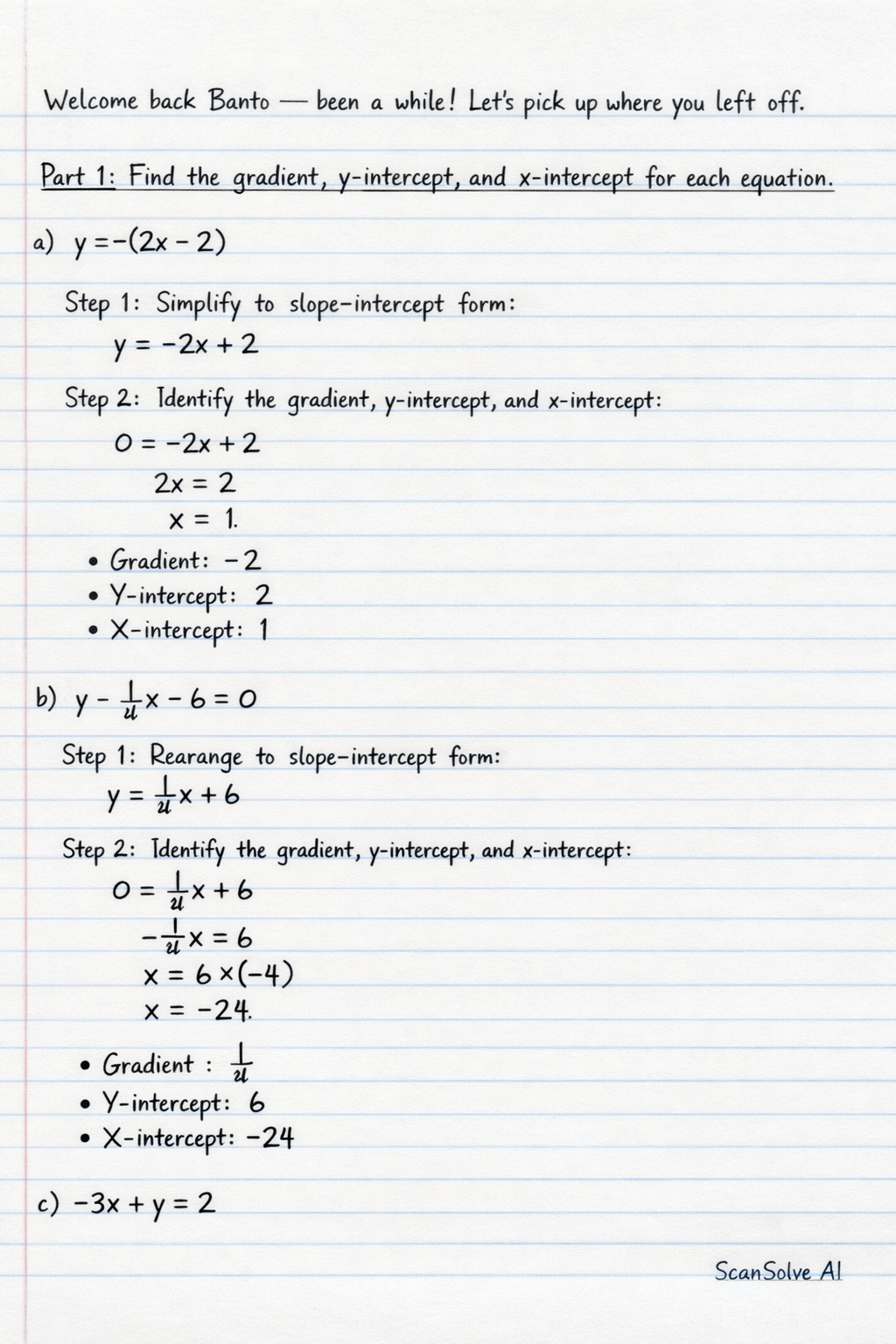
Handwritten Step-by-Step Solution
Get this as a handwritten image on WhatsApp — like a tutor wrote it for you.
Try on WhatsApp