
We read your photo as:
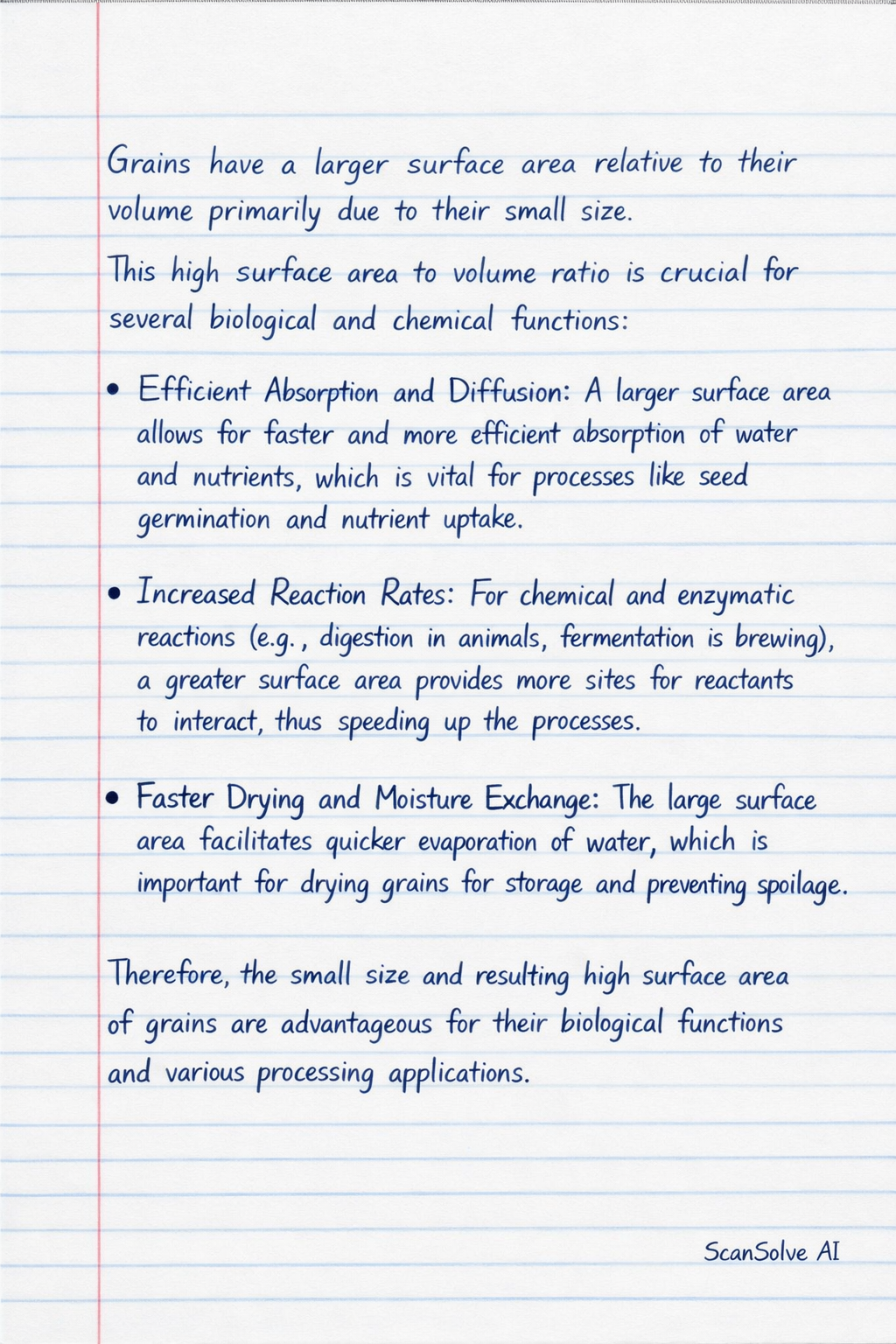
Grains have a larger surface area relative to their volume primarily due to their small size. This high surface area to volume ratio is crucial for several biological and chemical functions:
Mathematics
ScanSolve AI Answer
Grains have a larger surface area relative to their volume primarily due to their small size. This high surface area to volume ratio is crucial for several biological and chemical functions:
- Efficient Absorption and Diffusion: A larger surface area allows for faster and more efficient absorption of water and nutrients, which is vital for processes like seed germination and nutrient uptake.
- Increased Reaction Rates: For chemical and enzymatic reactions (e.g., digestion in animals, fermentation in brewing), a greater surface area provides more sites for reactants to interact, thus speeding up the processes.
- Faster Drying and Moisture Exchange: The large surface area facilitates quicker evaporation of water, which is important for drying grains for storage and preventing spoilage.
Therefore, the small size and resulting high surface area of grains are advantageous for their biological functions and various processing applications.
Was this helpful?
Still stuck on this one?
Ask a follow-up, and the answer starts from this question.
Got a different question?Ask your own question
More Mathematics Questions
QLarge surface area: The placenta has numerous, highly folded chorionic villi. This extensive folding…QSoil Mechanics: Calculate grain size distribution and explain its importance.QEpithelial cells, further increasing surface area.QExplain how the size of molecules affects diffusion.QA caterer has two cylindrical containers for serving porridge. The original container has a surface…
Handwritten Step-by-Step Solution
Get this as a handwritten image on WhatsApp — like a tutor wrote it for you.
Try on WhatsApp