

This mathematics problem involves applying core mathematical principles and formulas. Below you will find a complete step-by-step solution with detailed explanations for each step, helping you understand not just the answer but the method behind it.
ScanSolve AI Answer
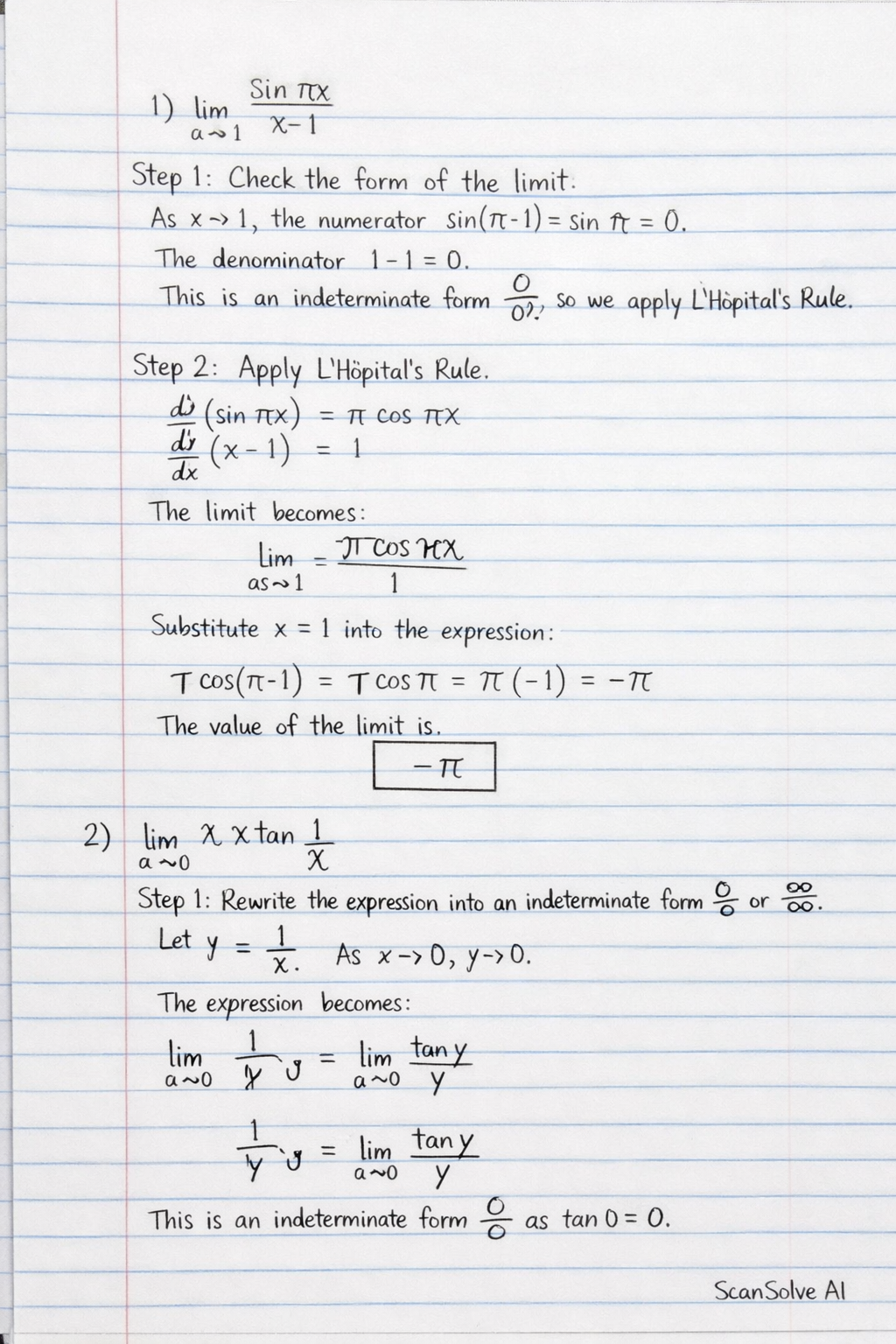
Here are the evaluations of the limits: 1) _x 1 ( x)/(x-1) Step 1: Check the form of the limit. As x 1, the numerator ( · 1) = = 0. The denominator 1-1 = 0. This is an indeterminate form (0)/(0), so we apply L'Hôpital's Rule. Step 2: Apply L'Hôpital's Rule. Take the derivative of the numerator and the denominator: (d)/(dx)( x) = x (d)/(dx)(x-1) = 1 The limit becomes: _x 1 ( x)/(1) Step 3: Evaluate the limit. Substitute x=1 into the expression: ( · 1) = = (-1) = - The value of the limit is -. 2) _x x (1/x) Step 1: Rewrite the expression into an indeterminate form (0)/(0) or ()/(). Let y = (1)/(x). As x , y 0. The expression becomes: _y 0 (1)/(y) y = _y 0 ( y)/(y) This is an indeterminate form (0)/(0) as 0 = 0. Step 2: Apply L'Hôpital's Rule. Take the derivative of the numerator and the denominator with respect to y: (d)/(dy)( y) = ^2 y (d)/(dy)(y) = 1 The limit becomes: _y 0 (^2 y)/(1) Step 3: Evaluate the limit. Substitute y=0 into the expression: ^2 0 = ((1)/( 0))^2 = ((1)/(1))^2 = 1^2 = 1 The value of the limit is 1. 3) _x (2 + 5x + x x)/(x^2 - 3x) Step 1: Divide the numerator and denominator by the highest power of x in the denominator, which is x^2. _x (2)/(x^2) + (5x)/(x^2) + (x x)/(x^2)(x^2)/(x^2) - (3x)/(x^2) Step 2: Simplify the expression. _x (2)/(x^2) + (5)/(x) + ( x)/(x)1 - (3)/(x) Step 3: Evaluate the limit of each term as x . _x (2)/(x^2) = 0 _x (5)/(x) = 0 _x (3)/(x) = 0 For _x ( x)/(x), we know that -1 x 1. Dividing by x (for x>0): -(1)/(x) ( x)/(x) (1)/(x) By the Squeeze Theorem, since _x -(1)/(x) = 0 and _x (1)/(x) = 0, then _x ( x)/(x) = 0. Step 4: Substitute the limits of the terms back into the expression. (0 + 0 + 0)/(1 - 0) = (0)/(1) = 0 The value of the limit is 0. 4) _x sqrt(x^2 + 3x) - x Step 1: Identify the indeterminate form. As x , this is an - indeterminate form. Step 2: Multiply by the conjugate. _x (sqrt(x^2 + 3x) - x) · sqrt(x^2 + 3x) + xsqrt(x^2 + 3x) + x Step 3: Simplify the numerator using the difference of squares formula (a-b)(a+b) = a^2 - b^2. _x (sqrt(x^2 + 3x))^2 - x^2sqrt(x^2 + 3x) + x = _x (x^2 + 3x - x^2)/(sqrt(x^2 + 3x) + x) = _x (3x)/(sqrt(x^2 + 3x) + x) Step 4: Factor out x from the square root in the denominator. For x , sqrt(x^2 + 3x) = sqrt(x^2(1 + (3)/(x))) = |x|sqrt(1 + (3)/(x)). Since x , x > 0, so |x|=x. _x (3x)/(xsqrt(1 + 3)x) + x Step 5: Divide the numerator and denominator by x. _x (3x)/(x)(xsqrt(1 + 3)/(x))x + (x)/(x) = _x (3)/(sqrt(1 + 3)x) + 1 Step 6: Evaluate the limit. As x , (3)/(x) 0. (3)/(sqrt(1 + 0) + 1) = (3)/(sqrt(1) + 1) = (3)/(1 + 1) = (3)/(2) The value of the limit is (3)/(2). Send me the next one 📸