
We read your photo as:
How do I construct a border and title block, and construct angles of 22.5° and 75° using geometric construction?
ScanSolve AI Answer
Step-by-step solution
48 stepshere are the instructions for the geometric constructions:
1. a) Draw your border line and title block
- Border Line: Draw a rectangular border around the sheet, typically 10mm from the edges on three sides (top, right, bottom) and 20mm on the left side (for binding).
- Title Block: Draw a rectangular block, usually in the bottom right corner of the drawing area. This block is divided into sections for information such as the drawing title, drawing number, scale, date, name of the drafter, and company/school name. The exact dimensions and layout vary by standard.
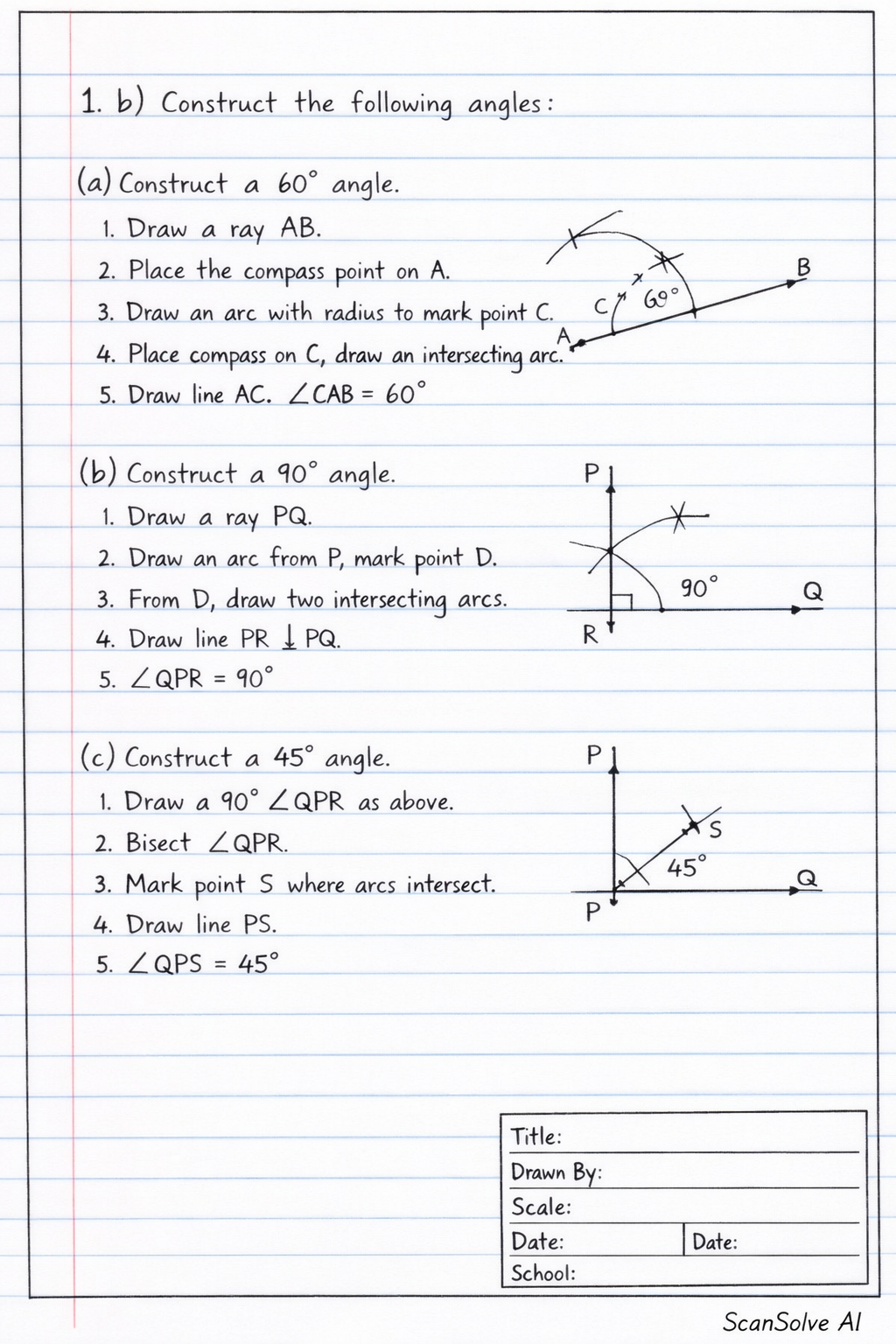
1. b) Construct the following angles
- i) 22.5°
Draw a horizontal line segment AB.
At point A, construct a perpendicular line AC to AB, forming a 90° angle.
Bisect the 90° angle (CAB) to get a 45° angle.
To do this, with A as center, draw an arc intersecting AB at D and AC at E. With D and E as centers and the same radius, draw arcs intersecting at F. Draw line AF. Angle FAB is 45°.
Bisect the 45° angle (FAB).
With A as center, draw an arc intersecting AB at G and AF at H. With G and H as centers and the same radius, draw arcs intersecting at I. Draw line AI. Angle IAB is 22.5°.
- ii) 75°
Draw a horizontal line segment AB.
At point A, construct a 60° angle.
With A as center, draw an arc intersecting AB at C. With C as center and the same radius, draw an arc intersecting the first arc at D. Draw line AD. Angle DAB is 60°.
At point A, construct a 90° angle.
Extend the arc from Step 2 to intersect a perpendicular line from A. Or, construct a perpendicular to AB at A. Let this line be AE. Angle EAB is 90°.
Bisect the angle between the 60° line (AD) and the 90° line (AE).
With D and the intersection of AE and the initial arc as centers, draw arcs to find the bisector. Let this bisector be AF. Angle DAF is 15°.
The angle formed by AB and AF is .
Angle FAB is 75°.
- iii) 7.5°
Construct a 60° angle as described in 1.b.ii, Step 2.
Let it be angle DAB.
Bisect the 60° angle (DAB) to get a 30° angle.
With A as center, draw an arc intersecting AB at C and AD at D. With C and D as centers, draw arcs intersecting at E. Draw line AE. Angle EAB is 30°.
Bisect the 30° angle (EAB) to get a 15° angle.
With A as center, draw an arc intersecting AB at F and AE at G. With F and G as centers, draw arcs intersecting at H. Draw line AH. Angle HAB is 15°.
Bisect the 15° angle (HAB).
With A as center, draw an arc intersecting AB at I and AH at J. With I and J as centers, draw arcs intersecting at K. Draw line AK. Angle KAB is 7.5°.
2. a) Make a freehand pictorial of a funnel stake
A funnel stake is a metalworking tool, typically a conical or pyramidal form mounted on a base, used for shaping sheet metal into funnel or cone shapes by hammering over it.- Sketch: Draw a sturdy base, then a slender, tapering cone or pyramid extending upwards from the base. The cone should have a smooth, rounded tip.
2. b) Construct regular polygon of five sided and name it.
A five-sided regular polygon is a regular pentagon.Draw a circle with center O and a desired radius.
Draw a horizontal diameter AB.
Construct a perpendicular diameter CD through O.
Bisect the radius OB at point E.
With E as center and radius EC, draw an arc to intersect the diameter AB at point F.
With C as center and radius CF, draw an arc to intersect the circle at points G and H.
With G as center and radius CG, draw an arc to intersect the circle at point I.
With H as center and radius CH, draw an arc to intersect the circle at point J.
Connect points C, G, I, J, H in order to form the regular pentagon.
3. Construct an ellipse of minor and major axes 120 and 80 respectively
(Assuming major axis = 120mm, minor axis = 80mm)Draw two perpendicular lines intersecting at the center O.
These will be the major and minor axes.
Mark points A and B on the major axis such that OA = OB = mm.
Mark points C and D on the minor axis such that OC = OD = mm.
Concentric Circles Method
* With O as center, draw two concentric circles: one with radius 60mm (major axis radius) and another with radius 40mm (minor axis radius). * Draw several radial lines from the center O, dividing the circles into multiple sectors (e.g., every 15° or 30°). * From each intersection point on the outer circle, draw a line parallel to the minor axis (vertical). * From each intersection point on the inner circle, draw a line parallel to the major axis (horizontal). * The intersection points of these parallel lines will lie on the ellipse. * Connect these intersection points with a smooth curve to form the **ellipse**.4. Construct the following polygons
- i) quadrilateral
Draw a line segment AB of any desired length.
From point B, draw another line segment BC at any angle and length.
From point C, draw a line segment CD at any angle and length.
Connect point D to point A with a line segment DA.
This forms a general **quadrilateral**. (If specific side lengths or angles were given, a more precise construction would be needed).- ii) six sided polygon A six-sided regular polygon is a regular hexagon.
Draw a circle with center O and a desired radius (this will be the side length of the hexagon).
Mark a point A on the circumference of the circle.
With A as center and the same radius, draw an arc intersecting the circle at point B.
With B as center and the same radius, draw an arc intersecting the circle at point C.
Continue this process around the circle, marking points D, E, and F.
The last arc from F should intersect the starting point A.
Connect points A, B, C, D, E, F in order with straight lines.
This forms the regular hexagon.
- iii) seven sided polygon A seven-sided regular polygon is a regular heptagon. This is an approximate construction using compass and straightedge.
Draw a circle with center O and a desired radius.
Draw a vertical diameter AB.
Divide the radius OA into two equal parts at point C (midpoint of OA).
With C as center and radius CB, draw an arc to intersect the horizontal line passing through O at point D.
The length BD is approximately the side length of a regular heptagon inscribed in the circle.
Starting from point B on the circle, use the length BD to step off seven equal divisions around the circumference of the circle.
Connect these seven points with straight lines to form the approximate regular heptagon.
4. b) The sides of a triangles 80,100,and 70. Construct the triangle
Draw a line segment AB of length 100mm.
With A as center and a radius of 80mm, draw an arc.
With B as center and a radius of 70mm, draw another arc.
The intersection of these two arcs is point C.
Connect points A to C and B to C with straight lines.
This forms the triangle with sides 80mm, 100mm, and 70mm.
Still stuck on this one?
Ask a follow-up, and the answer starts from this question.
More Mathematics Questions
Handwritten Step-by-Step Solution
Get this as a handwritten image on WhatsApp — like a tutor wrote it for you.
Try on WhatsApp