
I mean this should be in polynomial
ScanSolve AI Answer
Answer
(x-1)(x-3)(x+2)
Step-by-step solution
4 stepsIt appears there might have been a slight typo in the original problem. The polynomial does not have any rational roots, meaning it cannot be factored into linear factors with rational coefficients.
Assuming the problem intended to be (a common variation that is factorable with integer roots), here's how to factor it:
Find a root of the polynomial using the Rational Root Theorem.
Let .
The possible rational roots are factors of the constant term (6) divided by factors of the leading coefficient (1).
Factors of 6: .
Let's test :Since , is a root, which means is a factor of .
Use synthetic division to divide by .
The coefficients of are .
The quotient is .
Factor the resulting quadratic expression.
Now we need to factor . We look for two numbers that multiply to -6 and add to -1. These numbers are -3 and 2.
So, .Write the fully factored polynomial.
Combine the factor from Step 1 and the factors from Step 3:
The factored form (assuming the typo correction) is .
Try one yourself
A new problem that tests the same skill.
Still stuck on this one?
Ask a follow-up, and the answer starts from this question.
More Mathematics Questions
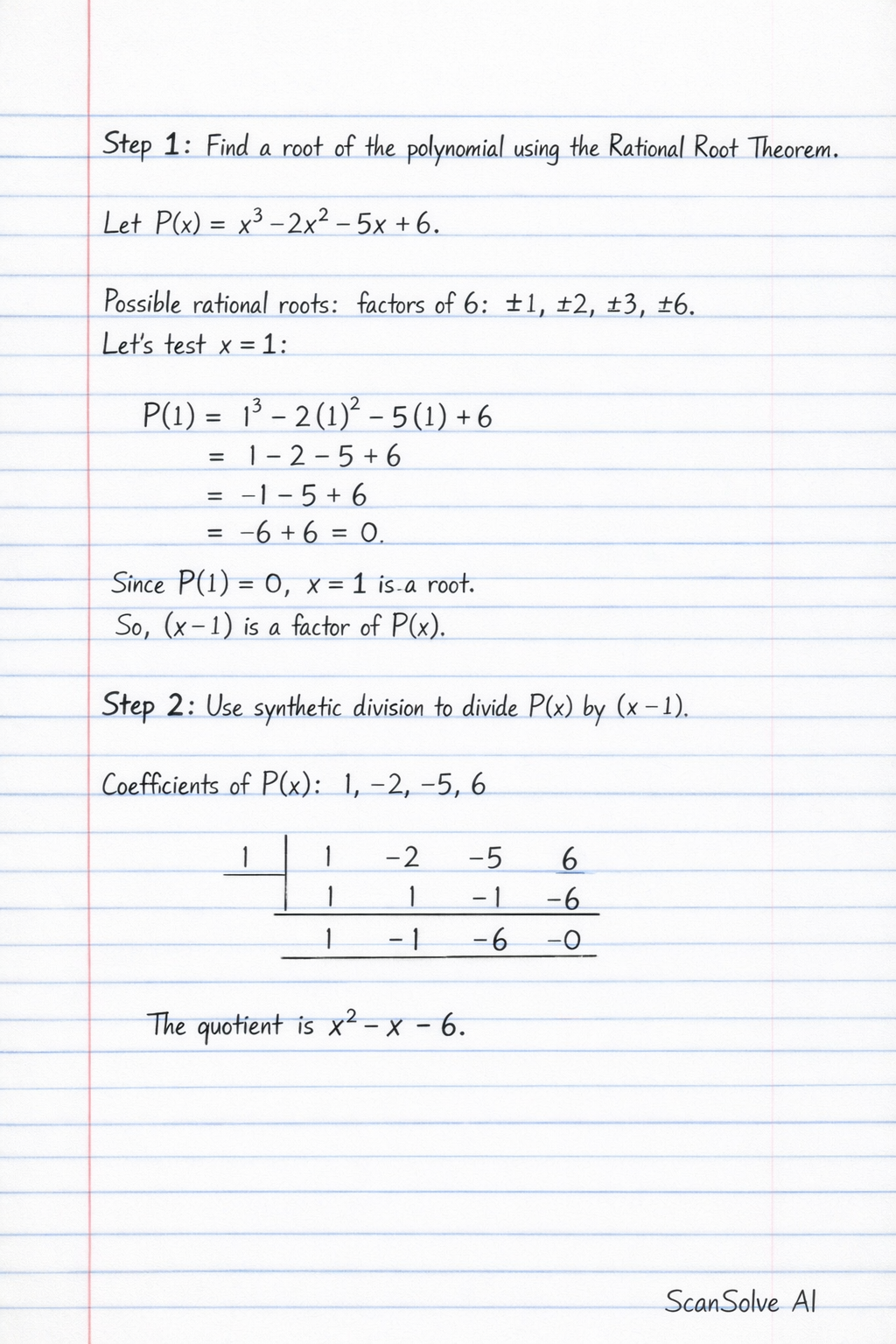
Handwritten Step-by-Step Solution
Get this as a handwritten image on WhatsApp — like a tutor wrote it for you.
Try on WhatsApp