This mathematics problem involves applying core mathematical principles and formulas. Below you will find a complete step-by-step solution with detailed explanations for each step, helping you understand not just the answer but the method behind it.
ScanSolve AI Answer
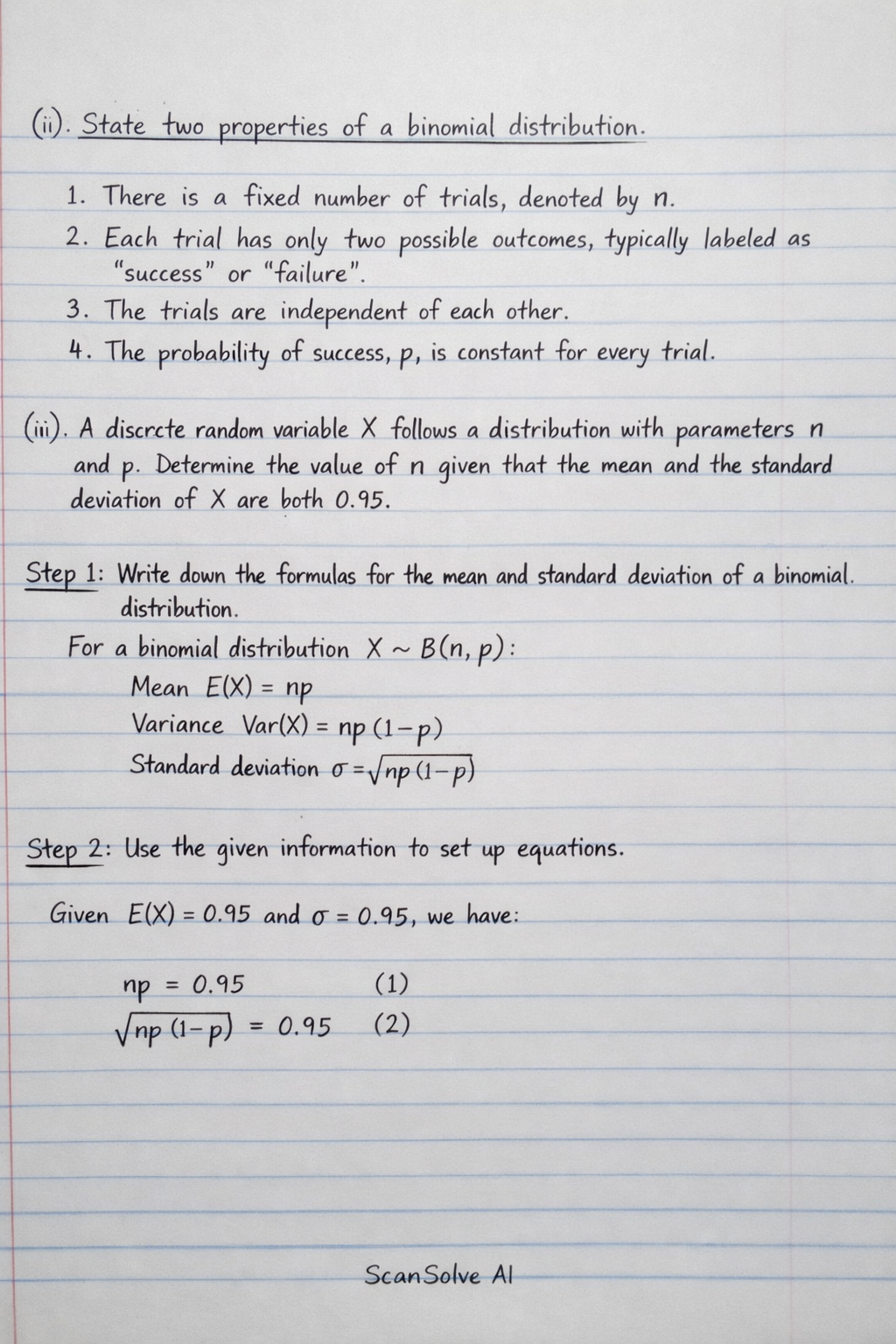
(i) State two properties of a binomial distribution.
1. There is a fixed number of trials, denoted by $n$.
2. Each trial has only two possible outcomes, typically labeled as "success" or "failure".
3. The trials are independent of each other.
4. The probability of success, $p$, is constant for every trial.
(ii) A discrete random variable $X$ follows a distribution with parameters $n$ and $p$. Determine the value of $n$ given that the mean and the standard deviation of $X$ are both 0.95.
Step 1: Write down the formulas for the mean and standard deviation of a binomial distribution.
For a binomial distribution $X \sim B(n, p)$:
Mean $E(X) = np$
Variance $Var(X) = np(1-p)$
Standard deviation $\sigma = \sqrt{np(1-p)}$
Step 2: Use the given information to set up equations.
Given $E(X) = 0.95$ and $\sigma = 0.95$.
$$np = 0.95 \quad (1)$$
$$\sqrt{np(1-p)} = 0.95 \quad (2)$$
Step 3: Solve for $p$ using the standard deviation equation.
Square both sides of equation (2):
$$np(1-p) = (0.95)^2$$
Substitute $np = 0.95$ from equation (1) into this equation:
$$0.95(1-p) = (0.95)^2$$
Divide both sides by 0.95:
$$1-p = 0.95$$
$$p = 1 - 0.95$$
$$p = 0.05$$
Step 4: Solve for $n$ using the mean equation and the value of $p$.
Substitute $p = 0.05$ into equation (1):
$$n(0.05) = 0.95$$
$$n = \frac{0.95}{0.05}$$
$$n = 19$$
The value of $n$ is $\boxed{19}$.
(iii) The volume of mineral water Sup bottles is Normally distributed with a mean of 502 ml and standard deviation 2.5 ml. A bottle of mineral water is selected at random. Determine the probability that the bottle will contain
Given: $\mu = 502$ ml, $\sigma = 2.5$ ml.
To calculate probabilities for a normal distribution, we use the z-score formula: $Z = \frac{X - \mu}{\sigma}$.
a) less than 506 ml.
Step 1: Calculate the z-score for $X = 506$ ml.
$$Z = \frac{506 - 502}{2.5}$$
$$Z = \frac{4}{2.5}$$
$$Z = 1.6$$
Step 2: Find the probability $P(X < 506)$.
$$P(X < 506) = P(Z < 1.6)$$
Using a standard normal distribution table, $P(Z < 1.6) = 0.9452$.
The probability is $\boxed{0.9452}$.
b) between 495 ml and 506 ml.
Step 1: Calculate the z-score for $X = 495$ ml.
$$Z_1 = \frac{495 - 502}{2.5}$$
$$Z_1 = \frac{-7}{2.5}$$
$$Z_1 = -2.8$$
Step 2: Calculate the z-score for $X = 506$ ml.
$$Z_2 = \frac{506 - 502}{2.5}$$
$$Z_2 = \frac{4}{2.5}$$
$$Z_2 = 1.6$$
Step 3: Find the probability $P(495 < X < 506)$.
$$P(495 < X < 506) = P(-2.8 < Z < 1.6)$$
$$P(-2.8 < Z < 1.6) = P(Z < 1.6) - P(Z < -2.8)$$
From a standard normal distribution table:
$P(Z < 1.6) = 0.9452$
$P(Z < -2.8) = P(Z > 2.8) = 1 - P(Z < 2.8) = 1 - 0.9974 = 0.0026$
$$P(-2.8 < Z < 1.6) = 0.9452 - 0.0026$$
$$P(-2.8 < Z < 1.6) = 0.9426$$
The probability is $\boxed{0.9426}$.
c) At least 502 ml
Step 1: Calculate the z-score for $X = 502$ ml.
$$Z = \frac{502 - 502}{2.5}$$
$$Z = \frac{0}{2.5}$$
$$Z = 0$$
Step 2: Find the probability $P(X \ge 502)$.
$$P(X \ge 502) = P(Z \ge 0)$$
Since the normal distribution is symmetric about its mean (where $Z=0$), the probability of being greater than or equal to the mean is 0.5.
$$P(Z \ge 0) = 0.5$$
The probability is $\boxed{0.5}$.
Question
(i) State two properties of a binomial distribution.
|Mathematics
(i) State two properties of a binomial distribution.
Answer
(i) State two properties of a binomial distribution.
There is a fixed number of trials, denoted by n.
Each trial has only two possible outcomes, typically labeled as "success" or "failure".
The trials are independent of each other.
The probability of success, p, is constant for every trial.
(ii) A discrete random variable X follows a distribution with parameters n and p. Determine the value of n given that the mean and the standard deviation of X are both 0.95.
Step 1: Write down the formulas for the mean and standard deviation of a binomial distribution.
For a binomial distribution X∼B(n,p):
Mean E(X)=np
Variance Var(X)=np(1−p)
Standard deviation σ=np(1−p)
Step 2: Use the given information to set up equations.
Given E(X)=0.95 and σ=0.95.
np=0.95(1)np(1−p)=0.95(2)
Step 3: Solve for p using the standard deviation equation.
Square both sides of equation (2):
np(1−p)=(0.95)2
Substitute np=0.95 from equation (1) into this equation:
0.95(1−p)=(0.95)2
Divide both sides by 0.95:
1−p=0.95p=1−0.95p=0.05
Step 4: Solve for n using the mean equation and the value of p.
Substitute p=0.05 into equation (1):
n(0.05)=0.95n=0.050.95n=19
The value of n is 19.
(iii) The volume of mineral water Sup bottles is Normally distributed with a mean of 502 ml and standard deviation 2.5 ml. A bottle of mineral water is selected at random. Determine the probability that the bottle will contain
Given: μ=502 ml, σ=2.5 ml.
To calculate probabilities for a normal distribution, we use the z-score formula: Z=σX−μ.
a) less than 506 ml.
Step 1: Calculate the z-score for X=506 ml.
Z=2.5506−502Z=2.54Z=1.6
Step 2: Find the probability P(X<506).
P(X<506)=P(Z<1.6)
Using a standard normal distribution table, P(Z<1.6)=0.9452.
The probability is 0.9452.
b) between 495 ml and 506 ml.
Step 1: Calculate the z-score for X=495 ml.
Z1=2.5495−502Z1=2.5−7Z1=−2.8
Step 2: Calculate the z-score for X=506 ml.
Z2=2.5506−502Z2=2.54Z2=1.6
Step 3: Find the probability P(495<X<506).
P(495<X<506)=P(−2.8<Z<1.6)P(−2.8<Z<1.6)=P(Z<1.6)−P(Z<−2.8)
From a standard normal distribution table:
P(Z<1.6)=0.9452P(Z<−2.8)=P(Z>2.8)=1−P(Z<2.8)=1−0.9974=0.0026P(−2.8<Z<1.6)=0.9452−0.0026P(−2.8<Z<1.6)=0.9426
The probability is 0.9426.
c) At least 502 ml
Step 1: Calculate the z-score for X=502 ml.
Z=2.5502−502Z=2.50Z=0
Step 2: Find the probability P(X≥502).
P(X≥502)=P(Z≥0)
Since the normal distribution is symmetric about its mean (where Z=0), the probability of being greater than or equal to the mean is 0.5.
P(Z≥0)=0.5
The probability is 0.5.
Need help with your own homework?
Get instant step-by-step solutions to any question. Free to start.