We read your photo as:

Identify the adjacent and opposite sides for angle C.

Mathematics

ScanSolve AI Answer

Step-by-step solution

13 steps

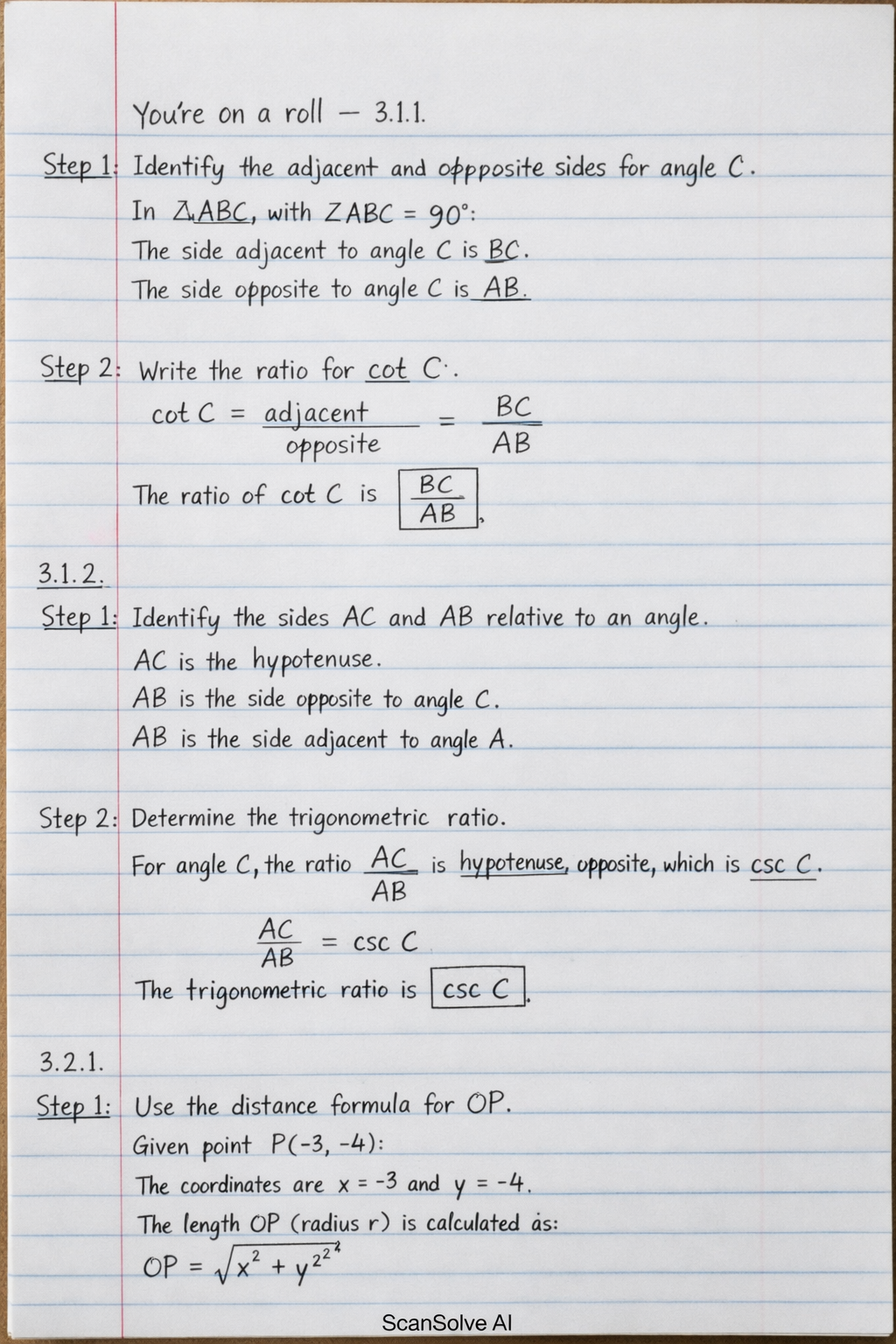
3.1.1

  1. Identify the adjacent and opposite sides for angle CC.

    In △ABC\triangle ABC, with ∠ABC=90∘\angle ABC = 90^\circ:
    The side adjacent to angle CC is BCBC.
    The side opposite to angle CC is ABAB.

  2. Write the ratio for cot⁡C\cot C.

    cot⁡C=adjacentopposite=BCAB\cot C = \frac{\text{adjacent}}{\text{opposite}} = \frac{BC}{AB}

    The ratio of cot⁡C\cot C is BCAB\boxed{\frac{BC}{AB}}.

    3.1.2

  3. Identify the sides ACAC and ABAB relative to an angle.

    ACAC is the hypotenuse.
    ABAB is the side opposite to angle CC.
    ABAB is the side adjacent to angle AA.

  4. Determine the trigonometric ratio.

    For angle CC, the ratio ACAB\frac{AC}{AB} is hypotenuseopposite\frac{\text{hypotenuse}}{\text{opposite}}, which is csc⁡C\csc C.

    ACAB=csc⁡C\frac{AC}{AB} = \csc C

    The trigonometric ratio is csc⁡C\boxed{\csc C}.

    3.2.1

  5. Use the distance formula for OPOP.

    Given point P(−3,−4)P(-3, -4), the coordinates are x=−3x = -3 and y=−4y = -4. The length OPOP (radius rr) is calculated as:

    OP=x2+y2OP = \sqrt{x^2 + y^2}
  6. Substitute the values and calculate.

    OP=(−3)2+(−4)2OP = \sqrt{(-3)^2 + (-4)^2} OP=9+16OP = \sqrt{9 + 16} OP=25OP = \sqrt{25} OP=5OP = 5

    The length of OPOP is 5\boxed{5}.

    3.2.2

  7. Determine the values of sec⁡θ\sec \theta and sin⁡θ\sin \theta.

    From P(−3,−4)P(-3, -4) and OP=5OP = 5, we have x=−3x = -3, y=−4y = -4, and r=5r = 5.

    cos⁡θ=xr=−35\cos \theta = \frac{x}{r} = \frac{-3}{5} sec⁡θ=1cos⁡θ=rx=5−3\sec \theta = \frac{1}{\cos \theta} = \frac{r}{x} = \frac{5}{-3} sin⁡θ=yr=−45\sin \theta = \frac{y}{r} = \frac{-4}{5}
  8. Calculate sin⁡2θ\sin^2 \theta.

    sin⁡2θ=(−45)2=1625\sin^2 \theta = \left(\frac{-4}{5}\right)^2 = \frac{16}{25}
  9. Substitute the values into the expression sec⁡θ+sin⁡2θ\sec \theta + \sin^2 \theta.

    sec⁡θ+sin⁡2θ=5−3+1625\sec \theta + \sin^2 \theta = \frac{5}{-3} + \frac{16}{25} sec⁡θ+sin⁡2θ=−53+1625\sec \theta + \sin^2 \theta = -\frac{5}{3} + \frac{16}{25}
  10. Find a common denominator and simplify.

    The common denominator for 3 and 25 is 75.

    sec⁡θ+sin⁡2θ=−5×253×25+16×325×3\sec \theta + \sin^2 \theta = -\frac{5 \times 25}{3 \times 25} + \frac{16 \times 3}{25 \times 3} sec⁡θ+sin⁡2θ=−12575+4875\sec \theta + \sin^2 \theta = -\frac{125}{75} + \frac{48}{75} sec⁡θ+sin⁡2θ=−125+4875\sec \theta + \sin^2 \theta = \frac{-125 + 48}{75} sec⁡θ+sin⁡2θ=−7775\sec \theta + \sin^2 \theta = \frac{-77}{75}

    The value of sec⁡θ+sin⁡2θ\sec \theta + \sin^2 \theta is −7775\boxed{-\frac{77}{75}}.

    3.3

  11. Recall the values of the special angles.

    csc⁡45∘=1sin⁡45∘=11/2=2\csc 45^\circ = \frac{1}{\sin 45^\circ} = \frac{1}{1/\sqrt{2}} = \sqrt{2} sin⁡90∘=1\sin 90^\circ = 1 tan⁡60∘=3\tan 60^\circ = \sqrt{3}
  12. Substitute these values into the expression.

    csc⁡45∘sin⁡90∘⋅tan⁡60∘=21⋅3\frac{\csc 45^\circ}{\sin 90^\circ \cdot \tan 60^\circ} = \frac{\sqrt{2}}{1 \cdot \sqrt{3}}
  13. Simplify the expression.

    21⋅3=23\frac{\sqrt{2}}{1 \cdot \sqrt{3}} = \frac{\sqrt{2}}{\sqrt{3}}

    To rationalize the denominator, multiply the numerator and denominator by 3\sqrt{3}:

    23×33=2×33=63\frac{\sqrt{2}}{\sqrt{3}} \times \frac{\sqrt{3}}{\sqrt{3}} = \frac{\sqrt{2 \times 3}}{3} = \frac{\sqrt{6}}{3}

    The value of the expression is 63\boxed{\frac{\sqrt{6}}{3}}.

Was this helpful?

Still stuck on this one?

Ask a follow-up, and the answer starts from this question.

Got a different question?Ask your own question
Handwritten step-by-step solution preview

Handwritten Step-by-Step Solution

Get this as a handwritten image on WhatsApp — like a tutor wrote it for you.

Try on WhatsApp