This mathematics problem involves applying core mathematical principles and formulas. Below you will find a complete step-by-step solution with detailed explanations for each step, helping you understand not just the answer but the method behind it.
ScanSolve AI Answer
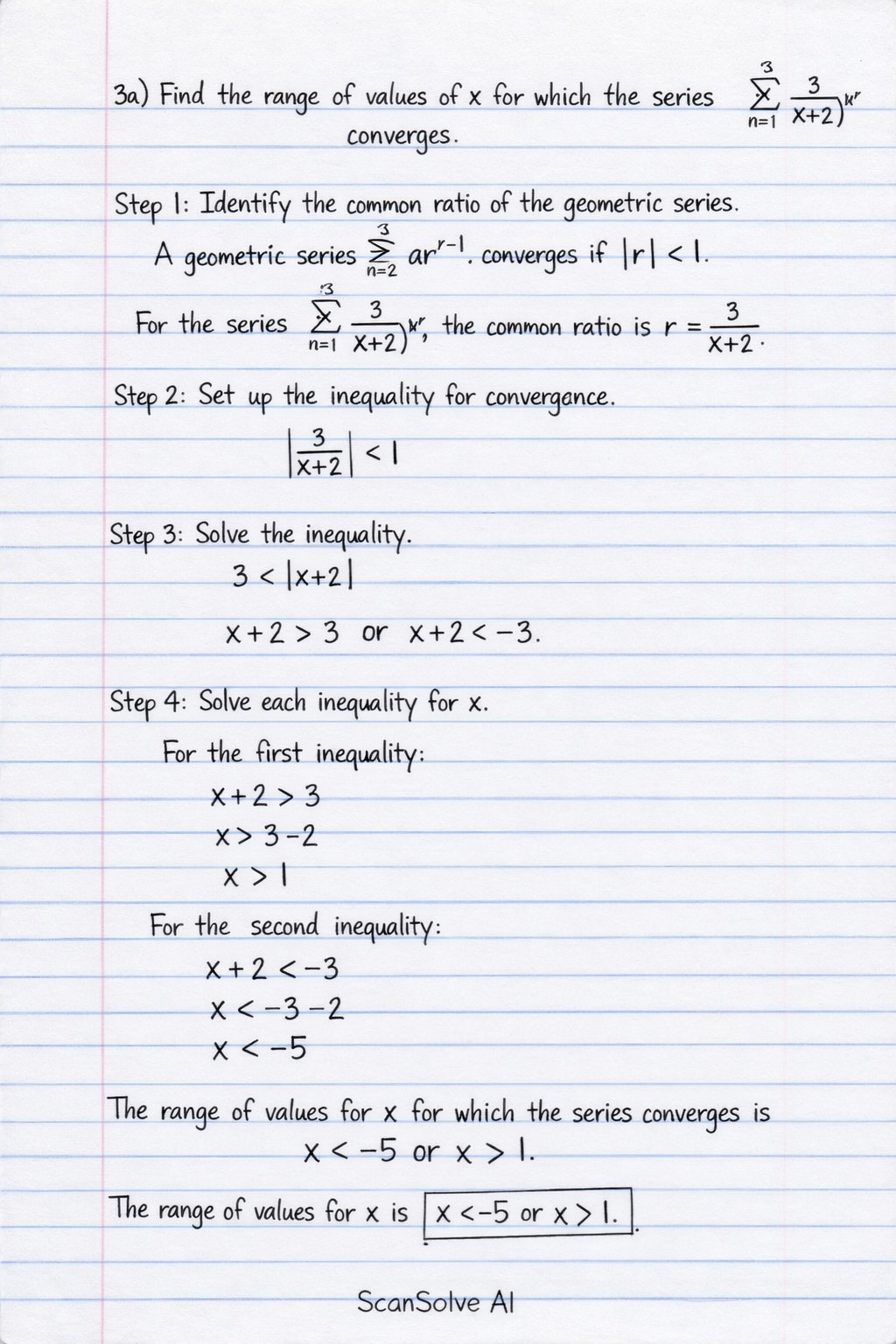
3a) Find the range of value of $x$ for which the series $\sum_{r=1}^{\infty} \left(\frac{3}{x+2}\right)^r$ converges.
Step 1: Identify the common ratio of the geometric series.
A geometric series $\sum_{r=1}^{\infty} ar^{r-1}$ converges if and only if the common ratio $r$ satisfies $|r| < 1$.
For the given series $\sum_{r=1}^{\infty} \left(\frac{3}{x+2}\right)^r$, the common ratio is $r = \frac{3}{x+2}$.
Step 2: Set up the inequality for convergence.
$$\left|\frac{3}{x+2}\right| < 1$$
Step 3: Solve the inequality.
This inequality can be rewritten as $3 < |x+2|$.
This implies two separate inequalities:
$$x+2 > 3 \quad \text{or} \quad x+2 < -3$$
Step 4: Solve each inequality for $x$.
For the first inequality:
$$x+2 > 3$$
$$x > 3-2$$
$$x > 1$$
For the second inequality:
$$x+2 < -3$$
$$x < -3-2$$
$$x < -5$$
The range of values for $x$ for which the series converges is $x < -5$ or $x > 1$.
The range of values for $x$ is $\boxed{x < -5 \text{ or } x > 1}$.
3b) The sum of the first $n$ terms of a series is $S_n = 5(2^n - 1)$. Find the general term ($a_n$) and show that the sequence is a G.P.
Step 1: Find the general term $a_n$.
The general term $a_n$ is given by $a_n = S_n - S_{n-1}$ for $n > 1$, and $a_1 = S_1$.
First, find $a_1$:
$$S_1 = 5(2^1 - 1) = 5(2-1) = 5(1) = 5$$
So, $a_1 = 5$.
Next, find $S_{n-1}$:
$$S_{n-1} = 5(2^{n-1} - 1)$$
Now, find $a_n$ for $n > 1$:
$$a_n = S_n - S_{n-1}$$
$$a_n = 5(2^n - 1) - 5(2^{n-1} - 1)$$
$$a_n = 5 \left[ (2^n - 1) - (2^{n-1} - 1) \right]$$
$$a_n = 5 \left[ 2^n - 1 - 2^{n-1} + 1 \right]$$
$$a_n = 5 \left[ 2^n - 2^{n-1} \right]$$
$$a_n = 5 \left[ 2 \cdot 2^{n-1} - 2^{n-1} \right]$$
$$a_n = 5 \left[ (2-1) \cdot 2^{n-1} \right]$$
$$a_n = 5 \cdot 2^{n-1}$$
This formula also holds for $n=1$ ($a_1 = 5 \cdot 2^0 = 5$).
The general term is $\boxed{a_n = 5 \cdot 2^{n-1}}$.
Step 2: Show that the sequence is a Geometric Progression (G.P.).
A sequence is a G.P. if the ratio of consecutive terms is constant. This constant ratio is the common ratio, $r$.
We need to show that $\frac{a_n}{a_{n-1}}$ is a constant for all $n > 1$.
Using the general term $a_n = 5 \cdot 2^{n-1}$:
$$a_{n-1} = 5 \cdot 2^{(n-1)-1} = 5 \cdot 2^{n-2}$$
Now, calculate the ratio:
$$\frac{a_n}{a_{n-1}} = \frac{5 \cdot 2^{n-1}}{5 \cdot 2^{n-2}}$$
$$= \frac{2^{n-1}}{2^{n-2}}$$
$$= 2^{(n-1) - (n-2)}$$
$$= 2^{n-1-n+2}$$
$$= 2^1$$
$$= 2$$
Since the ratio of consecutive terms is a constant value of $2$, the sequence is a Geometric Progression.
Identify the common ratio of the geometric series.
|Mathematics
Identify the common ratio of the geometric series.
ScanSolve AI Answer
3a) Find the range of value of x for which the series ∑r=1∞(x+23)r converges.
Step 1: Identify the common ratio of the geometric series.
A geometric series ∑r=1∞arr−1 converges if and only if the common ratio r satisfies ∣r∣<1.
For the given series ∑r=1∞(x+23)r, the common ratio is r=x+23.
Step 2: Set up the inequality for convergence.
x+23<1
Step 3: Solve the inequality.
This inequality can be rewritten as 3<∣x+2∣.
This implies two separate inequalities:
x+2>3orx+2<−3
Step 4: Solve each inequality for x.
For the first inequality:
x+2>3x>3−2x>1
For the second inequality:
x+2<−3x<−3−2x<−5
The range of values for x for which the series converges is x<−5 or x>1.
The range of values for x is x<−5orx>1.
3b) The sum of the first n terms of a series is Sn=5(2n−1). Find the general term (an) and show that the sequence is a G.P.
Step 1: Find the general term an.
The general term an is given by an=Sn−Sn−1 for n>1, and a1=S1.
First, find a1:
S1=5(21−1)=5(2−1)=5(1)=5
So, a1=5.
Next, find Sn−1:
Sn−1=5(2n−1−1)
Now, find an for n>1:
an=Sn−Sn−1an=5(2n−1)−5(2n−1−1)an=5[(2n−1)−(2n−1−1)]an=5[2n−1−2n−1+1]an=5[2n−2n−1]an=5[2⋅2n−1−2n−1]an=5[(2−1)⋅2n−1]an=5⋅2n−1
This formula also holds for n=1 (a1=5⋅20=5).
The general term is an=5⋅2n−1.
Step 2: Show that the sequence is a Geometric Progression (G.P.).
A sequence is a G.P. if the ratio of consecutive terms is constant. This constant ratio is the common ratio, r.
We need to show that an−1an is a constant for all n>1.
Using the general term an=5⋅2n−1:
an−1=5⋅2(n−1)−1=5⋅2n−2
Now, calculate the ratio:
an−1an=5⋅2n−25⋅2n−1=2n−22n−1=2(n−1)−(n−2)=2n−1−n+2=21=2
Since the ratio of consecutive terms is a constant value of 2, the sequence is a Geometric Progression.
Need help with your own homework?
Get instant step-by-step solutions to any question. Free to start.