

This physics problem tests your understanding of fundamental physical laws and their applications. The step-by-step solution below breaks down the problem using relevant equations and physical reasoning.
ScanSolve AI Answer
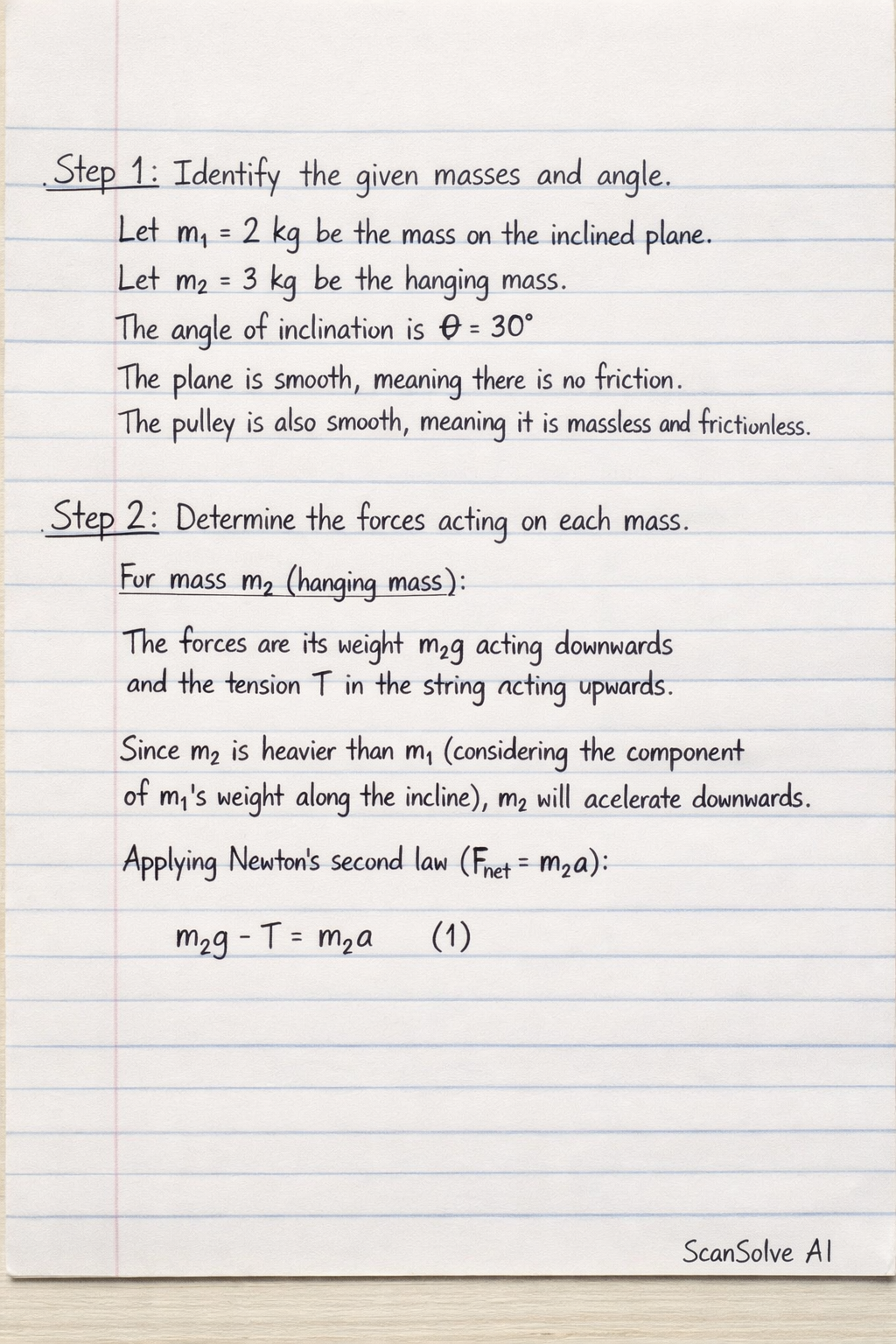
Step 1: Identify the given masses and angle. Let m_1 = 2 kg be the mass on the inclined plane. Let m_2 = 3 kg be the hanging mass. The angle of inclination is = 30^. The plane is smooth, meaning there is no friction. The pulley is also smooth, meaning it is massless and frictionless. Step 2: Determine the forces acting on each mass. For mass m_2 (hanging mass): The forces are its weight m_2 g acting downwards and the tension T in the string acting upwards. Since m_2 is heavier than m_1 (considering the component of m_1's weight along the incline), m_2 will accelerate downwards. Applying Newton's second law (F_net = m_2 a): m_2 g - T = m_2 a (1) For mass m_1 (on the inclined plane): The forces acting along the incline are the tension T acting upwards along the incline and the component of its weight m_1 g acting downwards along the incline. Since m_2 accelerates downwards, m_1 will accelerate upwards along the incline. Applying Newton's second law (F_net = m_1 a): T - m_1 g = m_1 a (2) Step 3: Solve the system of equations for acceleration a. Add equation (1) and equation (2) to eliminate T: (m_2 g - T) + (T - m_1 g ) = m_2 a + m_1 a m_2 g - m_1 g = (m_1 + m_2) a Factor out g on the left side and a on the right side: (m_2 - m_1 ) g = (m_1 + m_2) a Solve for a: a = ((m_2 - m_1 ) g)/(m_1 + m_2) Step 4: Substitute the given values into the equation for a. We know that (30^) = (1)/(2). a = (3 kg - 2 kg × (30^)) g2 kg + 3 kg a = ((3 - 2 × 1)/(2)) g5 a = ((3 - 1) g)/(5) a = (2g)/(5) The final answer is (2g)/(5).