

This mathematics problem involves applying core mathematical principles and formulas. Below you will find a complete step-by-step solution with detailed explanations for each step, helping you understand not just the answer but the method behind it.
ScanSolve AI Answer
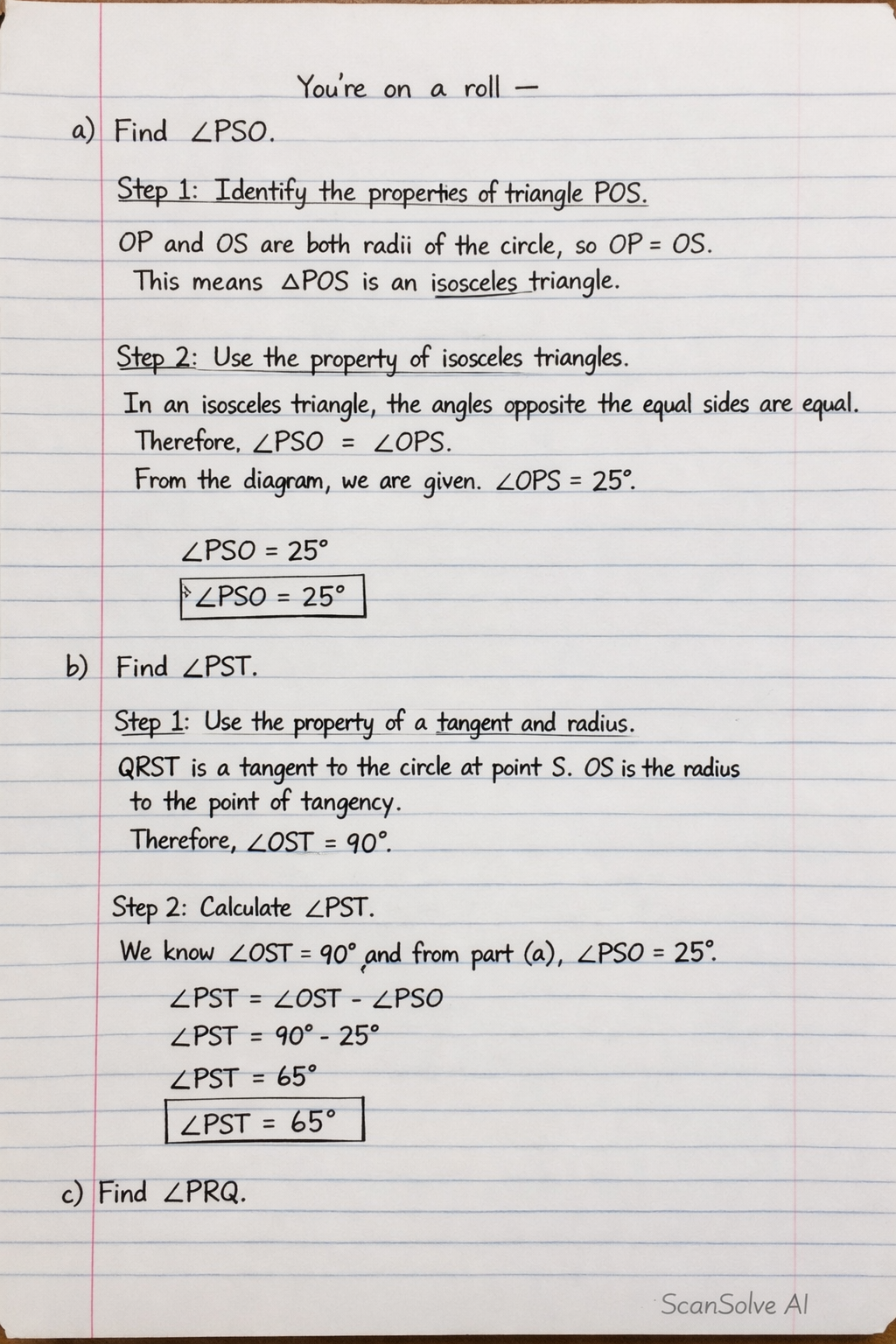
You're on a roll — a) Find PSO. Step 1: Identify the properties of triangle POS. OP and OS are both radii of the circle, so OP = OS. This means triangle POS is an isosceles triangle. Step 2: Use the property of isosceles triangles. In an isosceles triangle, the angles opposite the equal sides are equal. Therefore, PSO = OPS. From the diagram, we are given OPS = 25^ (assuming the typo OPC refers to OPS). PSO = 25^ PSO = 25^ b) Find PST. Step 1: Use the property of a tangent and radius. QRST is a tangent to the circle at point S. OS is the radius to the point of tangency. The radius to the point of tangency is perpendicular to the tangent. Therefore, OST = 90^. Step 2: Calculate PST. We know OST = 90^ and from part (a), PSO = 25^. PST = OST - PSO PST = 90^ - 25^ PST = 65^ PST = 65^ c) Find PRQ. Step 1: Find POS. In triangle POS, the sum of angles is 180^. We know OPS = 25^ and PSO = 25^. POS = 180^ - ( OPS + PSO) POS = 180^ - (25^ + 25^) POS = 180^ - 50^ POS = 130^ Step 2: Find ROS. POR is a straight line, so POS and ROS are angles on a straight line. ROS = 180^ - POS ROS = 180^ - 130^ ROS = 50^ Step 3: Find PRQ (which is ORS). Consider triangle ORS. We know OSR = 90^ (radius OS perpendicular to tangent QRST) and ROS = 50^. The sum of angles in triangle ORS is 180^. ORS + OSR + ROS = 180^ ORS + 90^ + 50^ = 180^ ORS + 140^ = 180^ ORS = 180^ - 140^ ORS = 40^ Since PRQ is the same as ORS: PRQ = 40^ PRQ = 40^ What's next?