

This mathematics problem involves applying core mathematical principles and formulas. Below you will find a complete step-by-step solution with detailed explanations for each step, helping you understand not just the answer but the method behind it.
ScanSolve AI Answer
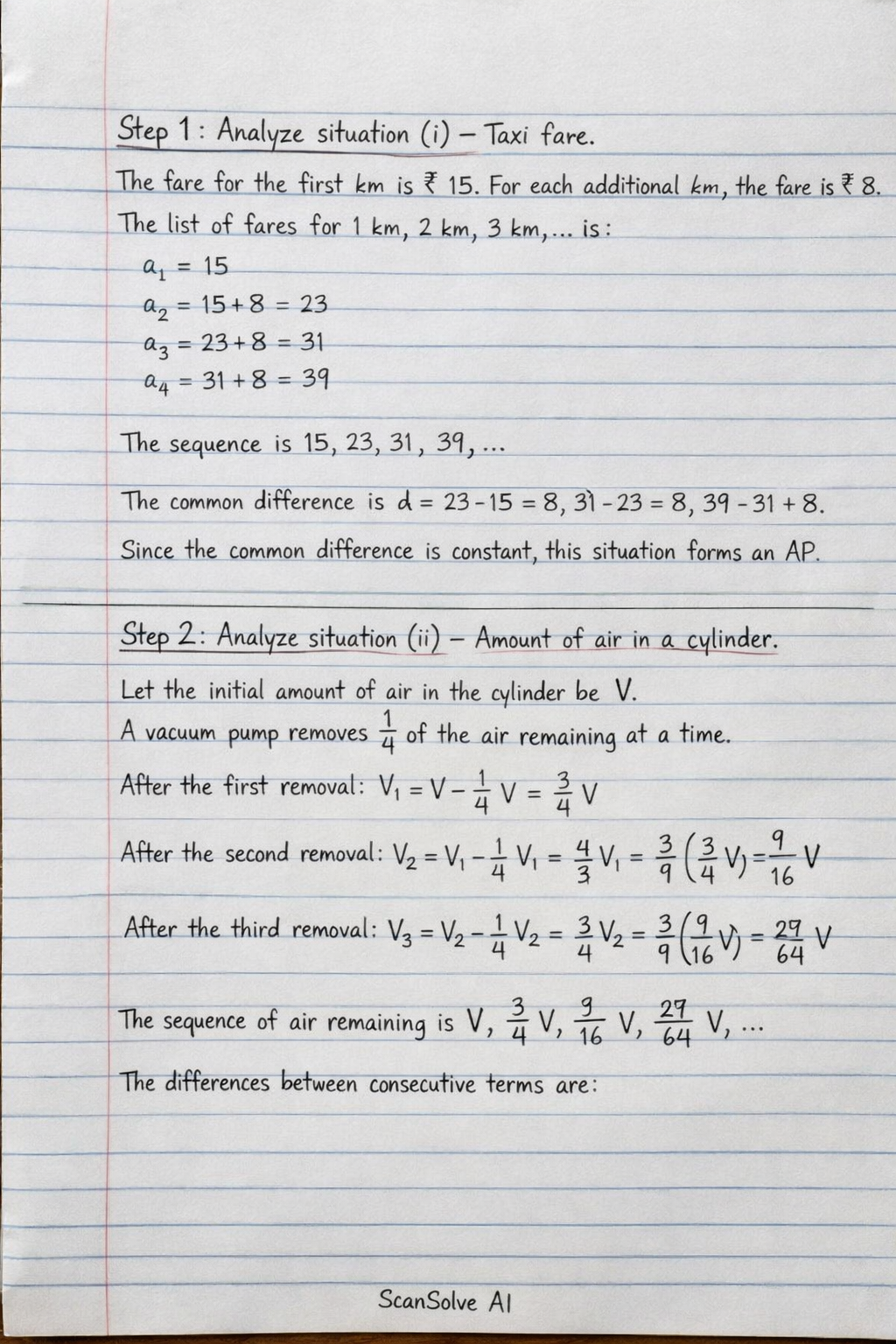
Step 1: Analyze situation (i) - Taxi fare. The fare for the first km is ₹ 15. For each additional km, the fare is ₹ 8. The list of fares for 1 km, 2 km, 3 km, ... is: a_1 = 15 a_2 = 15 + 8 = 23 a_3 = 23 + 8 = 31 a_4 = 31 + 8 = 39 The sequence is 15, 23, 31, 39, The common difference is d = 23 - 15 = 8, 31 - 23 = 8, 39 - 31 = 8. Since the common difference is constant, this situation forms an AP. Step 2: Analyze situation (ii) - Amount of air in a cylinder. Let the initial amount of air in the cylinder be V. A vacuum pump removes (1)/(4) of the air remaining at a time. After the first removal: V_1 = V - (1)/(4)V = (3)/(4)V After the second removal: V_2 = V_1 - (1)/(4)V_1 = (3)/(4)V_1 = (3)/(4)((3)/(4)V) = (9)/(16)V After the third removal: V_3 = V_2 - (1)/(4)V_2 = (3)/(4)V_2 = (3)/(4)((9)/(16)V) = (27)/(64)V The sequence of air remaining is V, (3)/(4)V, (9)/(16)V, (27)/(64)V, The differences between consecutive terms are: d_1 = (3)/(4)V - V = -(1)/(4)V d_2 = (9)/(16)V - (3)/(4)V = (9)/(16)V - (12)/(16)V = -(3)/(16)V Since d_1 ≠ d_2, the common difference is not constant. This situation does not form an AP. Step 3: Analyze situation (iii) - Cost of digging a well. The cost of digging the first metre is ₹ 150. The cost rises by ₹ 50 for each subsequent metre. The list of costs for 1 m, 2 m, 3 m, ... is: C_1 = 150 C_2 = 150 + 50 = 200 C_3 = 200 + 50 = 250 C_4 = 250 + 50 = 300 The sequence is 150, 200, 250, 300, The common difference is d = 200 - 150 = 50, 250 - 200 = 50, 300 - 250 = 50. Since the common difference is constant, this situation forms an AP. Step 4: Analyze situation (iv) - Amount of money with compound interest. Initial deposit = ₹ 10000. Compound interest at 8% per annum. The amount after n years is given by the formula A = P(1 + r)^n. A_0 = 10000 A_1 = 10000(1 + 0.08)^1 = 10000(1.08) = 10800 A_2 = 10000(1.08)^2 = 10000(1.1664) = 11664 A_3 = 10000(1.08)^3 = 10000(1.259712) = 12597.12 The sequence of amounts is 10000, 10800, 11664, 12597.12, The differences between consecutive terms are: d_1 = 10800 - 10000 = 800 d_2 = 11664 - 10800 = 864 Since d_1 ≠ d_2, the common difference is not constant. This situation does not form an AP. The situations that form an arithmetic progression are: *i) The taxi fare after each km when the fare is ₹ 15 for the first km and ₹ 8 for each additional km. This forms an AP because the fare increases by a constant amount (₹ 8) for each additional km. *iii) The cost of digging a well after every metre of digging, when it costs ₹ 150 for the first metre and rises by ₹ 50 for each subsequent metre. This forms an AP because the cost increases by a constant amount (₹ 50) for each additional metre. That's 2 down. 3 left today — send the next one.