

This mathematics problem involves applying core mathematical principles and formulas. Below you will find a complete step-by-step solution with detailed explanations for each step, helping you understand not just the answer but the method behind it.
ScanSolve AI Answer
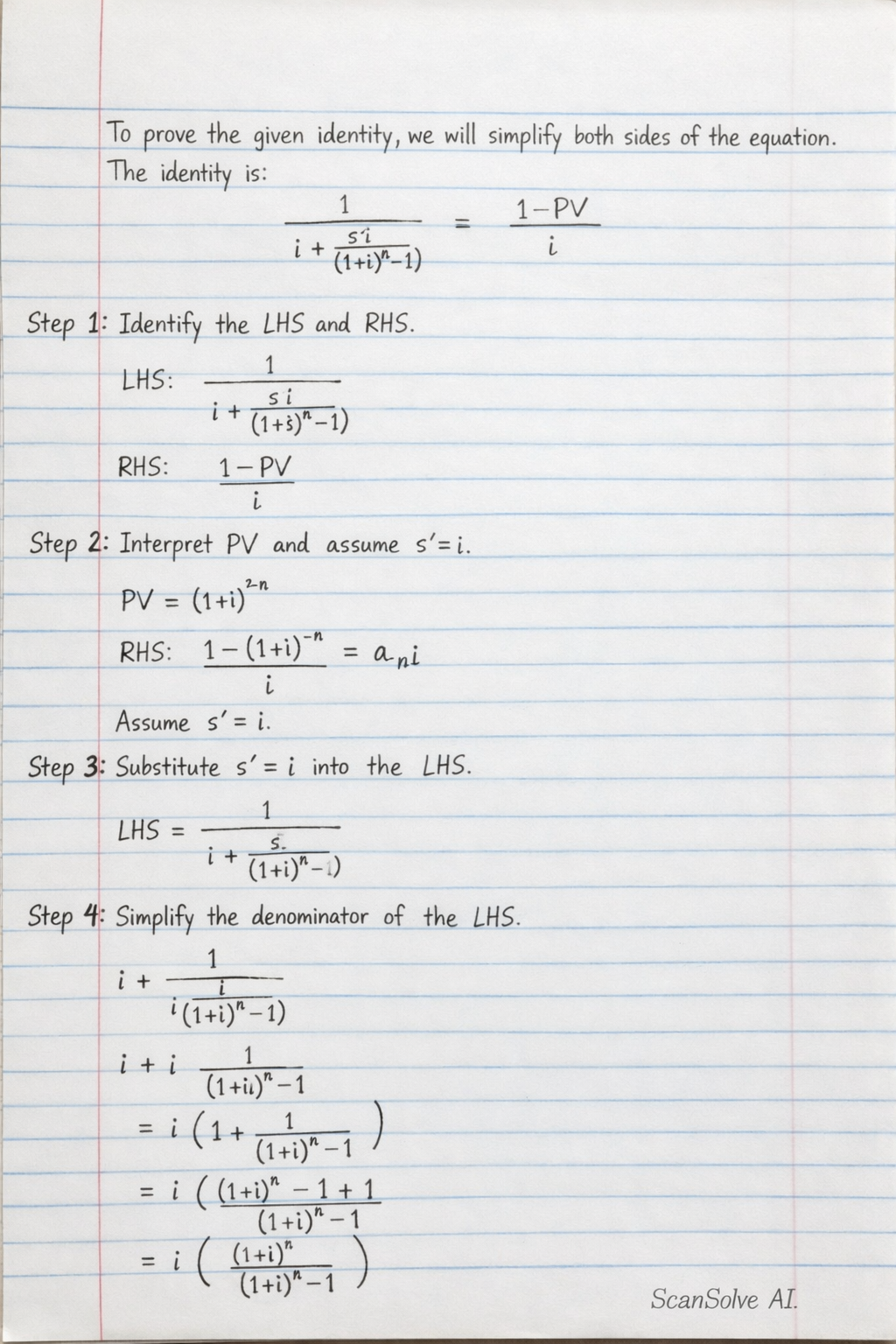
To prove the given identity, we will simplify both sides of the equation. The identity is: (1)/(i + s')(1+s')^n - 1 = (1-PV)/(i) Step 1: Identify the left-hand side (LHS) and the right-hand side (RHS). LHS: (1)/(i + s')(1+s')^n - 1 RHS: (1-PV)/(i) Step 2: Interpret PV and assume s'=i. In financial mathematics, PV typically represents the present value factor, which is (1+i)^-n. The RHS, 1-(1+i)^-ni, is the formula for the present value of an ordinary annuity, a_n|i. For the given identity to hold true, the interest rate s' on the LHS must be equal to the interest rate i on the RHS. Therefore, we assume s' = i. Step 3: Substitute s'=i into the LHS. LHS = (1)/(i + i)(1+i)^n - 1 Step 4: Simplify the denominator of the LHS. i + (i)/((1+i)^n - 1) = i ( 1 + (1)/((1+i)^n - 1) ) = i ( ((1+i)^n - 1 + 1)/((1+i)^n - 1) ) = i ( ((1+i)^n)/((1+i)^n - 1) ) Step 5: Substitute this simplified denominator back into the LHS expression. LHS = (1)/(i ( (1+i)^n)(1+i)^n - 1 ) = ((1+i)^n - 1)/(i (1+i)^n) Step 6: Simplify the RHS using PV = (1+i)^-n. RHS = 1-(1+i)^-ni = (1 - 1)/((1+i)^n)i = ((1+i)^n - 1)/((1+i)^n)i = ((1+i)^n - 1)/(i (1+i)^n) Step 7: Compare the simplified LHS and RHS. Since both the simplified LHS and RHS are equal to ((1+i)^n - 1)/(i (1+i)^n), the identity is proven. LHS = ((1+i)^n - 1)/(i (1+i)^n) = RHS The identity is proven. What's next? 📸