We read your photo as:

Prove the identity f( heta) = ( theta)/(1- theta) + ( theta)/(1- theta) theta + theta.

Mathematics

ScanSolve AI Answer

Answer

cos⁡θ+sin⁡θ\cos \theta + \sin \theta

Step-by-step solution

10 steps

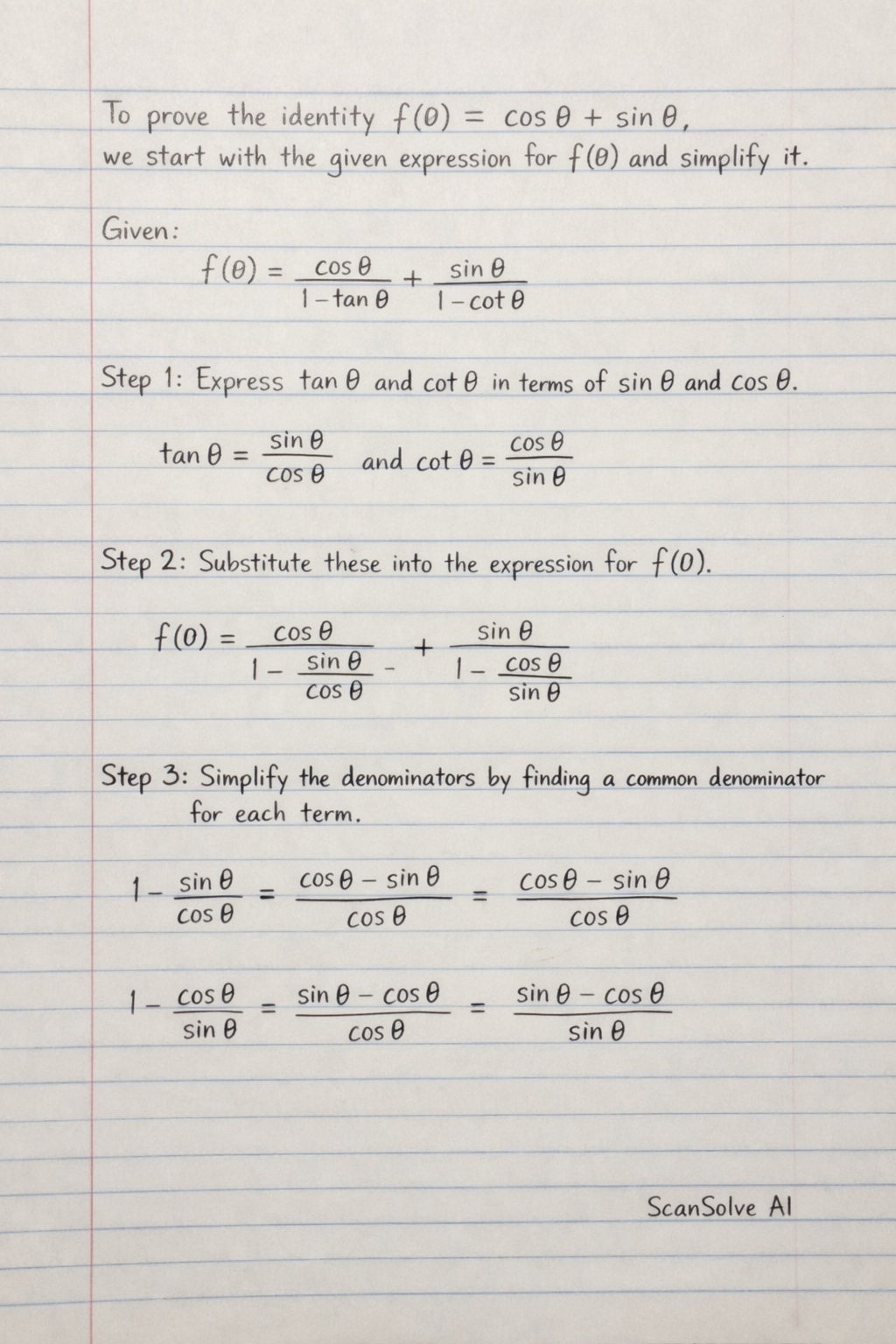
To prove the identity f(θ)≡cos⁡θ+sin⁡θf(\theta) \equiv \cos \theta + \sin \theta, we start with the given expression for f(θ)f(\theta) and simplify it.

Given:

f(θ)=cos⁡θ1−tan⁡θ+sin⁡θ1−cot⁡θf(\theta) = \frac{\cos \theta}{1-\tan \theta} + \frac{\sin \theta}{1-\cot \theta}
  1. Express tan⁡θ\tan \theta and cot⁡θ\cot \theta in terms of sin⁡θ\sin \theta and cos⁡θ\cos \theta.

    We know that tan⁡θ=sin⁡θcos⁡θ\tan \theta = \frac{\sin \theta}{\cos \theta} and cot⁡θ=cos⁡θsin⁡θ\cot \theta = \frac{\cos \theta}{\sin \theta}.

  2. Substitute these into the expression for f(θ)f(\theta).

    f(θ)=cos⁡θ1−sin⁡θcos⁡θ+sin⁡θ1−cos⁡θsin⁡θf(\theta) = \frac{\cos \theta}{1-\frac{\sin \theta}{\cos \theta}} + \frac{\sin \theta}{1-\frac{\cos \theta}{\sin \theta}}
  3. Simplify the denominators by finding a common denominator for each term.

    1−sin⁡θcos⁡θ=cos⁡θcos⁡θ−sin⁡θcos⁡θ=cos⁡θ−sin⁡θcos⁡θ1-\frac{\sin \theta}{\cos \theta} = \frac{\cos \theta}{\cos \theta} - \frac{\sin \theta}{\cos \theta} = \frac{\cos \theta - \sin \theta}{\cos \theta} 1−cos⁡θsin⁡θ=sin⁡θsin⁡θ−cos⁡θsin⁡θ=sin⁡θ−cos⁡θsin⁡θ1-\frac{\cos \theta}{\sin \theta} = \frac{\sin \theta}{\sin \theta} - \frac{\cos \theta}{\sin \theta} = \frac{\sin \theta - \cos \theta}{\sin \theta}
  4. Substitute the simplified denominators back into the expression for f(θ)f(\theta).

    f(θ)=cos⁡θcos⁡θ−sin⁡θcos⁡θ+sin⁡θsin⁡θ−cos⁡θsin⁡θf(\theta) = \frac{\cos \theta}{\frac{\cos \theta - \sin \theta}{\cos \theta}} + \frac{\sin \theta}{\frac{\sin \theta - \cos \theta}{\sin \theta}}
  5. Invert the denominators and multiply.

    f(θ)=cos⁡θ⋅cos⁡θcos⁡θ−sin⁡θ+sin⁡θ⋅sin⁡θsin⁡θ−cos⁡θf(\theta) = \cos \theta \cdot \frac{\cos \theta}{\cos \theta - \sin \theta} + \sin \theta \cdot \frac{\sin \theta}{\sin \theta - \cos \theta} f(θ)=cos⁡2θcos⁡θ−sin⁡θ+sin⁡2θsin⁡θ−cos⁡θf(\theta) = \frac{\cos^2 \theta}{\cos \theta - \sin \theta} + \frac{\sin^2 \theta}{\sin \theta - \cos \theta}
  6. Notice that the denominators are negatives of each other

    sin⁡θ−cos⁡θ=−(cos⁡θ−sin⁡θ)\sin \theta - \cos \theta = -(\cos \theta - \sin \theta). Rewrite the second term with the common denominator.

    f(θ)=cos⁡2θcos⁡θ−sin⁡θ+sin⁡2θ−(cos⁡θ−sin⁡θ)f(\theta) = \frac{\cos^2 \theta}{\cos \theta - \sin \theta} + \frac{\sin^2 \theta}{-(\cos \theta - \sin \theta)} f(θ)=cos⁡2θcos⁡θ−sin⁡θ−sin⁡2θcos⁡θ−sin⁡θf(\theta) = \frac{\cos^2 \theta}{\cos \theta - \sin \theta} - \frac{\sin^2 \theta}{\cos \theta - \sin \theta}
  7. Combine the fractions since they now have a common denominator.

    f(θ)=cos⁡2θ−sin⁡2θcos⁡θ−sin⁡θf(\theta) = \frac{\cos^2 \theta - \sin^2 \theta}{\cos \theta - \sin \theta}
  8. Apply the difference of squares identity, a2−b2=(a−b)(a+b)a^2 - b^2 = (a-b)(a+b), where a=cos⁡θa = \cos \theta and b=sin⁡θb = \sin \theta.

    cos⁡2θ−sin⁡2θ=(cos⁡θ−sin⁡θ)(cos⁡θ+sin⁡θ)\cos^2 \theta - \sin^2 \theta = (\cos \theta - \sin \theta)(\cos \theta + \sin \theta)
  9. Substitute this back into the expression for f(θ)f(\theta).

    f(θ)=(cos⁡θ−sin⁡θ)(cos⁡θ+sin⁡θ)cos⁡θ−sin⁡θf(\theta) = \frac{(\cos \theta - \sin \theta)(\cos \theta + \sin \theta)}{\cos \theta - \sin \theta}
  10. Cancel out the common term (cos⁡θ−sin⁡θ)(\cos \theta - \sin \theta) from the numerator and denominator (assuming cos⁡θ−sin⁡θ≠0\cos \theta - \sin \theta \neq 0).

    f(θ)=cos⁡θ+sin⁡θf(\theta) = \cos \theta + \sin \theta

    Thus, we have proven that f(θ)≡cos⁡θ+sin⁡θf(\theta) \equiv \cos \theta + \sin \theta.

    The final answer is cos⁡θ+sin⁡θ\cos \theta + \sin \theta.

Was this helpful?

Try one yourself

A new problem that tests the same skill.

Still stuck on this one?

Ask a follow-up, and the answer starts from this question.

Got a different question?Ask your own question
Handwritten step-by-step solution preview

Handwritten Step-by-Step Solution

Get this as a handwritten image on WhatsApp — like a tutor wrote it for you.

Try on WhatsApp