
We read your photo as:
Prove the identity ( heta)/(1- heta) + rac heta1− heta = heta + an heta
ScanSolve AI Answer
Answer
Step-by-step solution
8 stepsTo prove the identity , we start with the given expression for and simplify it.
Given:
Express and in terms of and .
We know that and .
Substitute these into the expression for :Simplify the denominators of each fraction.
For the first term:
For the second term:
Substitute the simplified denominators back into .
Invert and multiply to simplify the complex fractions.
Make the denominators common.
Notice that .
Rewrite the second term:Now substitute this back into the expression for :
Combine the fractions.
Use the difference of squares identity, .
Here, and .
So, .
Substitute this into the numerator:Cancel out the common term from the numerator and denominator (assuming ).
Thus, we have proven that .
The final answer is .
Try one yourself
A new problem that tests the same skill.
Still stuck on this one?
Ask a follow-up, and the answer starts from this question.
More Mathematics Questions
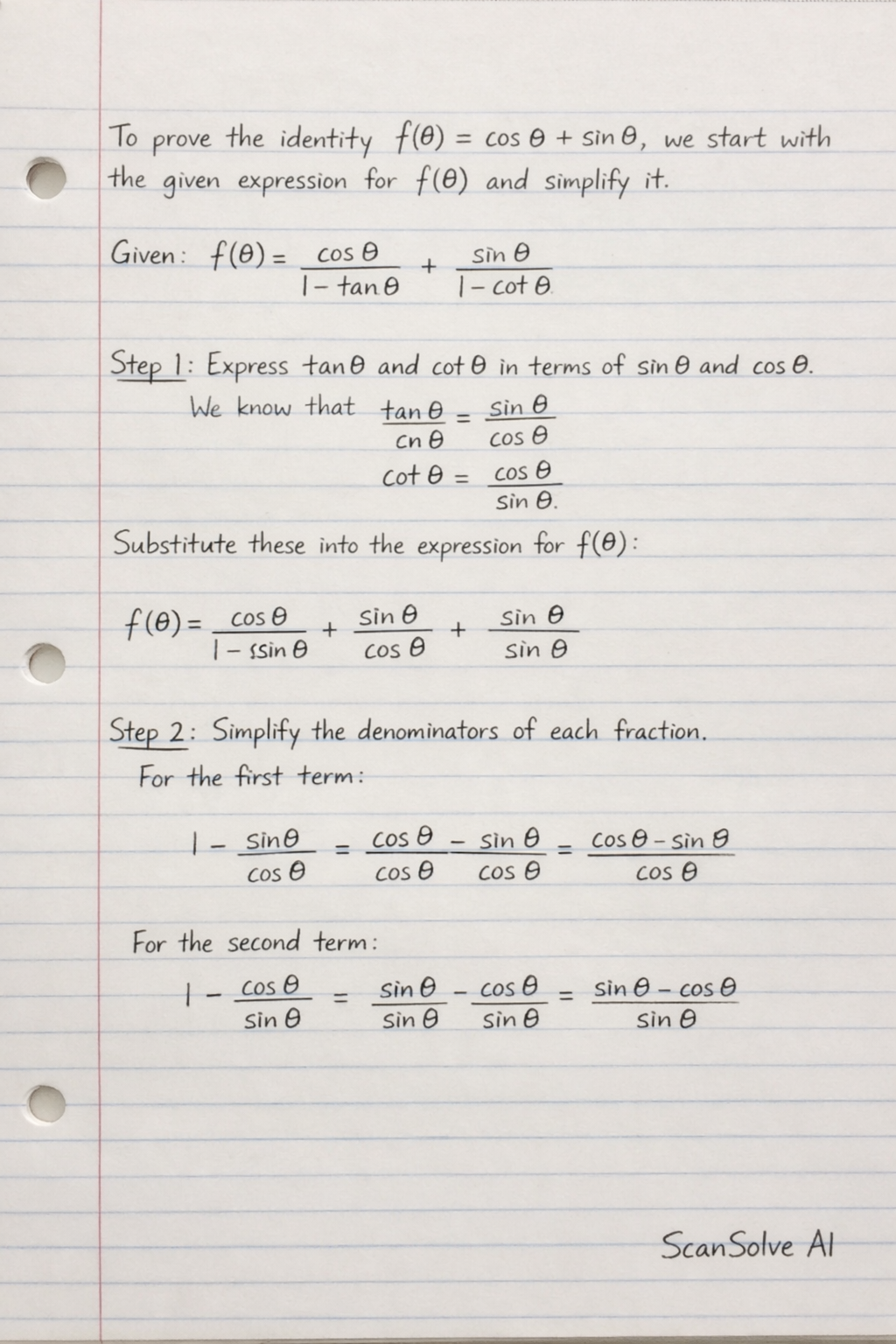
Handwritten Step-by-Step Solution
Get this as a handwritten image on WhatsApp — like a tutor wrote it for you.
Try on WhatsApp