

This mathematics problem involves applying core mathematical principles and formulas. Below you will find a complete step-by-step solution with detailed explanations for each step, helping you understand not just the answer but the method behind it.
ScanSolve AI Answer
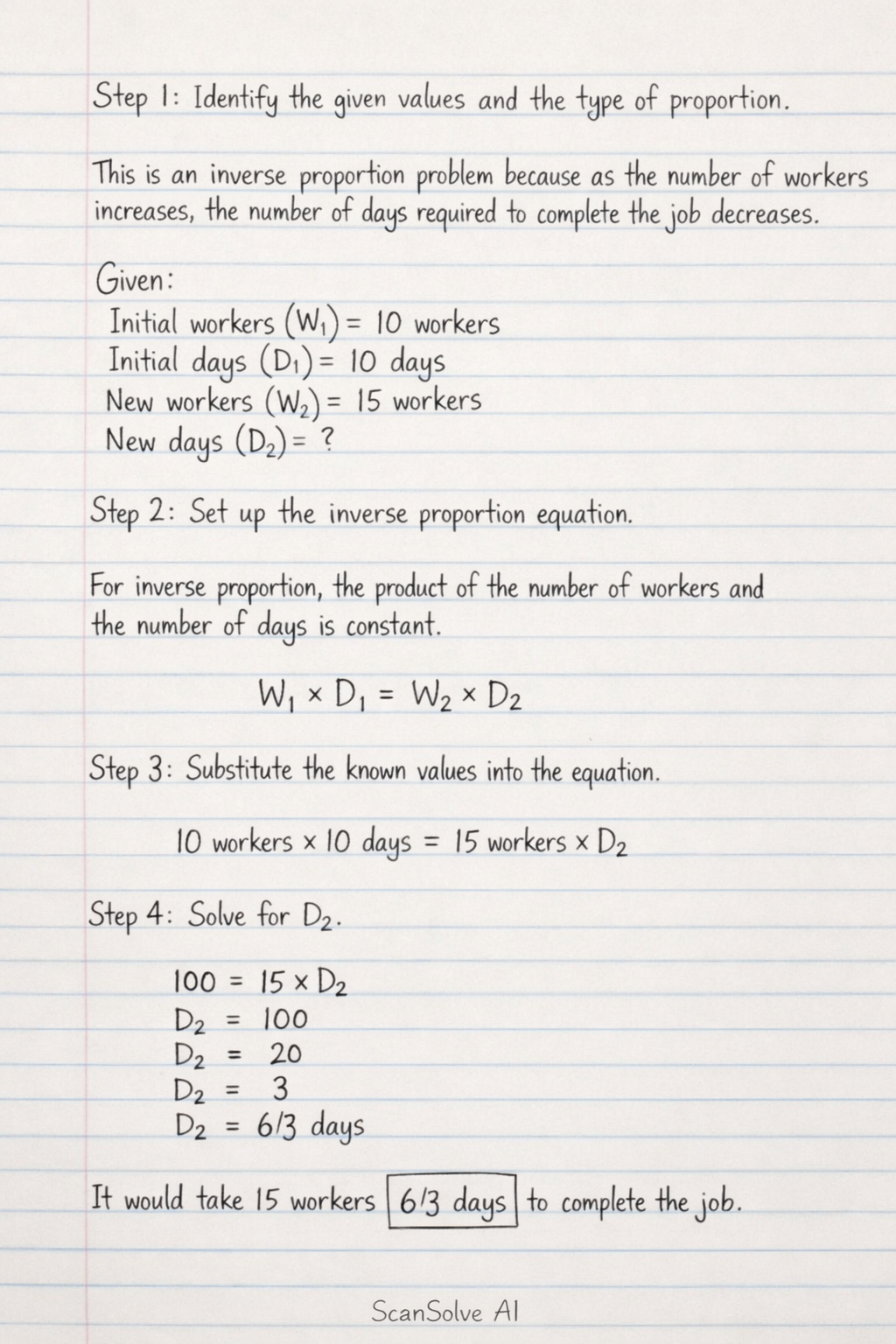
Step 1: Identify the given values and the type of proportion. This is an inverse proportion problem because as the number of workers increases, the number of days required to complete the job decreases. Given: Initial workers (W_1) = 10 workers Initial days (D_1) = 10 days New workers (W_2) = 15 workers New days (D_2) = ? Step 2: Set up the inverse proportion equation. For inverse proportion, the product of the number of workers and the number of days is constant. W_1 × D_1 = W_2 × D_2 Step 3: Substitute the known values into the equation. 10 workers × 10 days = 15 workers × D_2 Step 4: Solve for D_2. 100 = 15 × D_2 D_2 = (100)/(15) D_2 = (20)/(3) D_2 = 6(2)/(3) days It would take 15 workers 6(2)/(3) days to complete the job. Send me the next one 📸