
We read your photo as:
If A B = B, then B A? If A and B are disjoint sets, then n(A B) = n(A) + n(B)? For any two sets A and B, n(A) + n(B) - n(A B) = n(A B)?
ScanSolve AI Answer
Answer
Step-by-step solution
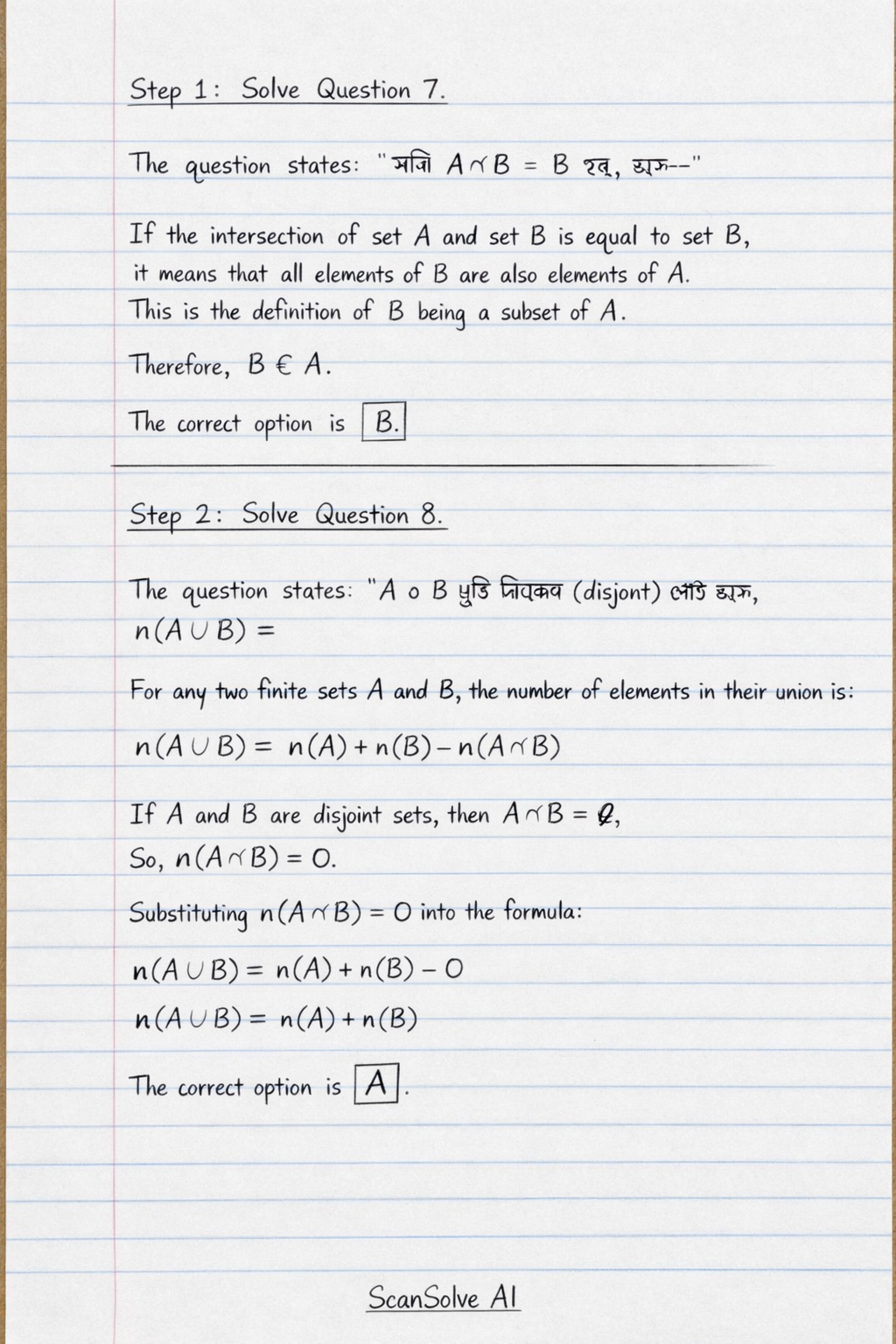
5 stepsSolve Question 7.
The question states: "যদি হয়, তবে—" (If , then—).
If the intersection of set and set is equal to set , it means that all elements of are also elements of . This is the definition of being a subset of .Therefore, .
The correct option is B.
Solve Question 8.
The question states: " ও দুটি বিচ্ছেদ (disjoint) সেট হলে, " (If and are two disjoint sets, then ).
For any two finite sets and , the number of elements in their union is given by the formula:If and are disjoint sets, it means they have no common elements. Therefore, their intersection is the empty set, , and the number of elements in their intersection is .
Substituting into the formula:The correct option is A.
Solve Question 9.
The question states: "যে-কোনো দুটি সেট ও -এর ক্ষেত্রে, " (For any two sets and , ).
This is the fundamental formula for the number of elements in the union of two finite sets.The correct option is A.
Solve Question 10.
The question states: "-এর দ্বৈত অভেদ হবে—" (The dual identity of will be—).
To find the dual of a set identity, we interchange the union operator () with the intersection operator (), and the universal set () with the empty set ().
Given identity:- Replace with :
- Replace with :
- Replace with on the right side: So, the dual identity is .
The correct option is D.
Solve Question 11.
The question states: " অভেদের দ্বৈত অভেদ হয়—" (The dual identity of is—).
To find the dual of a set identity, we interchange the union operator () with the intersection operator (), and vice versa.
Given identity:- Replace with : and
- Replace with : and and Applying these changes to the given identity: Left side: becomes Right side: becomes So, the dual identity is . This is the distributive law of intersection over union.
The correct option is A.
Try one yourself
A new problem that tests the same skill.
Still stuck on this one?
Ask a follow-up, and the answer starts from this question.
More Mathematics Questions
Handwritten Step-by-Step Solution
Get this as a handwritten image on WhatsApp — like a tutor wrote it for you.
Try on WhatsApp