

This mathematics problem involves applying core mathematical principles and formulas. Below you will find a complete step-by-step solution with detailed explanations for each step, helping you understand not just the answer but the method behind it.
ScanSolve AI Answer
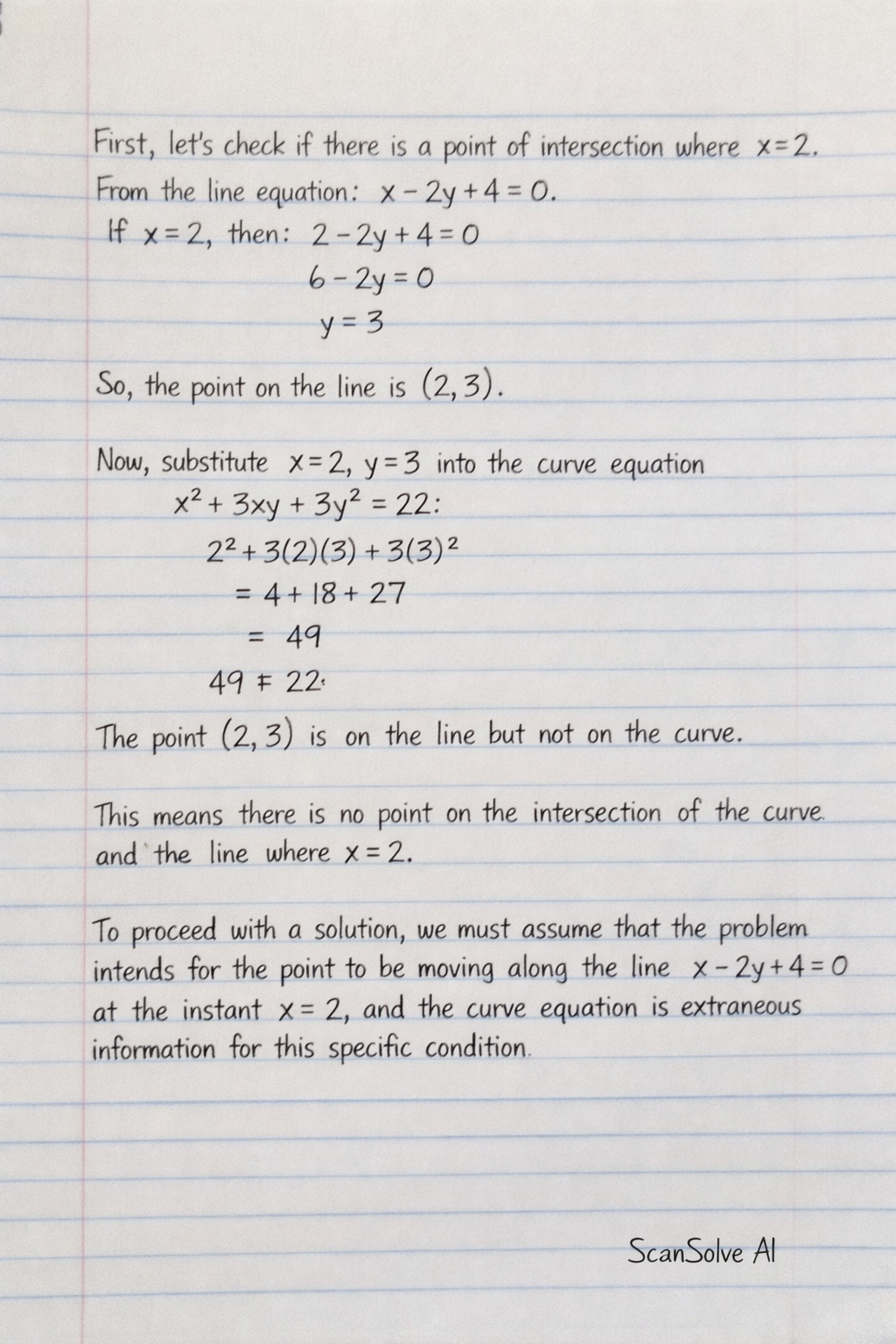
The problem asks for the speed of a point moving on the intersection of a curve x^2 + 3xy + 3y^2 = 22 and a line x - 2y + 4 = 0, when x=2 and (dx)/(dt) = 3 units/second. First, let's check if there is a point of intersection where x=2. From the line equation, x - 2y + 4 = 0, if x=2, then 2 - 2y + 4 = 0 6 - 2y = 0 y = 3. So, the point on the line is (2, 3). Now, substitute x=2 and y=3 into the curve equation x^2 + 3xy + 3y^2 = 22: (2)^2 + 3(2)(3) + 3(3)^2 = 4 + 18 + 27 = 49 Since 49 ≠ 22, the point (2, 3) is on the line but not on the curve. This means there is no point on the intersection of the curve and the line where x=2. To proceed with a solution, we must assume that the problem intends for the point to be moving along the line x - 2y + 4 = 0 at the instant x=2, and the curve equation is extraneous information for this specific condition. Step 1: Find the y-coordinate when x=2 using the line equation. Given the line equation x - 2y + 4 = 0. Substitute x=2: 2 - 2y + 4 = 0 6 - 2y = 0 2y = 6 y = 3 So, at the instant x=2, the point is (2, 3). Step 2: Differentiate the line equation with respect to time t. The equation of the line is x - 2y + 4 = 0. Differentiate both sides with respect to t: (d)/(dt)(x - 2y + 4) = (d)/(dt)(0) (dx)/(dt) - 2(dy)/(dt) + 0 = 0 (dx)/(dt) - 2(dy)/(dt) = 0 Step 3: Substitute the given rate (dx)/(dt) to find (dy)/(dt). We are given that x is increasing at the rate of 3 units/second, so (dx)/(dt) = 3. Substitute this into the differentiated equation: 3 - 2(dy)/(dt) = 0 2(dy)/(dt) = 3 (dy)/(dt) = (3)/(2) units/second Step 4: Calculate the speed of the point. The speed of a point (x(t), y(t)) in two dimensions is given by the formula: Speed = sqrt(((dx)/(dt))^2 + ((dy)/(dt))^2) Substitute the values of (dx)/(dt) = 3 and (dy)/(dt) = (3)/(2): Speed = sqrt((3)^2 + ((3)/(2))^2) Speed = sqrt(9 + (9)/(4)) Speed = sqrt((36)/(4) + (9)/(4)) Speed = sqrt((45)/(4)) Speed = sqrt(45)sqrt(4) Speed = sqrt(9 × 5)2 Speed = 3sqrt(5)2 units/second The speed of the point is 3sqrt(5)2 units/second. That's 2 down. 3 left today — send the next one.