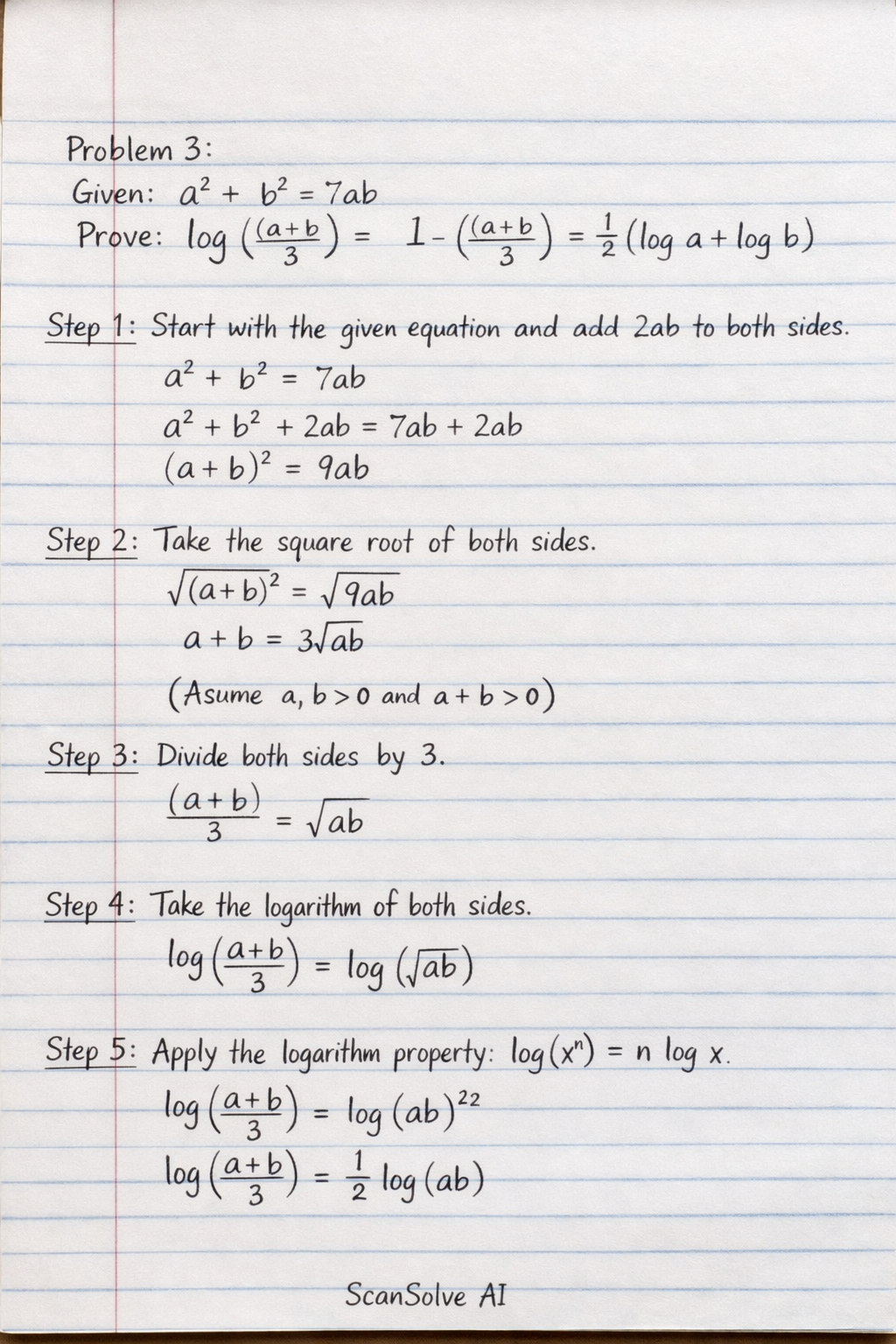
If a2+b2 = 7ab, Prove that log((a+b)/3) = 1/2(loga+logb). If x = logbc, y = logca and z = logab, Prove that xyz = x+y+z
|Mathematics
If a2+b2 = 7ab, Prove that log((a+b)/3) = 1/2(loga+logb). If x = logbc, y = logca and z = logab, Prove that xyz = x+y+z
ScanSolve AI Answer
Answer
Proven: log(3a+b)=21(loga+logb)
Here are the solutions to the problems.
:
Given the equation a2+b2=7ab, we need to prove that log(3a+b)=21(loga+logb).
Step 1: Start with the given equation and add 2ab to both sides to form a perfect square.
a2+b2=7aba2+b2+2ab=7ab+2ab(a+b)2=9ab
Step 2: Take the square root of both sides.
(a+b)2=9aba+b=3ab
(Assuming a,b>0 for the logarithms to be defined and a+b>0)
Step 3: Divide both sides by 3.
3a+b=ab
Step 4: Take the logarithm of both sides.
log(3a+b)=log(ab)
Step 5: Apply the logarithm property log(xn)=nlogx.
log(3a+b)=log((ab)1/2)log(3a+b)=21log(ab)
Step 6: Apply the logarithm property log(xy)=logx+logy.
log(3a+b)=21(loga+logb)
This completes the proof.
Proven:log(3a+b)=21(loga+logb)
:
Given x=logabc, y=logbca, and z=logcab, we need to prove that xyz=x+y+z+2.
Step 1: Use the change of base formula logpq=logplogq. Let's use a common base (e.g., natural logarithm or base 10 logarithm) for log. Let loga=La, logb=Lb, logc=Lc.
x=loga(bc)=logalog(bc)=logalogb+logc=LaLb+Lcy=logb(ca)=logblog(ca)=logblogc+loga=LbLc+Laz=logc(ab)=logclog(ab)=logcloga+logb=LcLa+Lb
Step 2: Calculate the product xyz.
xyz=(LaLb+Lc)(LbLc+La)(LcLa+Lb)xyz=LaLbLc(Lb+Lc)(Lc+La)(La+Lb)
Expand the numerator:
(Lb+Lc)(Lc+La)(La+Lb)=(LbLc+LbLa+Lc2+LcLa)(La+Lb)=LaLbLc+La2Lb+LaLc2+La2Lc+Lb2Lc+LaLb2+LbLc2+LaLbLc=La2Lb+La2Lc+Lb2La+Lb2Lc+Lc2La+Lc2Lb+2LaLbLc
So,
xyz=LaLbLcLa2Lb+La2Lc+Lb2La+Lb2Lc+Lc2La+Lc2Lb+2LaLbLcxyz=LaLbLcLa2Lb+LaLbLcLa2Lc+LaLbLcLb2La+LaLbLcLb2Lc+LaLbLcLc2La+LaLbLcLc2Lb+LaLbLc2LaLbLcxyz=LcLa+LbLa+LcLb+LaLb+LbLc+LaLc+2
Step 3: Calculate the sum x+y+z.
x+y+z=LaLb+Lc+LbLc+La+LcLa+Lbx+y+z=(LaLb+LaLc)+(LbLc+LbLa)+(LcLa+LcLb)x+y+z=LaLb+LaLc+LbLc+LbLa+LcLa+LcLb
Step 4: Compare xyz and x+y+z+2.
From Step 2:
xyz=LaLb+LaLc+LbLc+LbLa+LcLa+LcLb+2
From Step 3:
✂️ _That answer was long and got cut off. Reply *continue* and I'll finish it._
Was this helpful?
Need help with your own homework?
Get instant step-by-step solutions to any question. Free to start.
This mathematics problem involves applying core mathematical principles and formulas. Below you will find a complete step-by-step solution with detailed explanations for each step, helping you understand not just the answer but the method behind it.
ScanSolve AI Answer
Here are the solutions to the problems. Problem 3: Given the equation a^2 + b^2 = 7ab, we need to prove that ((a+b)/(3)) = (1)/(2)( a + b). Step 1: Start with the given equation and add 2ab to both sides to form a perfect square. a^2 + b^2 = 7ab a^2 + b^2 + 2ab = 7ab + 2ab (a+b)^2 = 9ab Step 2: Take the square root of both sides. sqrt((a+b)^2) = sqrt(9ab) a+b = 3sqrt(ab) (Assuming a, b > 0 for the logarithms to be defined and a+b > 0) Step 3: Divide both sides by 3. (a+b)/(3) = sqrt(ab) Step 4: Take the logarithm of both sides. ((a+b)/(3)) = (sqrt(ab)) Step 5: Apply the logarithm property (x^n) = n x. ((a+b)/(3)) = ((ab)^1/2) ((a+b)/(3)) = (1)/(2) (ab) Step 6: Apply the logarithm property (xy) = x + y. ((a+b)/(3)) = (1)/(2) ( a + b) This completes the proof. Proven: ((a+b)/(3)) = (1)/(2)( a + b) Problem 4: Given x = _a bc, y = _b ca, and z = _c ab, we need to prove that xyz = x+y+z+2. Step 1: Use the change of base formula _p q = ( q)/( p). Let's use a common base (e.g., natural logarithm or base 10 logarithm) for . Let a = L_a, b = L_b, c = L_c. x = _a (bc) = ((bc))/( a) = ( b + c)/( a) = (L_b + L_c)/(L_a) y = _b (ca) = ((ca))/( b) = ( c + a)/( b) = (L_c + L_a)/(L_b) z = _c (ab) = ((ab))/( c) = ( a + b)/( c) = (L_a + L_b)/(L_c) Step 2: Calculate the product xyz. xyz = ((L_b + L_c)/(L_a)) ((L_c + L_a)/(L_b)) ((L_a + L_b)/(L_c)) xyz = ((L_b + L_c)(L_c + L_a)(L_a + L_b))/(L_a L_b L_c) Expand the numerator: (L_b + L_c)(L_c + L_a)(L_a + L_b) = (L_b L_c + L_b L_a + L_c^2 + L_c L_a)(L_a + L_b) = L_a L_b L_c + L_a^2 L_b + L_a L_c^2 + L_a^2 L_c + L_b^2 L_c + L_a L_b^2 + L_b L_c^2 + L_a L_b L_c = L_a^2 L_b + L_a^2 L_c + L_b^2 L_a + L_b^2 L_c + L_c^2 L_a + L_c^2 L_b + 2 L_a L_b L_c So, xyz = (L_a^2 L_b + L_a^2 L_c + L_b^2 L_a + L_b^2 L_c + L_c^2 L_a + L_c^2 L_b + 2 L_a L_b L_c)/(L_a L_b L_c) xyz = (L_a^2 L_b)/(L_a L_b L_c) + (L_a^2 L_c)/(L_a L_b L_c) + (L_b^2 L_a)/(L_a L_b L_c) + (L_b^2 L_c)/(L_a L_b L_c) + (L_c^2 L_a)/(L_a L_b L_c) + (L_c^2 L_b)/(L_a L_b L_c) + (2 L_a L_b L_c)/(L_a L_b L_c) xyz = (L_a)/(L_c) + (L_a)/(L_b) + (L_b)/(L_c) + (L_b)/(L_a) + (L_c)/(L_b) + (L_c)/(L_a) + 2 Step 3: Calculate the sum x+y+z. x+y+z = (L_b + L_c)/(L_a) + (L_c + L_a)/(L_b) + (L_a + L_b)/(L_c) x+y+z = ((L_b)/(L_a) + (L_c)/(L_a)) + ((L_c)/(L_b) + (L_a)/(L_b)) + ((L_a)/(L_c) + (L_b)/(L_c)) x+y+z = (L_b)/(L_a) + (L_c)/(L_a) + (L_c)/(L_b) + (L_a)/(L_b) + (L_a)/(L_c) + (L_b)/(L_c) Step 4: Compare xyz and x+y+z+2. From Step 2: xyz = (L_b)/(L_a) + (L_c)/(L_a) + (L_c)/(L_b) + (L_a)/(L_b) + (L_a)/(L_c) + (L_b)/(L_c) + 2 From Step 3: x+y+z = (L_b)/(L_a) + (L_c)/(L_a) + (L_c)/(L_b) + (L_a)/(L_b) + (L_a)/(L_c) + L ✂️ _That answer was long and got cut off. Reply continue and I'll finish it._