We read your photo as:

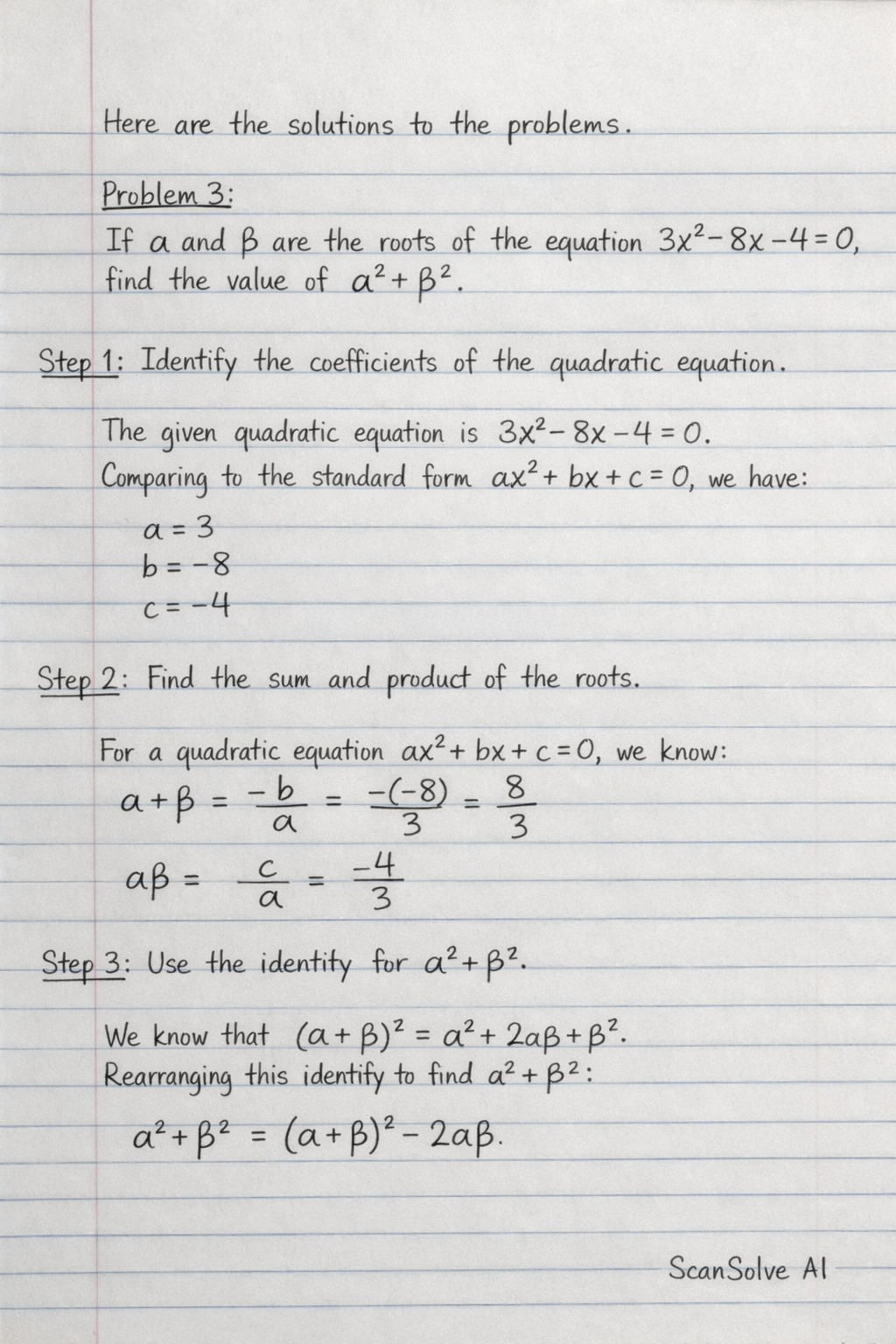
If alpha and beta are the roots of the equation 3x2 − 8x − 4 = 0, find the value of alpha2 + beta2.

Mathematics

ScanSolve AI Answer

Step-by-step solution

9 steps

Here are the solutions to the problems.

:
If α\alpha and β\beta are the roots of the equation 3x2−8x−4=03x^2 - 8x - 4 = 0, find the value of α2+β2\alpha^2 + \beta^2.

  1. Identify the coefficients of the quadratic equation.

    The given quadratic equation is 3x2−8x−4=03x^2 - 8x - 4 = 0.
    Comparing this to the standard form ax2+bx+c=0ax^2 + bx + c = 0, we have:
    a=3a = 3
    b=−8b = -8
    c=−4c = -4

  2. Find the sum and product of the roots.

    For a quadratic equation ax2+bx+c=0ax^2 + bx + c = 0, the sum of the roots (α+β\alpha + \beta) and the product of the roots (αβ\alpha\beta) are given by:

    α+β=−ba=−−83=83\alpha + \beta = -\frac{b}{a} = -\frac{-8}{3} = \frac{8}{3} αβ=ca=−43\alpha\beta = \frac{c}{a} = \frac{-4}{3}
  3. Use the identity for α2+β2\alpha^2 + \beta^2.

    We know that (α+β)2=α2+2αβ+β2(\alpha + \beta)^2 = \alpha^2 + 2\alpha\beta + \beta^2.
    Rearranging this identity to find α2+β2\alpha^2 + \beta^2:

    α2+β2=(α+β)2−2αβ\alpha^2 + \beta^2 = (\alpha + \beta)^2 - 2\alpha\beta
  4. Substitute the values of the sum and product of roots into the identity.

    α2+β2=(83)2−2(−43)\alpha^2 + \beta^2 = \left(\frac{8}{3}\right)^2 - 2\left(\frac{-4}{3}\right) α2+β2=649−(−83)\alpha^2 + \beta^2 = \frac{64}{9} - \left(-\frac{8}{3}\right) α2+β2=649+83\alpha^2 + \beta^2 = \frac{64}{9} + \frac{8}{3}
  5. Add the fractions to find the final value.

    To add the fractions, find a common denominator, which is 9.

    α2+β2=649+8×33×3\alpha^2 + \beta^2 = \frac{64}{9} + \frac{8 \times 3}{3 \times 3} α2+β2=649+249\alpha^2 + \beta^2 = \frac{64}{9} + \frac{24}{9} α2+β2=64+249\alpha^2 + \beta^2 = \frac{64 + 24}{9} α2+β2=889\alpha^2 + \beta^2 = \frac{88}{9}

    The final answer is 889\boxed{\frac{88}{9}}.


    :
    Find the coefficient of x11x^{11} in the expression of (x2+1x)10(x^2 + \frac{1}{x})^{10}.

  6. Write the general term of the binomial expansion.

    The binomial theorem states that the general term Tr+1T_{r+1} in the expansion of (a+b)n(a+b)^n is given by:

    Tr+1=(nr)an−rbrT_{r+1} = \binom{n}{r} a^{n-r} b^r

    In this expression, a=x2a = x^2, b=1x=x−1b = \frac{1}{x} = x^{-1}, and n=10n = 10.
    Substitute these values into the general term formula:

    Tr+1=(10r)(x2)10−r(x−1)rT_{r+1} = \binom{10}{r} (x^2)^{10-r} (x^{-1})^r
  7. Simplify the powers of xx.

    Tr+1=(10r)x2(10−r)x−rT_{r+1} = \binom{10}{r} x^{2(10-r)} x^{-r} Tr+1=(10r)x20−2rx−rT_{r+1} = \binom{10}{r} x^{20-2r} x^{-r}

    Combine the terms with xx:

    Tr+1=(10r)x20−2r−rT_{r+1} = \binom{10}{r} x^{20-2r-r} Tr+1=(10r)x20−3rT_{r+1} = \binom{10}{r} x^{20-3r}
  8. Set the exponent of xx equal to 11 to find rr.

    We are looking for the coefficient of x11x^{11}, so we set the exponent 20−3r20-3r equal to 11:

    20−3r=1120 - 3r = 11 3r=20−113r = 20 - 11 3r=93r = 9 r=3r = 3
  9. Calculate the binomial coefficient for r=3r=3.

    The coefficient of x11x^{11} is (10r)\binom{10}{r} when r=3r=3.

    Coefficient=(103)\text{Coefficient} = \binom{10}{3} (103)=10!3!(10−3)!=10!3!7!\binom{10}{3} = \frac{10!}{3!(10-3)!} = \frac{10!}{3!7!} (103)=10×9×8×7!3×2×1×7!\binom{10}{3} = \frac{10 \times 9 \times 8 \times 7!}{3 \times 2 \times 1 \times 7!} (103)=10×9×83×2×1\binom{10}{3} = \frac{10 \times 9 \times 8}{3 \times 2 \times 1} (103)=7206\binom{10}{3} = \frac{720}{6} (103)=120\binom{10}{3} = 120

    The final answer is 120\boxed{120}.

Was this helpful?

Still stuck on this one?

Ask a follow-up, and the answer starts from this question.

Got a different question?Ask your own question
Handwritten step-by-step solution preview

Handwritten Step-by-Step Solution

Get this as a handwritten image on WhatsApp — like a tutor wrote it for you.

Try on WhatsApp