We read your photo as:

If cos theta = -5/13 where 180° < theta < 360°, determine, without using a calculator, the value of: 1.1 sin² theta 1.2 tan(360° - theta) 1.3 cos(theta - 135°)

Mathematics

ScanSolve AI Answer

Answers

3 parts
1.1

144169\frac{144}{169}

1.2

−125-\frac{12}{5}

1.3

−7226-\frac{7\sqrt{2}}{26}

tan⁡(2x)\tan(2x)

1

Step-by-step solution

7 steps

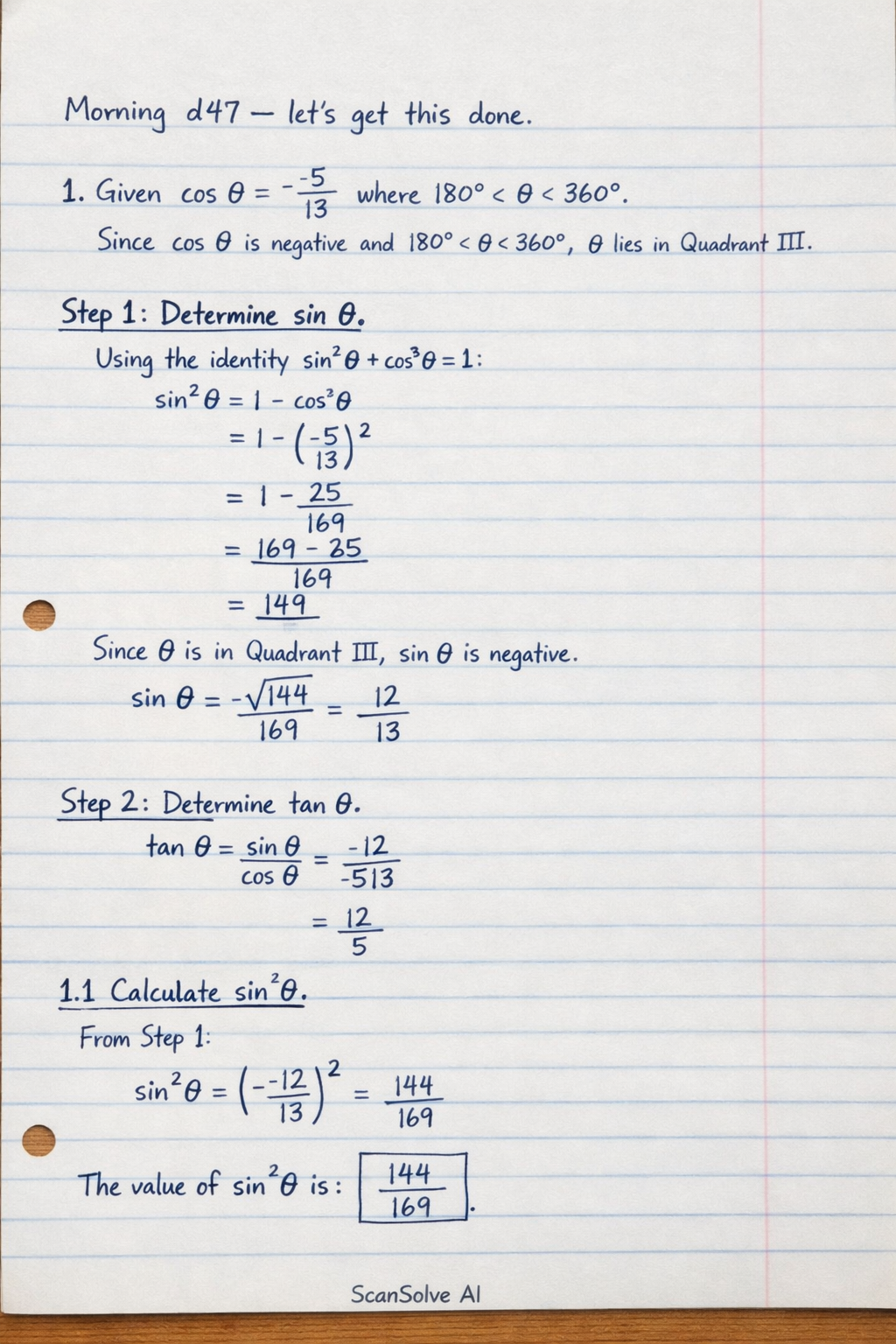
1. Given cos⁡θ=−513\cos \theta = -\frac{5}{13} where 180∘<θ<360∘180^\circ < \theta < 360^\circ.
Since cos⁡θ\cos \theta is negative and 180∘<θ<360∘180^\circ < \theta < 360^\circ, θ\theta lies in Quadrant III.

Step 1: Determine sin⁡θ\sin \theta.
Using the identity sin⁡2θ+cos⁡2θ=1\sin^2 \theta + \cos^2 \theta = 1:

sin⁡2θ=1−cos⁡2θ=1−(−513)2=1−25169=169−25169=144169\sin^2 \theta = 1 - \cos^2 \theta = 1 - \left(-\frac{5}{13}\right)^2 = 1 - \frac{25}{169} = \frac{169 - 25}{169} = \frac{144}{169}

Since θ\theta is in Quadrant III, sin⁡θ\sin \theta is negative.

sin⁡θ=−144169=−1213\sin \theta = -\sqrt{\frac{144}{169}} = -\frac{12}{13}

Step 2: Determine tan⁡θ\tan \theta.

tan⁡θ=sin⁡θcos⁡θ=−12/13−5/13=125\tan \theta = \frac{\sin \theta}{\cos \theta} = \frac{-12/13}{-5/13} = \frac{12}{5}

Part 1.1

Calculate sin⁡2θ\sin^2 \theta.

From Step 1:

sin⁡2θ=(−1213)2=144169\sin^2 \theta = \left(-\frac{12}{13}\right)^2 = \frac{144}{169}

The value of sin⁡2θ\sin^2 \theta is 144169\boxed{\frac{144}{169}}.

Part 1.2

−125-\frac{12}{5}

Calculate tan⁡(360∘−θ)\tan(360^\circ - \theta).

Using the reduction formula tan⁡(360∘−θ)=−tan⁡θ\tan(360^\circ - \theta) = -\tan \theta:

tan⁡(360∘−θ)=−(125)=−125\tan(360^\circ - \theta) = -\left(\frac{12}{5}\right) = -\frac{12}{5}

The value of tan⁡(360∘−θ)\tan(360^\circ - \theta) is −125\boxed{-\frac{12}{5}}.

Part 1.3

−7226-\frac{7\sqrt{2}}{26}

Calculate cos⁡(θ−135∘)\cos(\theta - 135^\circ).

Using the compound angle formula cos⁡(A−B)=cos⁡Acos⁡B+sin⁡Asin⁡B\cos(A - B) = \cos A \cos B + \sin A \sin B:

cos⁡(θ−135∘)=cos⁡θcos⁡135∘+sin⁡θsin⁡135∘\cos(\theta - 135^\circ) = \cos \theta \cos 135^\circ + \sin \theta \sin 135^\circ

We know cos⁡135∘=cos⁡(180∘−45∘)=−cos⁡45∘=−22\cos 135^\circ = \cos(180^\circ - 45^\circ) = -\cos 45^\circ = -\frac{\sqrt{2}}{2}.
And sin⁡135∘=sin⁡(180∘−45∘)=sin⁡45∘=22\sin 135^\circ = \sin(180^\circ - 45^\circ) = \sin 45^\circ = \frac{\sqrt{2}}{2}.
Substitute the values of cos⁡θ\cos \theta, sin⁡θ\sin \theta, cos⁡135∘\cos 135^\circ, and sin⁡135∘\sin 135^\circ:

cos⁡(θ−135∘)=(−513)(−22)+(−1213)(22)\cos(\theta - 135^\circ) = \left(-\frac{5}{13}\right)\left(-\frac{\sqrt{2}}{2}\right) + \left(-\frac{12}{13}\right)\left(\frac{\sqrt{2}}{2}\right) cos⁡(θ−135∘)=5226−12226=52−12226=−7226\cos(\theta - 135^\circ) = \frac{5\sqrt{2}}{26} - \frac{12\sqrt{2}}{26} = \frac{5\sqrt{2} - 12\sqrt{2}}{26} = \frac{-7\sqrt{2}}{26}

The value of cos⁡(θ−135∘)\cos(\theta - 135^\circ) is −7226\boxed{-\frac{7\sqrt{2}}{26}}.

2. Simplify the expression 2cos⁡(180∘−x)sin⁡(−x)1−2cos⁡2(90∘−x)\frac{2 \cos(180^\circ - x) \sin(-x)}{1 - 2 \cos^2(90^\circ - x)} to a single trigonometric term.

  1. Simplify the numerator.

    Using reduction formulas: cos⁡(180∘−x)=−cos⁡x\cos(180^\circ - x) = -\cos x and sin⁡(−x)=−sin⁡x\sin(-x) = -\sin x.

    2cos⁡(180∘−x)sin⁡(−x)=2(−cos⁡x)(−sin⁡x)=2sin⁡xcos⁡x2 \cos(180^\circ - x) \sin(-x) = 2(-\cos x)(-\sin x) = 2 \sin x \cos x

    This is the double angle identity for sine: 2sin⁡xcos⁡x=sin⁡(2x)2 \sin x \cos x = \sin(2x).

  2. Simplify the denominator.

    Using the cofunction identity: cos⁡(90∘−x)=sin⁡x\cos(90^\circ - x) = \sin x.

    1−2cos⁡2(90∘−x)=1−2(sin⁡x)2=1−2sin⁡2x1 - 2 \cos^2(90^\circ - x) = 1 - 2 (\sin x)^2 = 1 - 2 \sin^2 x

    This is the double angle identity for cosine: 1−2sin⁡2x=cos⁡(2x)1 - 2 \sin^2 x = \cos(2x).

  3. Combine the simplified numerator and denominator.

    2cos⁡(180∘−x)sin⁡(−x)1−2cos⁡2(90∘−x)=sin⁡(2x)cos⁡(2x)=tan⁡(2x)\frac{2 \cos(180^\circ - x) \sin(-x)}{1 - 2 \cos^2(90^\circ - x)} = \frac{\sin(2x)}{\cos(2x)} = \tan(2x)

    The simplified expression is tan⁡(2x)\boxed{\tan(2x)}.

    3. Calculate the value of the expression (tan⁡92∘)(tan⁡94∘)(tan⁡96∘)…(tan⁡176∘)(tan⁡178∘)(\tan 92^\circ)(\tan 94^\circ)(\tan 96^\circ) \dots (\tan 176^\circ)(\tan 178^\circ).

  4. Determine the number of terms and simplify each term.

    The angles are 92∘,94∘,…,178∘92^\circ, 94^\circ, \dots, 178^\circ. This is an arithmetic progression with a common difference of 2∘2^\circ.
    The number of terms nn is found by 178=92+(n−1)2178 = 92 + (n-1)2, which gives 86=(n−1)286 = (n-1)2, so 43=n−143 = n-1, and n=44n=44.
    Each term can be written using the reduction formula tan⁡(90∘+α)=−cot⁡α\tan(90^\circ + \alpha) = -\cot \alpha:
    tan⁡92∘=tan⁡(90∘+2∘)=−cot⁡2∘\tan 92^\circ = \tan(90^\circ + 2^\circ) = -\cot 2^\circ
    tan⁡94∘=tan⁡(90∘+4∘)=−cot⁡4∘\tan 94^\circ = \tan(90^\circ + 4^\circ) = -\cot 4^\circ
    ...
    tan⁡178∘=tan⁡(90∘+88∘)=−cot⁡88∘\tan 178^\circ = \tan(90^\circ + 88^\circ) = -\cot 88^\circ

  5. Rewrite the product.

    The product is (−cot⁡2∘)(−cot⁡4∘)…(−cot⁡88∘)(-\cot 2^\circ)(-\cot 4^\circ) \dots (-\cot 88^\circ).
    Since there are 44 terms (an even number), the product of the negative signs is positive.

    P=(cot⁡2∘)(cot⁡4∘)…(cot⁡88∘)P = (\cot 2^\circ)(\cot 4^\circ) \dots (\cot 88^\circ)
  6. Pair the terms using the identity cot⁡α=tan⁡(90∘−α)\cot \alpha = \tan(90^\circ - \alpha).

    We can pair terms such that their product is 1: cot⁡α⋅cot⁡(90∘−α)=cot⁡α⋅tan⁡α=1\cot \alpha \cdot \cot(90^\circ - \alpha) = \cot \alpha \cdot \tan \alpha = 1.
    The terms in the product are cot⁡2∘,cot⁡4∘,…,cot⁡44∘,cot⁡46∘,…,cot⁡88∘\cot 2^\circ, \cot 4^\circ, \dots, \cot 44^\circ, \cot 46^\circ, \dots, \cot 88^\circ.
    We form pairs:
    (cot⁡2∘⋅cot⁡88∘)=(cot⁡2∘⋅tan⁡2∘)=1(\cot 2^\circ \cdot \cot 88^\circ) = (\cot 2^\circ \cdot \tan 2^\circ) = 1
    (cot⁡4∘⋅cot⁡86∘)=(cot⁡4∘⋅tan⁡4∘)=1(\cot 4^\circ \cdot \cot 86^\circ) = (\cot 4^\circ \cdot \tan 4^\circ) = 1
    ...
    The last pair will be (cot⁡44∘⋅cot⁡46∘)=(cot⁡44∘⋅tan⁡44∘)=1(\cot 44^\circ \cdot \cot 46^\circ) = (\cot 44^\circ \cdot \tan 44^\circ) = 1.
    There are 44/2=2244/2 = 22 such pairs.

  7. Calculate the final product.

    Since each pair multiplies to 1, the entire product is 1221^{22}.

    P=122=1P = 1^{22} = 1

    The value of the expression is 1\boxed{1}.

Was this helpful?

Try one yourself

A new problem that tests the same skill.

Still stuck on this one?

Ask a follow-up, and the answer starts from this question.

Got a different question?Ask your own question
Handwritten step-by-step solution preview

Handwritten Step-by-Step Solution

Get this as a handwritten image on WhatsApp — like a tutor wrote it for you.

Try on WhatsApp