
We read your photo as:
If events A and B are independent, P(A) = 0.4, and P(B) = 0.5, what is P(A^c intersect B^c)?
Mathematics
ScanSolve AI Answer
Answer
Step-by-step solution
5 stepsIdentify the given information.
We are given that events and are independent.
We are given the probabilities:
Calculate the probabilities of the complements of events and .
The probability of the complement of an event , denoted , is .
For event :For event :
Use the property of independent events.
If events and are independent, then their complements and are also independent.
For independent events and , the probability of their intersection is .
Therefore, for and :Substitute the calculated values and find the result.
Compare the result with the given options.
The calculated value 0.3 matches option B.
Was this helpful?
Try one yourself
A new problem that tests the same skill.
Still stuck on this one?
Ask a follow-up, and the answer starts from this question.
Got a different question?Ask your own question
More Mathematics Questions
QGiven P(A) = 0.4, P(B) = 0.6, and P(A U B) = 0.8, calculate P(A^c | B) and P(A U B | A).QGiven P(A) = 1/2, P(B^c) = 5/6, and P(A U B) = 5/12, find P(A intersect B).QIf P(A)=0.4 and P(B)=0.3 and A and B are independent events, then P(A and B) isQGiven P(A) = 0.8 and P(A intersect B) = 0.7, find P(B') under different conditions for A and B.
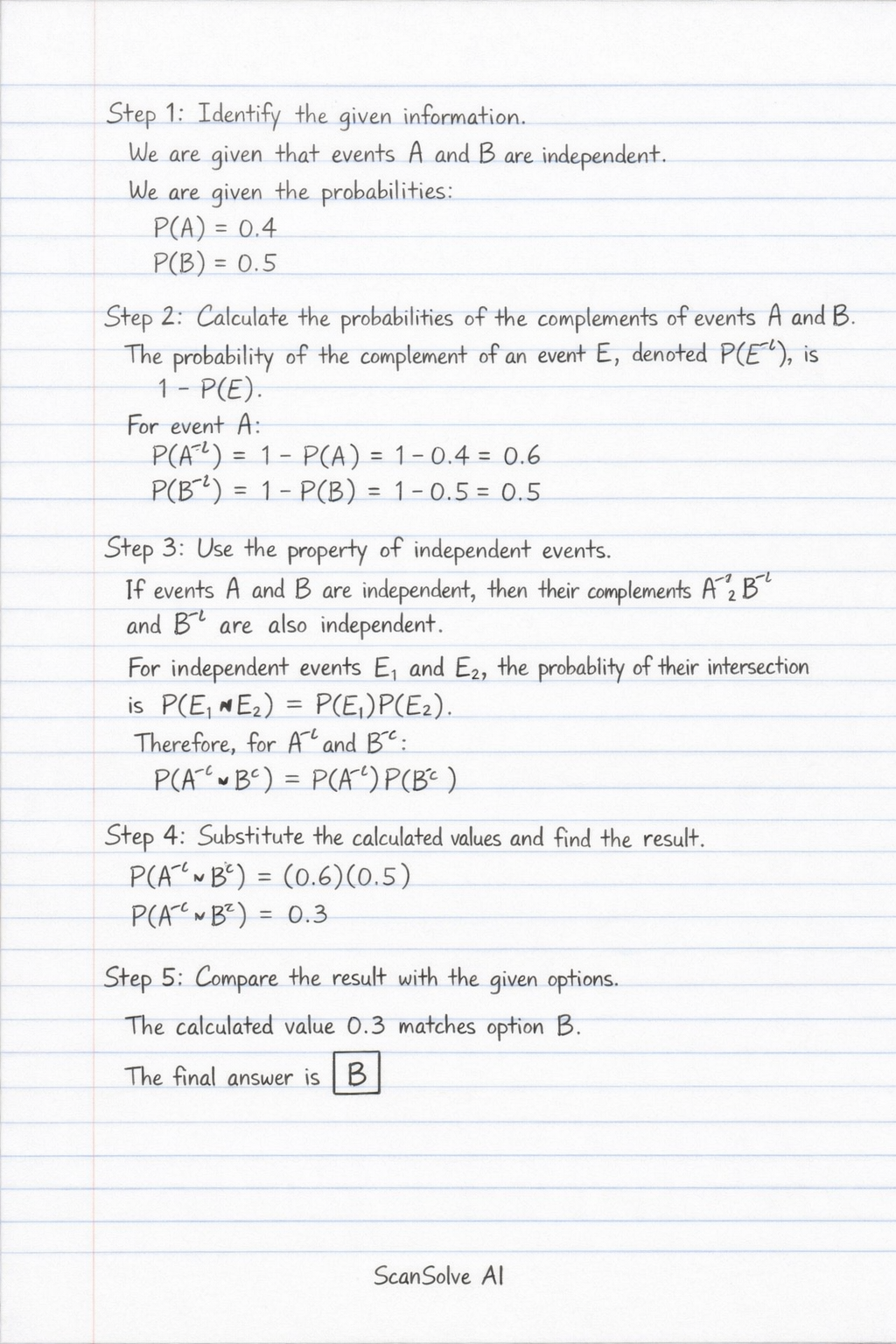
Handwritten Step-by-Step Solution
Get this as a handwritten image on WhatsApp — like a tutor wrote it for you.
Try on WhatsApp