
We read your photo as:
If f(x) = x², then find f' from the first principle. 2. Complete the following statement. Derivative of sum is of derivative and derivative of difference is of derivative. 3. If y = xn, then find dy/dx. 4. If e−2x+y = 3xy, then find dy/dx.
ScanSolve AI Answer
Step-by-step solution
9 stepsHere are the solutions to the problems.
1. If , then find from the first principle.
Apply the definition of the derivative from the first principle.
Substitute and .
Expand and simplify the numerator.
Factor out from the numerator and cancel it with the denominator.
Evaluate the limit as .
2. Complete the following statement. Derivative of sum is ______ of derivative and derivative of difference is ______ of derivative.
Recall the linearity properties of derivatives.
The derivative of a sum of functions is the sum of their derivatives. The derivative of a difference of functions is the difference of their derivatives.
Derivative of sum is sum of derivative and derivative of difference is difference of derivative.3. If , then find .
Apply the power rule for differentiation.
Given .
4. If , then find .
Differentiate both sides of the equation with respect to implicitly.
Using the chain rule for the left side and the product rule for the right side:
Equating the derivatives, the given line in the problem is:
Expand the left side and rearrange the equation to isolate terms with .
Factor out and solve for it.
Still stuck on this one?
Ask a follow-up, and the answer starts from this question.
More Mathematics Questions
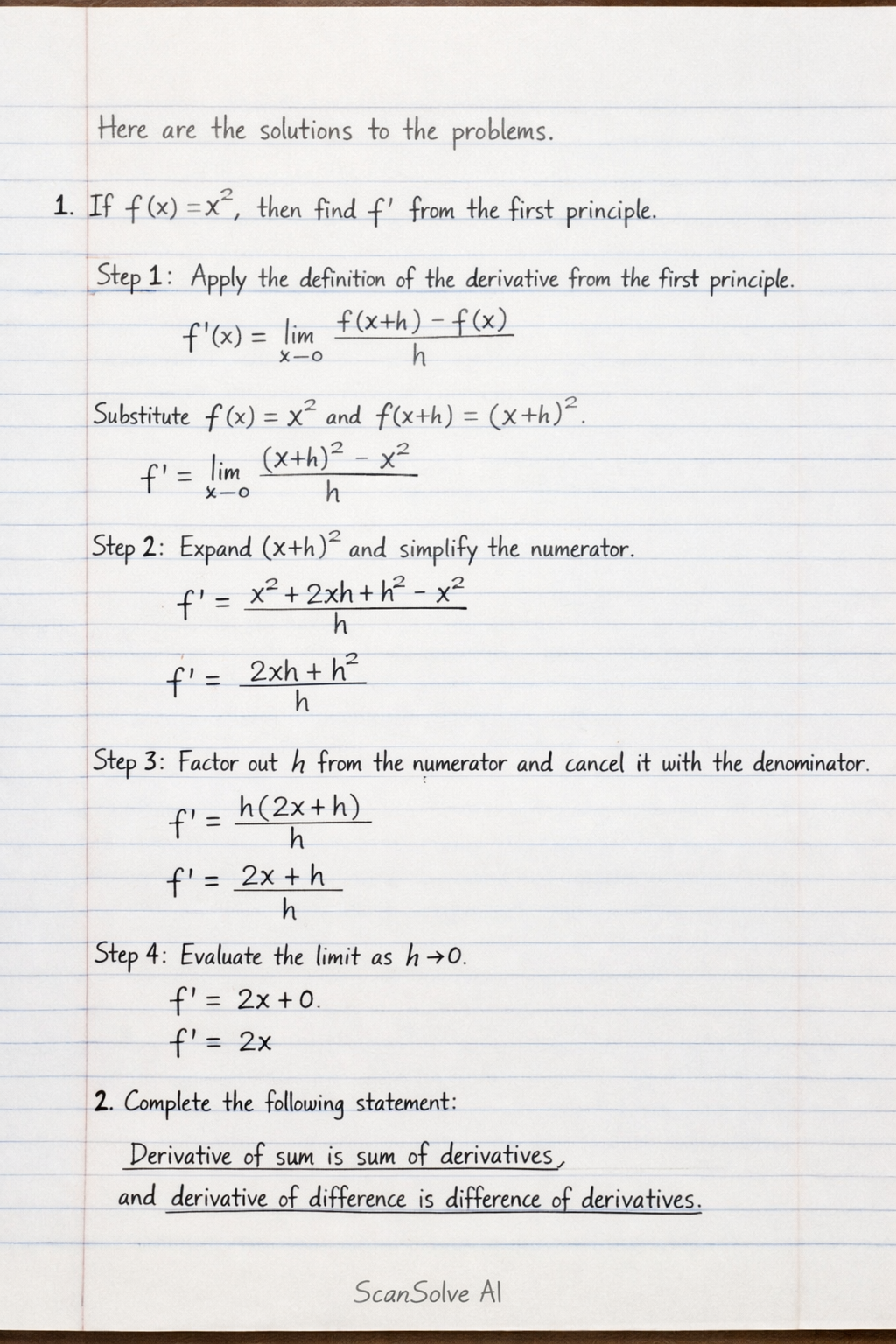
Handwritten Step-by-Step Solution
Get this as a handwritten image on WhatsApp — like a tutor wrote it for you.
Try on WhatsApp