
We read your photo as:
If m = (tb2)/xy + t, express t in terms of m, b, x and y.
ScanSolve AI Answer
Answer
Step-by-step solution
4 stepsTo calculate for the given quadratic equation , we first find the sum and product of the roots.
Identify the coefficients of the quadratic equation.
For a quadratic equation , we have:
Calculate the sum of the roots ().
The sum of the roots is given by the formula .
Calculate the product of the roots ().
The product of the roots is given by the formula .
Simplify the expression and substitute the values.
To add the fractions, find a common denominator:
Now, substitute the values found in Step 2 and Step 3:
The calculated value is . Comparing this with the given options, it matches option A.
The final answer is .
Try one yourself
A new problem that tests the same skill.
Still stuck on this one?
Ask a follow-up, and the answer starts from this question.
More Mathematics Questions
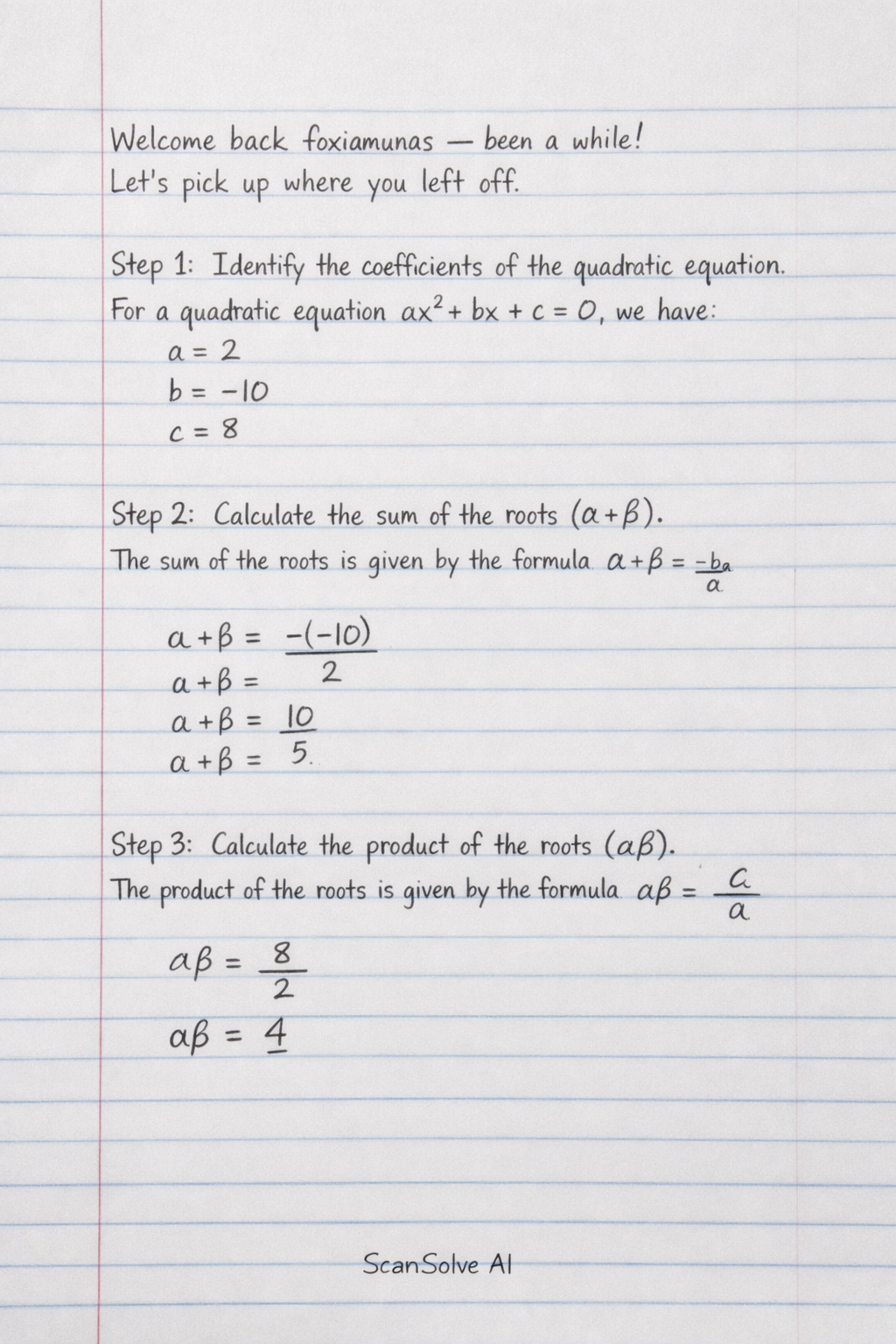
Handwritten Step-by-Step Solution
Get this as a handwritten image on WhatsApp — like a tutor wrote it for you.
Try on WhatsApp