
We read your photo as:
Solve the system of equations: xy = 1 and t2 x − y = t3 − (1)/(t) for x in terms of t.
ScanSolve AI Answer
Step-by-step solution
7 stepsExpress in terms of from the first equation.
Given the equation , we can write as:
This assumes .
Substitute the expression for into the second equation.
The second equation is .
Substitute :This assumes .
Eliminate the denominators by multiplying by .
Multiply both sides of the equation by :
Rearrange the equation into a quadratic form in terms of .
Move all terms to one side to form a quadratic equation :
Solve the quadratic equation for using the quadratic formula.
The quadratic formula is .
Here, , , and .Recognize that :
Calculate the two possible values for .
For the positive root:
For the negative root:
Find the corresponding values for using .
For :
For :
The solutions for the system of equations are:
Still stuck on this one?
Ask a follow-up, and the answer starts from this question.
More Mathematics Questions
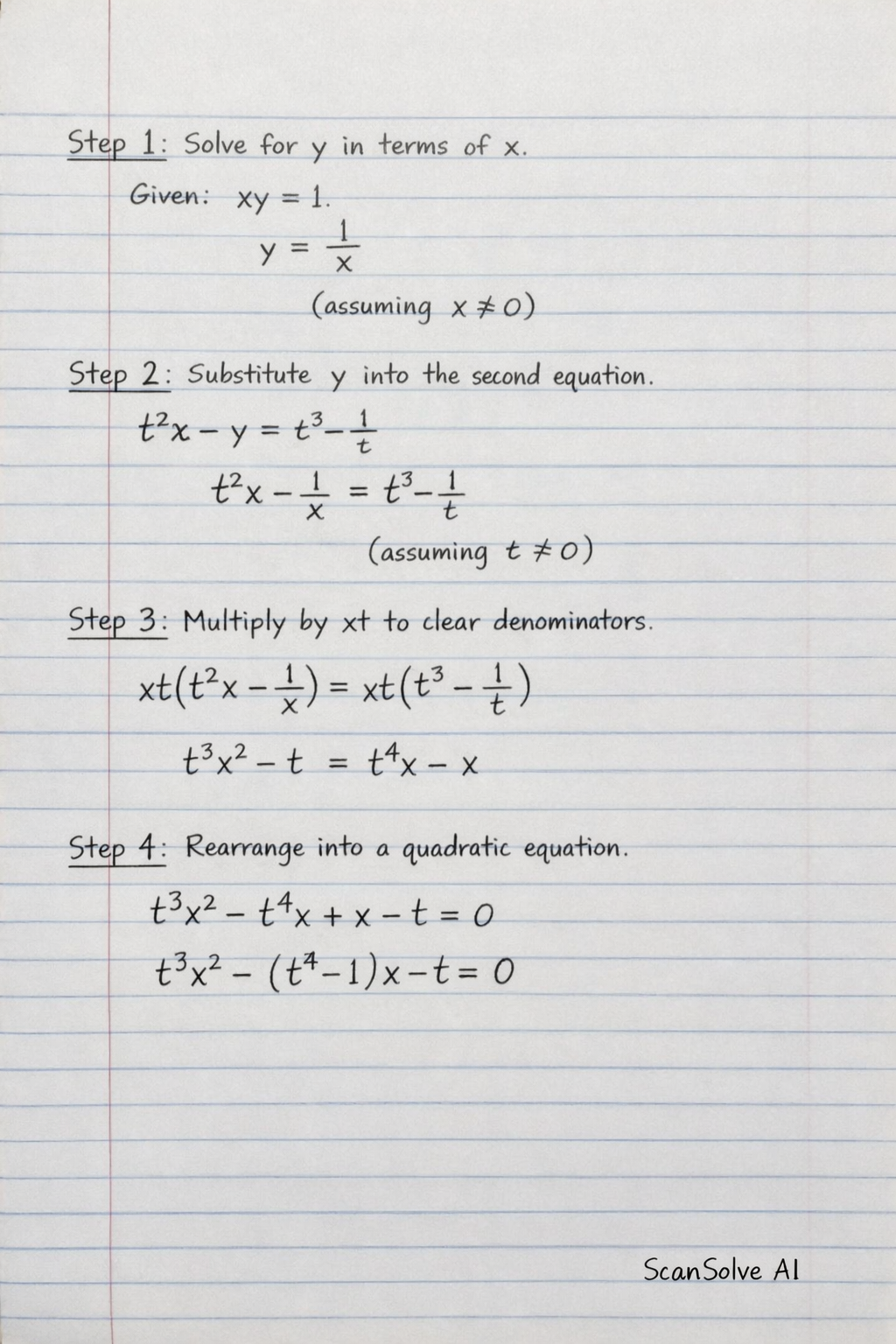
Handwritten Step-by-Step Solution
Get this as a handwritten image on WhatsApp — like a tutor wrote it for you.
Try on WhatsApp