

This mathematics problem involves applying core mathematical principles and formulas. Below you will find a complete step-by-step solution with detailed explanations for each step, helping you understand not just the answer but the method behind it.
ScanSolve AI Answer
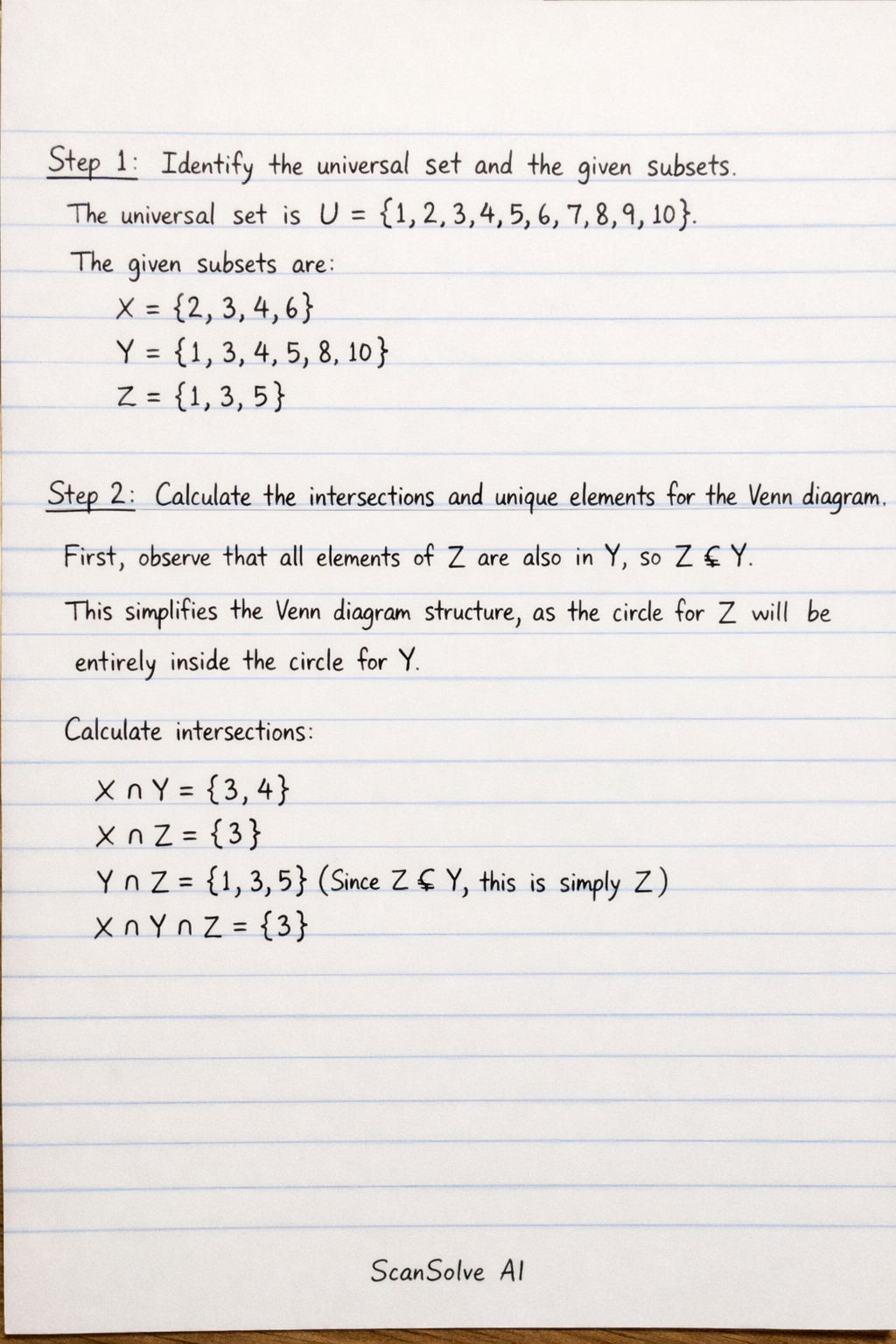
Step 1: Identify the universal set and the given subsets. The universal set is U = \1, 2, 3, 4, 5, 6, 7, 8, 9, 10\. The given subsets are: X = \2, 3, 4, 6\ Y = \1, 3, 4, 5, 8, 10\ Z = \1, 3, 5\ Step 2: Calculate the intersections and unique elements for the Venn diagram. First, observe that all elements of Z are also in Y, so Z is a subset of Y (Z Y). This simplifies the Venn diagram structure, as the circle for Z will be entirely inside the circle for Y. Calculate intersections: X Y = \3, 4\ X Z = \3\ Y Z = \1, 3, 5\ (Since Z Y, this is simply Z) X Y Z = \3\ Calculate elements for each distinct region: • Elements in X Y Z: \3\ • Elements in X Y but not in Z: (X Y) Z = \3, 4\ \1, 3, 5\ = \4\ • Elements in Y Z but not in X: (Y Z) X = \1, 3, 5\ \2, 3, 4, 6\ = \1, 5\ • Elements in X only: X (Y Z) = \2, 3, 4, 6\ (\1, 3, 4, 5, 8, 10\ \1, 3, 5\) = \2, 3, 4, 6\ \1, 3, 4, 5, 8, 10\ = \2, 6\ • Elements in Y only (outside X and Z): Y (X Z) = \1, 3, 4, 5, 8, 10\ (\2, 3, 4, 6\ \1, 3, 5\) = \1, 3, 4, 5, 8, 10\ \1, 2, 3, 4, 5, 6\ = \8, 10\ • Elements in Z only: Z (X Y) = (as Z Y, and all elements are accounted for in X Y Z or (Y Z) X) • Elements outside X Y Z: U (X Y Z) = \1, ..., 10\ (\1, 2, 3, 4, 5, 6, 8, 10\) = \7, 9\ Step 3: Illustrate the information on a Venn diagram (part a). A Venn diagram would show three overlapping circles for X, Y, and Z. The circle for Z would be drawn entirely inside the circle for Y. The elements are placed in the corresponding regions: • The region common to X, Y, and Z (i.e., X Z): \3\ • The region common to X and Y but outside Z: \4\ • The region common to Y and Z but outside X: \1, 5\ • The region for X only: \2, 6\ • The region for Y only (outside X and Z): \8, 10\ • The region outside all three sets: \7, 9\ Step 4: Find X' Y (part b, i). First, find the complement of X, denoted X'. X' = U X = \1, 2, 3, 4, 5, 6, 7, 8, 9, 10\ \2, 3, 4, 6\ = \1, 5, 7, 8, 9, 10\ Now, find the intersection of X' and Y: X' Y = \1, 5, 7, 8, 9, 10\ \1, 3, 4, 5, 8, 10\ X' Y = \1, 5, 8, 10\ Step 5: Find Z' (X Y) (part b, ii). First, find the complement of Z, denoted Z'. Z' = U Z = \1, 2, 3, 4, 5, 6, 7, 8, 9, 10\ \1, 3, 5\ = \2, 4, 6, 7, 8, 9, 10\ Next, find the intersection of X and Y: X Y = \2, 3, 4, 6\ \1, 3, 4, 5, 8, 10\ = \3, 4\ Finally, find the union of Z' and (X Y): Z' (X Y) = \2, 4, 6, 7, 8, 9, 10\ \3, 4\ Z' (X Y) = \2, 3, 4, 6, 7, 8, 9, 10\ Send me the next one 📸