
We read your photo as:
Determine if the fraction is proper or improper.
ScanSolve AI Answer
Answer
Step-by-step solution
4 stepsTo resolve the given expression into partial fractions, we first check if it is a proper or improper fraction.
Determine if the fraction is proper or improper.
The given fraction is .
The degree of the numerator () is 2.
The degree of the denominator () is 2.
Since the degree of the numerator is equal to the degree of the denominator, the fraction is improper. We must perform polynomial long division first.Perform polynomial long division.
Divide by .
We can write this as:
Comparing the coefficients of :
Substitute back into the equation:
Subtract from both sides:
Comparing the coefficients of :
Comparing the constant terms:
So, the division gives a quotient of and a remainder of .
Therefore, we can write the expression as:To simplify the remainder term, multiply the numerator and denominator by 2:
Check if the denominator of the remainder term can be factored.
The denominator of the proper fraction part is .
We calculate the discriminant for this quadratic.
Here, , , .Since the discriminant , the quadratic has no real roots and is irreducible over the real numbers.
State the partial fraction decomposition.
Since the denominator is an irreducible quadratic factor, the term is already in its simplest partial fraction form.
Thus, the partial fraction decomposition is:
Try one yourself
A new problem that tests the same skill.
Still stuck on this one?
Ask a follow-up, and the answer starts from this question.
More Mathematics Questions
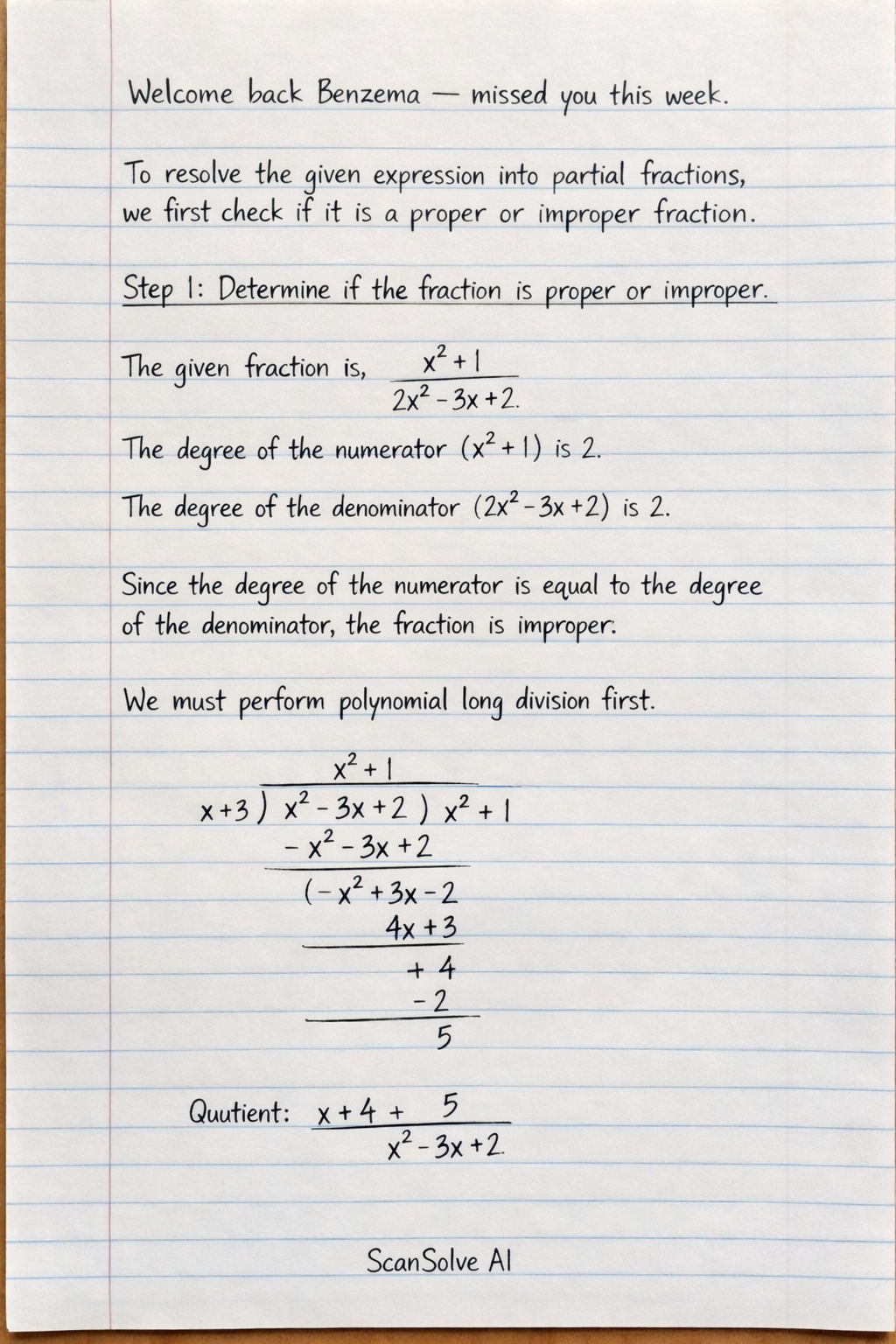
Handwritten Step-by-Step Solution
Get this as a handwritten image on WhatsApp — like a tutor wrote it for you.
Try on WhatsApp