
We read your photo as:
Determine if the relation R = (1,1), (1,2), (1,3), (2,1), (2,2), (2,3), (3,3), (4,1) on the set A = 1, 2, 3, 4 is reflexive, symmetric, or transitive.
ScanSolve AI Answer
Step-by-step solution
5 stepsCheck for Reflexivity.
A relation on a set is reflexive if for every element , the pair is in .
The set is . For to be reflexive, it must contain .
Given .
We observe that is not in .
Therefore, is not reflexive.Check for Symmetry.
A relation on a set is symmetric if for every pair , the pair is also in .
Let's check the pairs in :- , and . This part is symmetric.
- . For to be symmetric, must also be in . However, is not in . Therefore, is not symmetric.
Check for Transitivity.
A relation on a set is transitive if for every , if and , then must also be in .
Let's check for a counterexample:- Consider and . For to be transitive, must be in . However, is not in . Therefore, is not transitive.
Conclude the properties of .
Based on the checks, the relation is not reflexive, not symmetric, and not transitive.
Select the correct option.
Comparing our findings with the given options:
(A) is not reflexive but symmetric - Incorrect (not symmetric)
(B) is reflexive but not transitive - Incorrect (not reflexive)
(C) is neither reflexive, nor symmetric, nor transitive - Correct
(D) Equivalence Relation - Incorrect (an equivalence relation must be reflexive, symmetric, and transitive)The final answer is
Still stuck on this one?
Ask a follow-up, and the answer starts from this question.
More Mathematics Questions
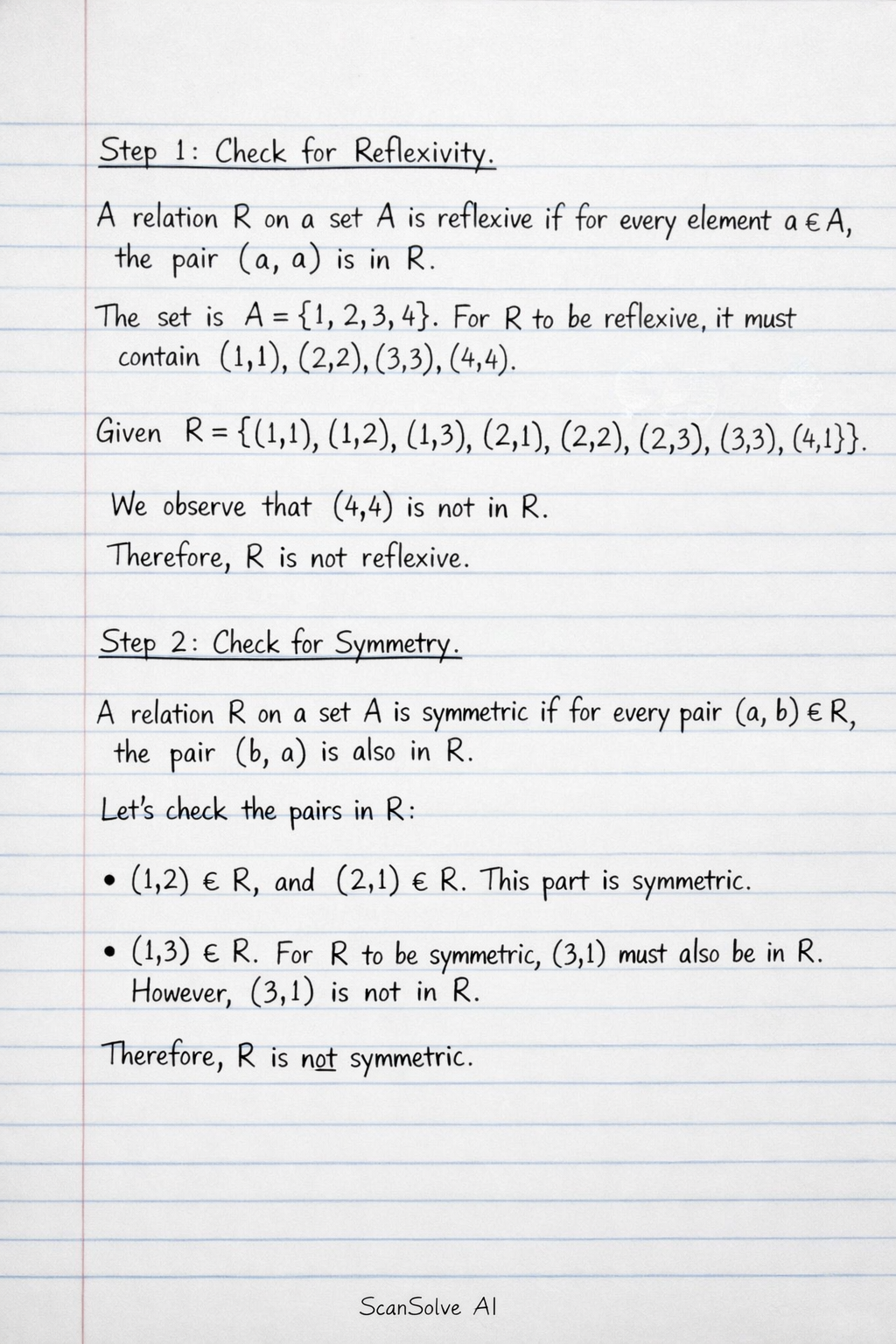
Handwritten Step-by-Step Solution
Get this as a handwritten image on WhatsApp — like a tutor wrote it for you.
Try on WhatsApp