We read your photo as:

Determine if the transformation T(x,y) = (2x, 2y) from R2 to R2 is linear.

Mathematics

ScanSolve AI Answer

Answer

linear\text{linear}

Step-by-step solution

2 steps

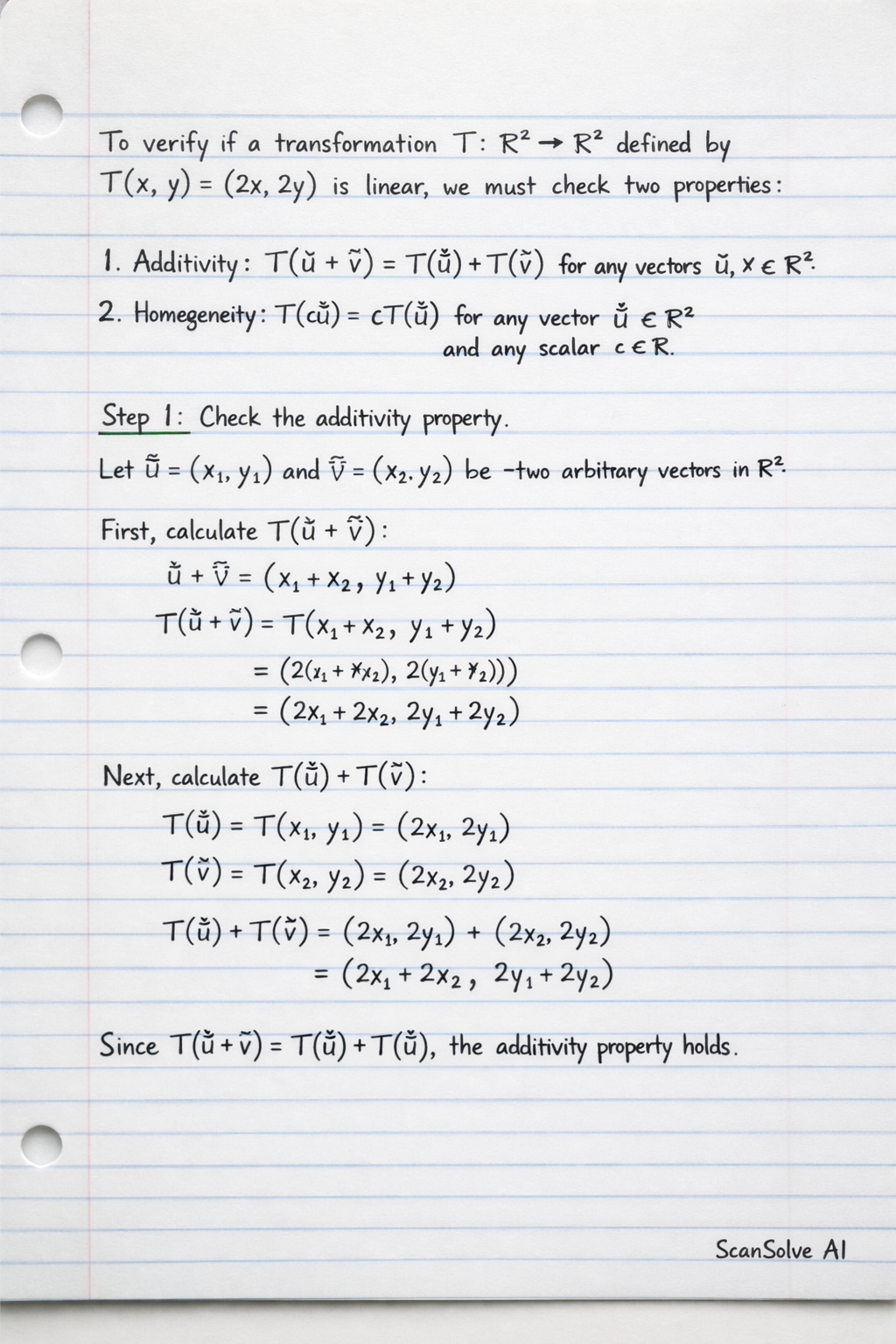
To verify if a transformation T:R2→R2T: \mathbb{R}^2 \to \mathbb{R}^2 defined by T(x,y)=(2x,2y)T(x,y) = (2x, 2y) is linear, we must check two properties:

  1. Additivity: T(u⃗+v⃗)=T(u⃗)+T(v⃗)T(\vec{u} + \vec{v}) = T(\vec{u}) + T(\vec{v}) for any vectors u⃗,v⃗∈R2\vec{u}, \vec{v} \in \mathbb{R}^2.
  2. Homogeneity: T(cu⃗)=cT(u⃗)T(c\vec{u}) = cT(\vec{u}) for any vector u⃗∈R2\vec{u} \in \mathbb{R}^2 and any scalar c∈Rc \in \mathbb{R}.
  1. Check the additivity property.

    Let u⃗=(x1,y1)\vec{u} = (x_1, y_1) and v⃗=(x2,y2)\vec{v} = (x_2, y_2) be two arbitrary vectors in R2\mathbb{R}^2.
    First, calculate T(u⃗+v⃗)T(\vec{u} + \vec{v}):

    u⃗+v⃗=(x1+x2,y1+y2)\vec{u} + \vec{v} = (x_1 + x_2, y_1 + y_2) T(u⃗+v⃗)=T(x1+x2,y1+y2)=(2(x1+x2),2(y1+y2))=(2x1+2x2,2y1+2y2)T(\vec{u} + \vec{v}) = T(x_1 + x_2, y_1 + y_2) = (2(x_1 + x_2), 2(y_1 + y_2)) = (2x_1 + 2x_2, 2y_1 + 2y_2)

    Next, calculate T(u⃗)+T(v⃗)T(\vec{u}) + T(\vec{v}):

    T(u⃗)=T(x1,y1)=(2x1,2y1)T(\vec{u}) = T(x_1, y_1) = (2x_1, 2y_1) T(v⃗)=T(x2,y2)=(2x2,2y2)T(\vec{v}) = T(x_2, y_2) = (2x_2, 2y_2) T(u⃗)+T(v⃗)=(2x1,2y1)+(2x2,2y2)=(2x1+2x2,2y1+2y2)T(\vec{u}) + T(\vec{v}) = (2x_1, 2y_1) + (2x_2, 2y_2) = (2x_1 + 2x_2, 2y_1 + 2y_2)

    Since T(u⃗+v⃗)=T(u⃗)+T(v⃗)T(\vec{u} + \vec{v}) = T(\vec{u}) + T(\vec{v}), the additivity property holds.

  2. Check the homogeneity property.

    Let u⃗=(x,y)\vec{u} = (x, y) be an arbitrary vector in R2\mathbb{R}^2 and cc be an arbitrary scalar.
    First, calculate T(cu⃗)T(c\vec{u}):

    cu⃗=(cx,cy)c\vec{u} = (cx, cy) T(cu⃗)=T(cx,cy)=(2(cx),2(cy))=(2cx,2cy)T(c\vec{u}) = T(cx, cy) = (2(cx), 2(cy)) = (2cx, 2cy)

    Next, calculate cT(u⃗)cT(\vec{u}):

    T(u⃗)=T(x,y)=(2x,2y)T(\vec{u}) = T(x, y) = (2x, 2y) cT(u⃗)=c(2x,2y)=(c⋅2x,c⋅2y)=(2cx,2cy)cT(\vec{u}) = c(2x, 2y) = (c \cdot 2x, c \cdot 2y) = (2cx, 2cy)

    Since T(cu⃗)=cT(u⃗)T(c\vec{u}) = cT(\vec{u}), the homogeneity property holds.

    Since both the additivity and homogeneity properties are satisfied, the transformation TT is linear.

    The transformation T(x,y)=(2x,2y)T(x,y) = (2x, 2y) is indeed linear\boxed{\text{linear}}.

Was this helpful?

Try one yourself

A new problem that tests the same skill.

Still stuck on this one?

Ask a follow-up, and the answer starts from this question.

Got a different question?Ask your own question
Handwritten step-by-step solution preview

Handwritten Step-by-Step Solution

Get this as a handwritten image on WhatsApp — like a tutor wrote it for you.

Try on WhatsApp