

This mathematics problem involves applying core mathematical principles and formulas. Below you will find a complete step-by-step solution with detailed explanations for each step, helping you understand not just the answer but the method behind it.
ScanSolve AI Answer
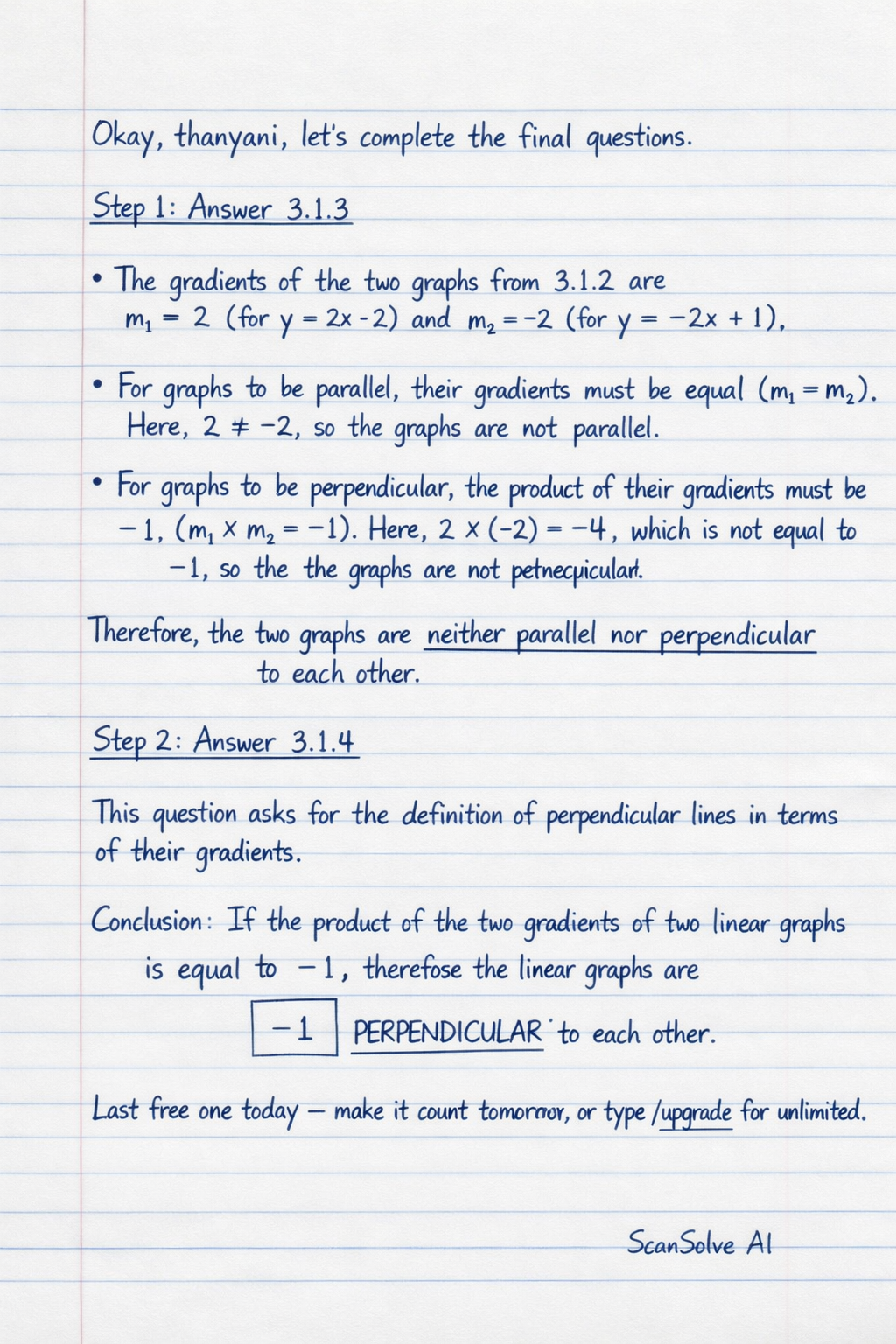
Okay, thanyani, let's complete the final questions. Step 1: Answer 3.1.3 The gradients of the two graphs from 3.1.2 are m_1 = 2 (for y = 2x - 2) and m_2 = -2 (for y = -2x + 1). • For graphs to be parallel, their gradients must be equal (m_1 = m_2). Here, 2 ≠ -2, so the graphs are not parallel. • For graphs to be perpendicular, the product of their gradients must be -1 (m_1 × m_2 = -1). Here, 2 × (-2) = -4, which is not equal to -1, so the graphs are not perpendicular. Therefore, the two graphs are neither parallel nor perpendicular to each other. Step 2: Answer 3.1.4 This question asks for the definition of perpendicular lines in terms of their gradients. Conclusion: If the product of the two gradients of two linear graphs is equal to -1, therefore the linear graphs are perpendicular to each other. Last free one today — make it count tomorrow, or type /upgrade for unlimited.