We read your photo as:

In a class of 65 students, 2 were absent. 28 had sculpture books, 30 graphics, and 32 leather work books. 11 had sculpture and graphics, 12 sculpture and leather, 9 graphics and leather. Find (a) stud

Mathematics

ScanSolve AI Answer

Answers

3 parts
a

5\text{5}

b

17\text{17}

c

41\text{41}

Step-by-step solution

3 steps

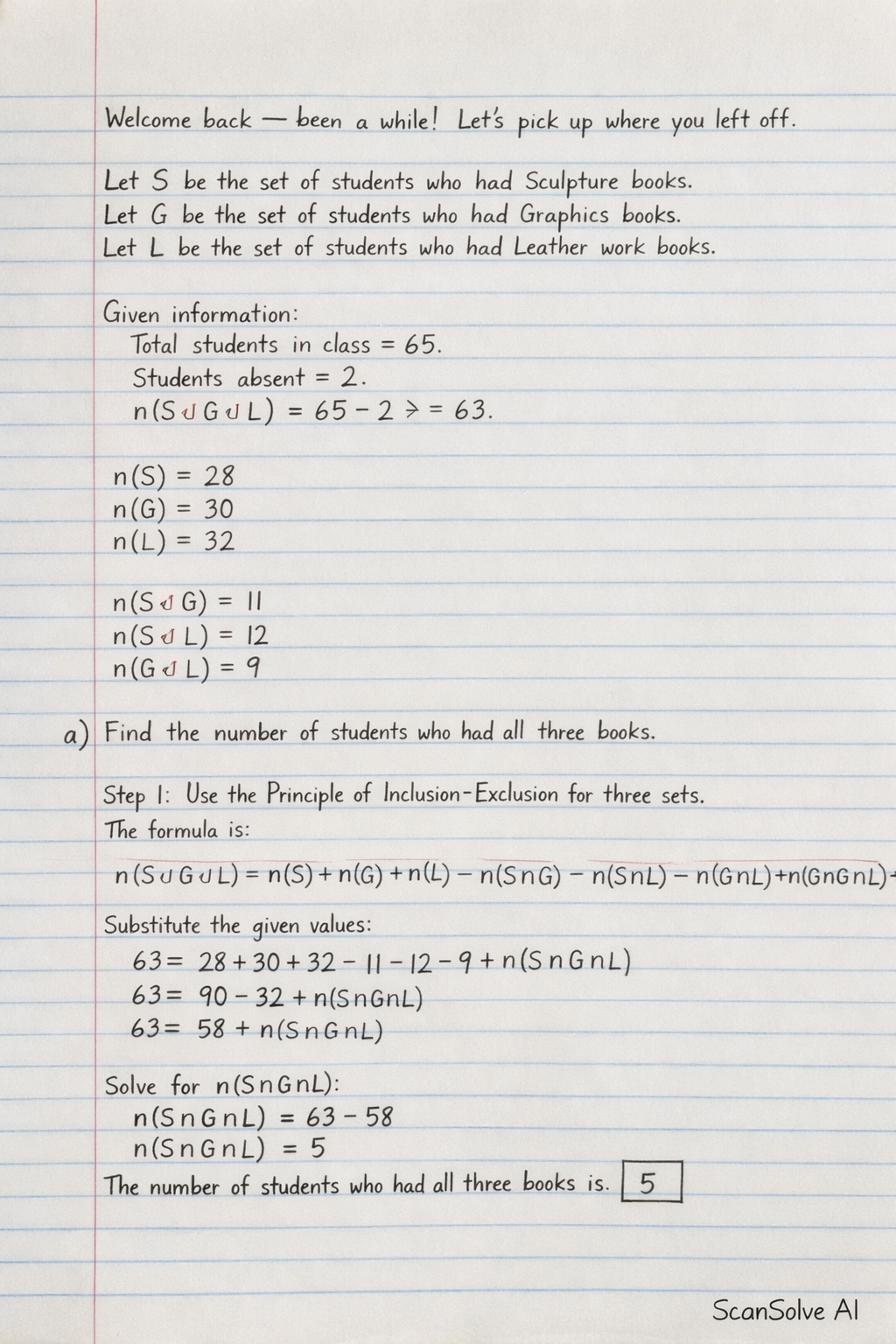
Let SS be the set of students who had Sculpture books.
Let GG be the set of students who had Graphics books.
Let LL be the set of students who had Leather work books.

Given information:
Total students in class = 65
Students absent = 2
Number of students who had at least one book, n(S∪G∪L)=65−2=63n(S \cup G \cup L) = 65 - 2 = 63.

n(S)=28n(S) = 28
n(G)=30n(G) = 30
n(L)=32n(L) = 32

n(S∩G)=11n(S \cap G) = 11
n(S∩L)=12n(S \cap L) = 12
n(G∩L)=9n(G \cap L) = 9

Part a· 1 step

Find the number of students who had all three books.

  1. Use the Principle of Inclusion-Exclusion for three sets.

    The formula is:

    n(S∪G∪L)=n(S)+n(G)+n(L)−n(S∩G)−n(S∩L)−n(G∩L)+n(S∩G∩L)n(S \cup G \cup L) = n(S) + n(G) + n(L) - n(S \cap G) - n(S \cap L) - n(G \cap L) + n(S \cap G \cap L)

    Substitute the given values:

    63=28+30+32−11−12−9+n(S∩G∩L)63 = 28 + 30 + 32 - 11 - 12 - 9 + n(S \cap G \cap L) 63=90−32+n(S∩G∩L)63 = 90 - 32 + n(S \cap G \cap L) 63=58+n(S∩G∩L)63 = 58 + n(S \cap G \cap L)

    Solve for n(S∩G∩L)n(S \cap G \cap L):

    n(S∩G∩L)=63−58n(S \cap G \cap L) = 63 - 58 n(S∩G∩L)=5n(S \cap G \cap L) = 5

    The number of students who had all three books is 5\boxed{\text{5}}.

Part b

17\text{17}

Find the number of students who had exactly two books.

  1. Calculate the number of students who had exactly two specific books.

    Number of students with Sculpture and Graphics books ONLY:

    n(S∩G only)=n(S∩G)−n(S∩G∩L)=11−5=6n(S \cap G \text{ only}) = n(S \cap G) - n(S \cap G \cap L) = 11 - 5 = 6

    Number of students with Sculpture and Leather books ONLY:

    n(S∩L only)=n(S∩L)−n(S∩G∩L)=12−5=7n(S \cap L \text{ only}) = n(S \cap L) - n(S \cap G \cap L) = 12 - 5 = 7

    Number of students with Graphics and Leather books ONLY:

    n(G∩L only)=n(G∩L)−n(S∩G∩L)=9−5=4n(G \cap L \text{ only}) = n(G \cap L) - n(S \cap G \cap L) = 9 - 5 = 4

    The number of students who had exactly two books is the sum of these values:

    6+7+4=176 + 7 + 4 = 17

    The number of students who had exactly two books is 17\boxed{\text{17}}.

Part c

41\text{41}

Find the number of students who had only one book.

  1. Calculate the number of students who had only one specific book.

    Number of students with Sculpture books ONLY:

    n(S only)=n(S)−n(S∩G only)−n(S∩L only)−n(S∩G∩L)n(S \text{ only}) = n(S) - n(S \cap G \text{ only}) - n(S \cap L \text{ only}) - n(S \cap G \cap L) n(S only)=28−6−7−5=28−18=10n(S \text{ only}) = 28 - 6 - 7 - 5 = 28 - 18 = 10

    Number of students with Graphics books ONLY:

    n(G only)=n(G)−n(S∩G only)−n(G∩L only)−n(S∩G∩L)n(G \text{ only}) = n(G) - n(S \cap G \text{ only}) - n(G \cap L \text{ only}) - n(S \cap G \cap L) n(G only)=30−6−4−5=30−15=15n(G \text{ only}) = 30 - 6 - 4 - 5 = 30 - 15 = 15

    Number of students with Leather books ONLY:

    n(L only)=n(L)−n(S∩L only)−n(G∩L only)−n(S∩G∩L)n(L \text{ only}) = n(L) - n(S \cap L \text{ only}) - n(G \cap L \text{ only}) - n(S \cap G \cap L) n(L only)=32−7−4−5=32−16=16n(L \text{ only}) = 32 - 7 - 4 - 5 = 32 - 16 = 16

    The number of students who had only one book is the sum of these values:

    10+15+16=4110 + 15 + 16 = 41

    The number of students who had only one book is 41\boxed{\text{41}}.

Was this helpful?

Try one yourself

A new problem that tests the same skill.

Still stuck on this one?

Ask a follow-up, and the answer starts from this question.

Got a different question?Ask your own question
Handwritten step-by-step solution preview

Handwritten Step-by-Step Solution

Get this as a handwritten image on WhatsApp — like a tutor wrote it for you.

Try on WhatsApp