
We read your photo as:
In a group of 62 students, 42 take Mathematics, 38 take Physics, and 40 take Chemistry. 20 take Math and Physics, 25 take Math and Chemistry, and 28 take Physics and Chemistry. 18 students take all th
ScanSolve AI Answer
Step-by-step solution
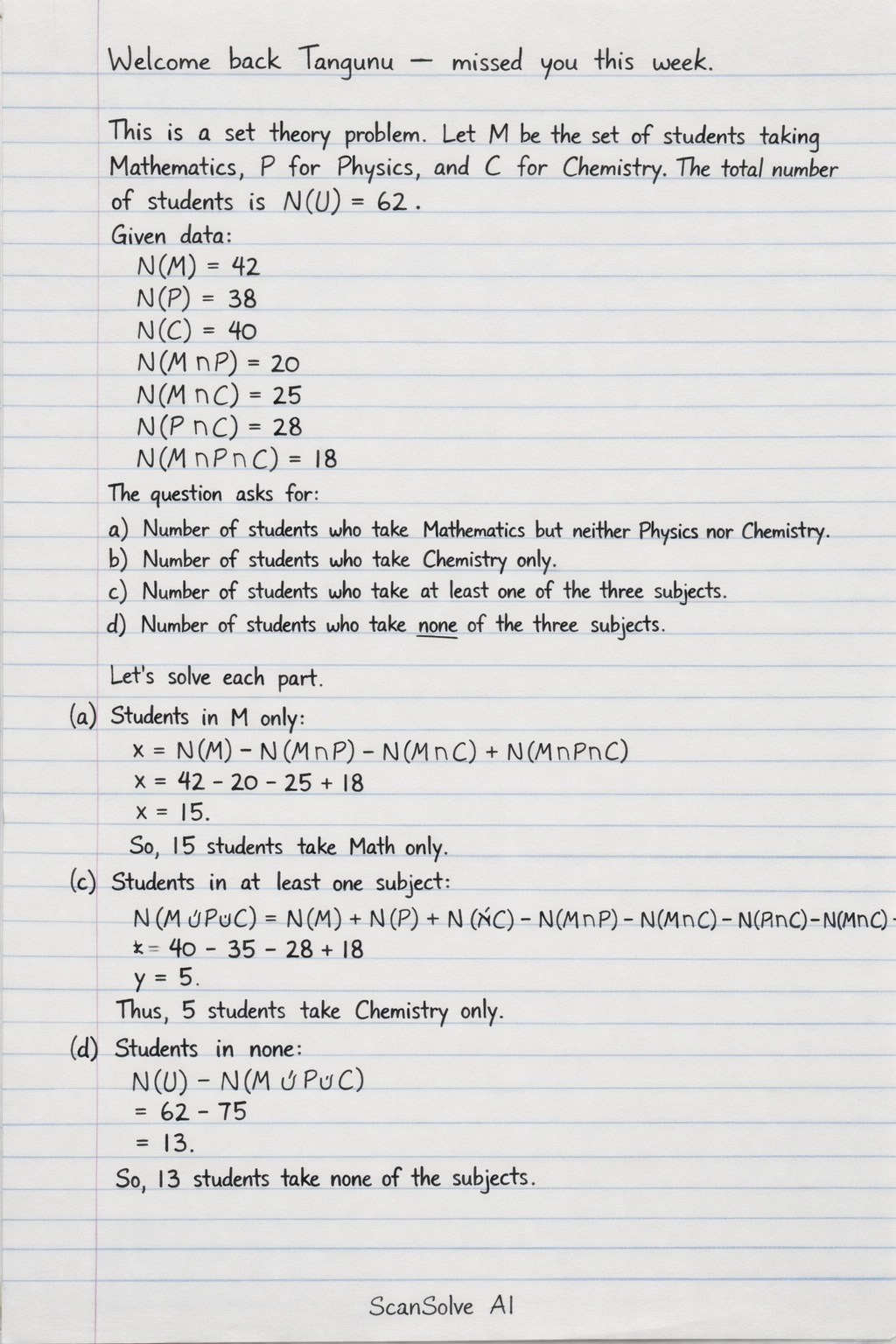
13 stepsThis is a set theory problem. Let be the set of students taking Mathematics, for Physics, and for Chemistry. The total number of students is .
Given data:
The question asks for:
a) Number of students who take Mathematics but neither Physics nor Chemistry.
b) Number of students who take Chemistry only.
c) Number of students who take at least one of the three subjects.
d) Number of students who take none of the three subjects.
Let's solve each part.
a) Number of students who take Mathematics but neither Physics nor Chemistry.
This is represented by .
Use the formula for .
Substitute the given values into the formula.
Calculate the result.
The number of students who take Mathematics but neither Physics nor Chemistry is 15.
b) Number of students who take Chemistry only.
This is represented by .Use the formula for .
Substitute the given values into the formula.
Calculate the result.
The number of students who take Chemistry only is 5.
c) Number of students who take at least one of the three subjects.
This is represented by .Use the Principle of Inclusion-Exclusion for three sets.
Substitute the given values into the formula.
Calculate the sum and subtractions.
Calculate the final result.
The number of students who take at least one of the three subjects is 65.
d) Number of students who take none of the three subjects.
This is represented by .Use the total number of students and the result from part (c).
Substitute the values.
Calculate the result.
This result indicates an inconsistency in the provided data, as the number of students taking none of the subjects cannot be negative. It implies that the sum of students taking at least one subject (65) is greater than the total number of students (62).
Let's re-check the calculations for part (c) to ensure accuracy.
The calculation for part (c) is correct based on the given numbers. The negative result in part (d) suggests that the problem statement contains inconsistent data. However, if we must provide an answer based on the given numbers, the calculation leads to -3. Since the number of students cannot be negative, this indicates an issue with the problem's input values.
Assuming the question expects a numerical answer based on the provided data, even if it leads to an impossible real-world scenario:
The number of students who take none of the three subjects is .
Still stuck on this one?
Ask a follow-up, and the answer starts from this question.
More Mathematics Questions
Handwritten Step-by-Step Solution
Get this as a handwritten image on WhatsApp — like a tutor wrote it for you.
Try on WhatsApp