

This mathematics problem involves applying core mathematical principles and formulas. Below you will find a complete step-by-step solution with detailed explanations for each step, helping you understand not just the answer but the method behind it.
ScanSolve AI Answer
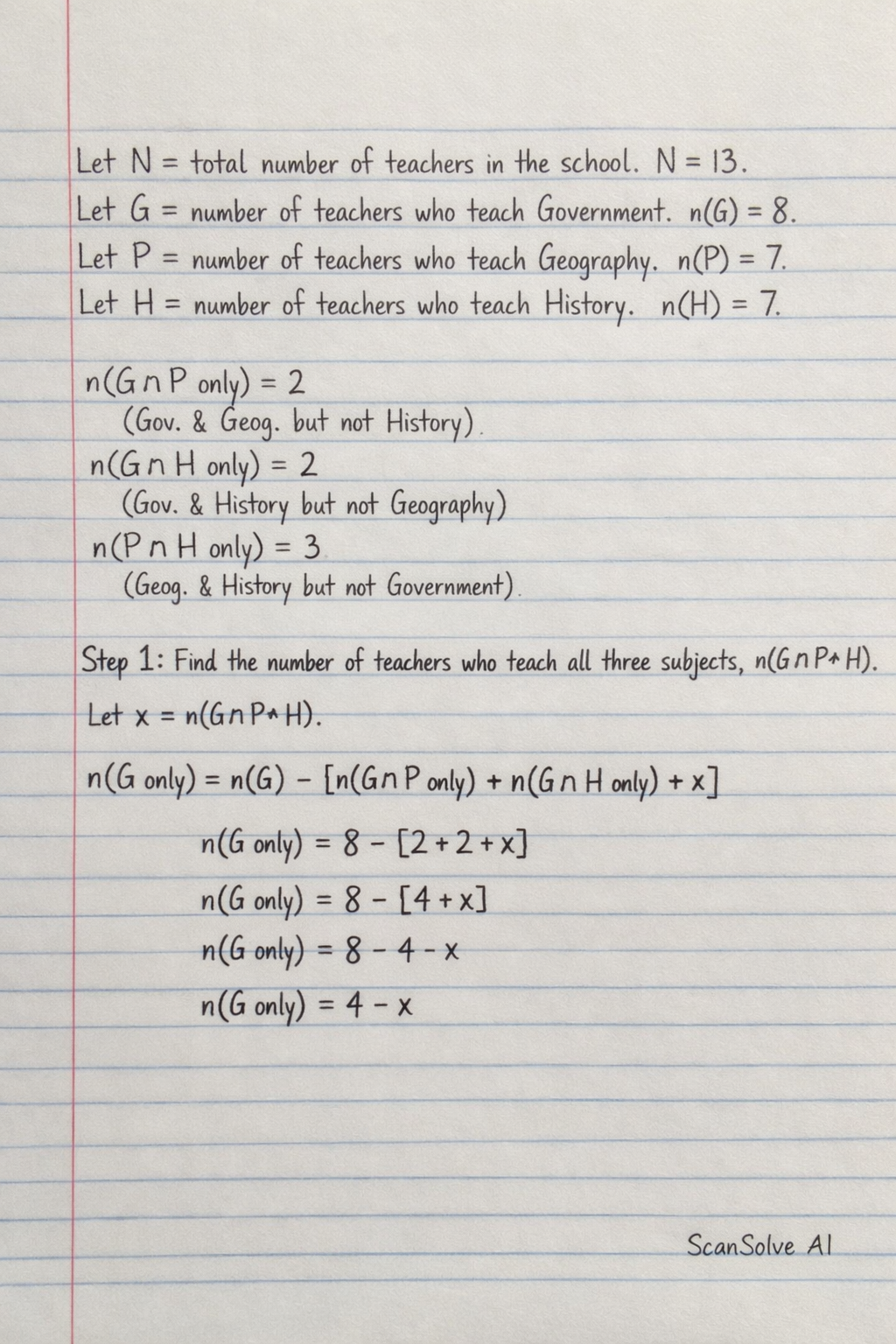
here's how to solve this problem involving sets and Venn diagrams: First, let's define the sets and the given information: Let N be the total number of teachers in the school. N = 13. Let G be the set of teachers who teach Government. n(G) = 8. Let P be the set of teachers who teach Geography. n(P) = 7. Let H be the set of teachers who teach History. n(H) = 7. We are given the following "only" intersections: n(G P only) = 2 (teachers who teach Government and Geography but not History) n(G H only) = 2 (teachers who teach Government and History but not Geography) n(P H only) = 3 (teachers who teach Geography and History but not Government) Step 1: Find the number of teachers who teach all three subjects, n(G P H). Let x = n(G P H). The number of teachers who teach only Government is n(G only) = n(G) - [n(G P only) + n(G H only) + x]. n(G only) = 8 - (2 + 2 + x) = 8 - (4 + x) = 4 - x. The number of teachers who teach only Geography is n(P only) = n(P) - [n(G P only) + n(P H only) + x]. n(P only) = 7 - (2 + 3 + x) = 7 - (5 + x) = 2 - x. The number of teachers who teach only History is n(H only) = n(H) - [n(G H only) + n(P H only) + x]. n(H only) = 7 - (2 + 3 + x) = 7 - (5 + x) = 2 - x. The sum of all disjoint regions must equal the total number of teachers, assuming all teachers teach at least one subject. n(G P H) = n(G only) + n(P only) + n(H only) + n(G P only) + n(G H only) + n(P H only) + n(G P H) 13 = (4 - x) + (2 - x) + (2 - x) + 2 + 2 + 3 + x 13 = 4 - x + 2 - x + 2 - x + 2 + 2 + 3 + x ✂️ _That answer was long and got cut off. Reply continue and I'll finish it._