

This mathematics problem involves applying core mathematical principles and formulas. Below you will find a complete step-by-step solution with detailed explanations for each step, helping you understand not just the answer but the method behind it.
ScanSolve AI Answer
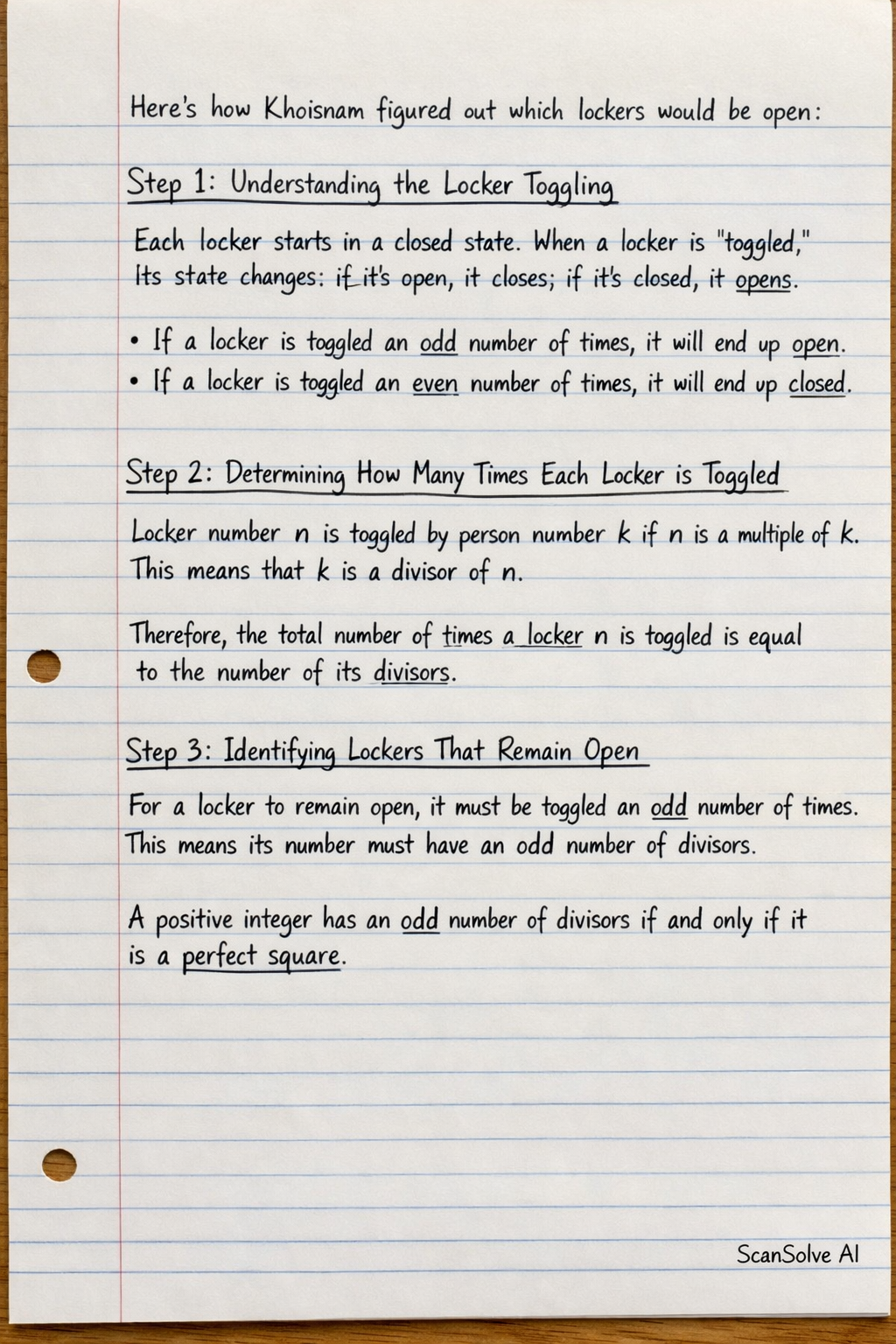
Here's how Khoisnam figured out which lockers would be open: Step 1: Understanding the Locker Toggling Each locker starts in a closed state. When a locker is "toggled," its state changes: if it's open, it closes; if it's closed, it opens. • If a locker is toggled an odd number of times, it will end up open. • If a locker is toggled an even number of times, it will end up closed. Step 2: Determining How Many Times Each Locker is Toggled Locker number n is toggled by person number k if n is a multiple of k. This means that k is a divisor of n. Therefore, the total number of times a locker n is toggled is equal to the number of its divisors. Step 3: Identifying Lockers That Remain Open For a locker to remain open, it must be toggled an odd number of times. This means its number must have an odd number of divisors. A positive integer has an odd number of divisors if and only if it is a perfect square. Step 4: Listing the Perfect Squares Khoisnam would have identified all the perfect squares between 1 and 100. These are the numbers of the lockers that will remain open: 1^2 = 1 2^2 = 4 3^2 = 9 4^2 = 16 5^2 = 25 6^2 = 36 7^2 = 49 8^2 = 64 9^2 = 81 10^2 = 100 Khoisnam figured out that the lockers corresponding to these perfect square numbers would be the ones to remain open. The lockers that will be open at the end are: 1, 4, 9, 16, 25, 36, 49, 64, 81, 100