
We read your photo as:
In a class of 120 students, 70 take Math, 65 take Physics, and 50 take Chemistry. 30 take Math and Physics, 25 take Math and Chemistry, 20 take Physics and Chemistry, and 10 take all three. How many s
ScanSolve AI Answer
Answers
3 partsStep-by-step solution
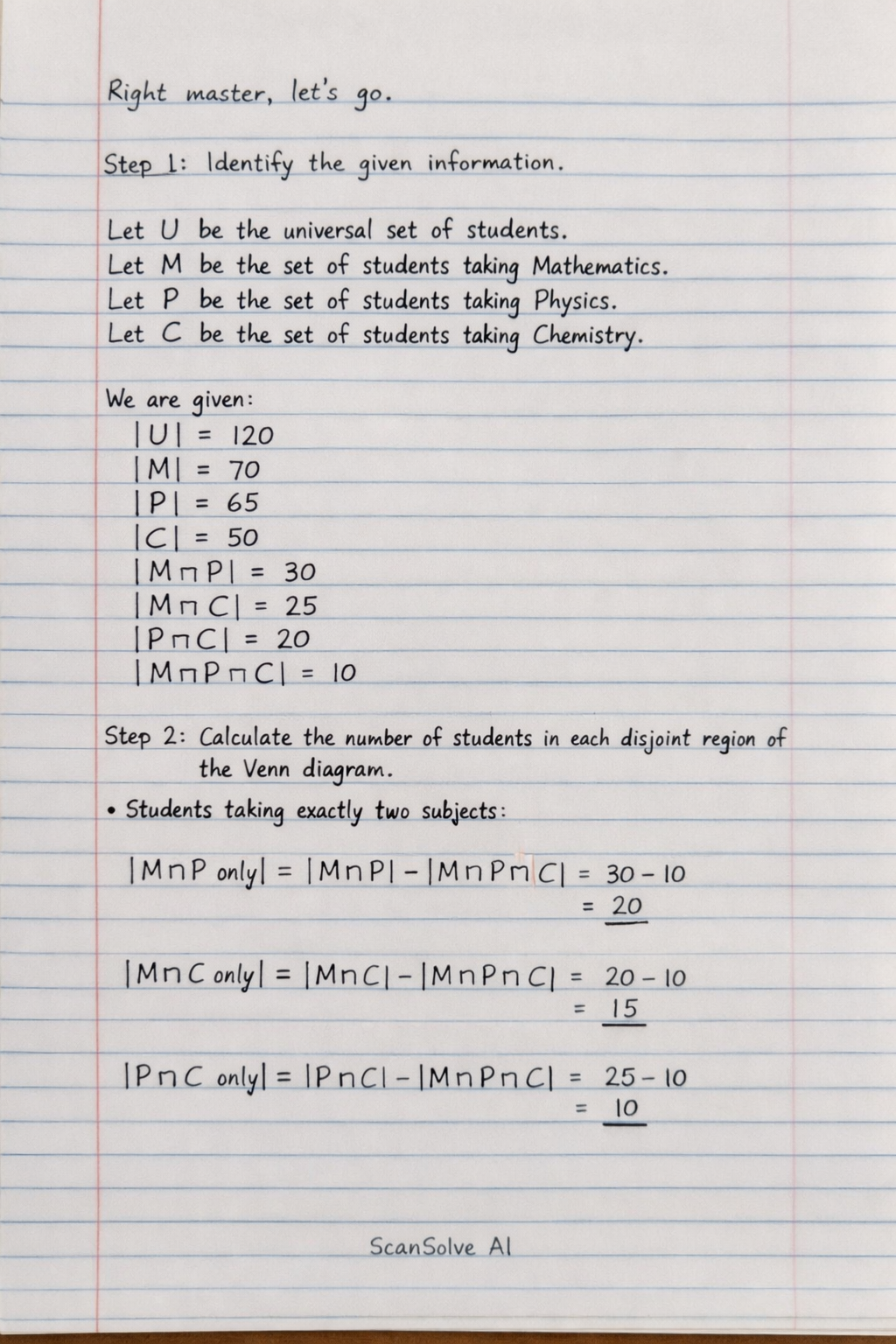
3 stepsStep 1: Identify the given information.
Let be the universal set of students.
Let be the set of students taking Mathematics.
Let be the set of students taking Physics.
Let be the set of students taking Chemistry.
We are given:
Total number of students,
Number of students taking Mathematics,
Number of students taking Physics,
Number of students taking Chemistry,
Number of students taking Mathematics and Physics,
Number of students taking Mathematics and Chemistry,
Number of students taking Physics and Chemistry,
Number of students taking all three subjects,
Step 2: Calculate the number of students in each disjoint region of the Venn diagram.
- Students taking exactly two subjects:
- Students taking exactly one subject:
Step 3: Answer part (a).
Part a· 1 step
How many students take only mathematics?
The number of students who take only Mathematics is .
The number of students who take only mathematics is .
Answer part (b).
Part b
How many take exactly two subjects?
The number of students who take exactly two subjects is the sum of those taking (M and P only), (M and C only), and (P and C only).
The number of students who take exactly two subjects is .
Answer part (c).
Part c
How many students take none of the three subjects?
First, calculate the total number of students taking at least one subject:
The number of students taking none of the three subjects is .
The number of students who take none of the three subjects is .
Answer part (d).
Part d
Draw a Venn diagram with all the information.
As an AI, I cannot physically draw a diagram. However, I can describe the Venn diagram by listing the number of students in each distinct region:
- Students taking only Mathematics: 25
- Students taking only Physics: 25
- Students taking only Chemistry: 15
- Students taking Mathematics and Physics only (not Chemistry): 20
- Students taking Mathematics and Chemistry only (not Physics): 15
- Students taking Physics and Chemistry only (not Mathematics): 10
- Students taking Mathematics, Physics, and Chemistry: 10
- Students taking none of the subjects: 0
Try one yourself
A new problem that tests the same skill.
Still stuck on this one?
Ask a follow-up, and the answer starts from this question.
More Mathematics Questions
Handwritten Step-by-Step Solution
Get this as a handwritten image on WhatsApp — like a tutor wrote it for you.
Try on WhatsApp