We read your photo as:

In an AP of 4, 6 1/2, 9, 11 1/2, ..., determine the number of terms needed to make a total of 126.

Mathematics

ScanSolve AI Answer

Answer

9

Step-by-step solution

4 steps

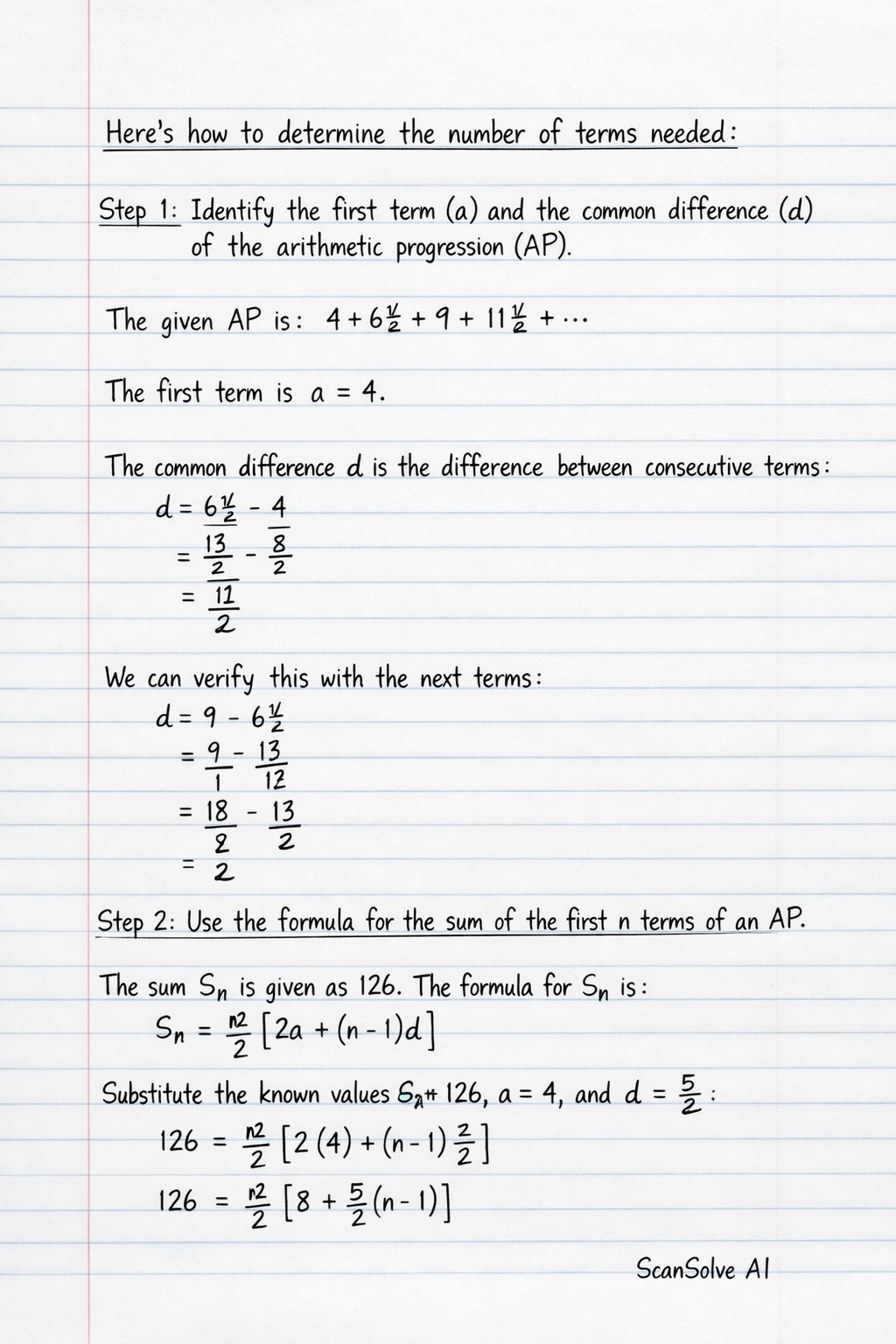
Here's how to determine the number of terms needed:

  1. Identify the first term (aa) and the common difference (dd) of the arithmetic progression (AP).

    The given AP is 4+612+9+1112+…4 + 6\frac{1}{2} + 9 + 11\frac{1}{2} + \dots
    The first term is a=4a = 4.
    The common difference dd is the difference between consecutive terms:

    d=612−4=132−82=52d = 6\frac{1}{2} - 4 = \frac{13}{2} - \frac{8}{2} = \frac{5}{2}

    We can verify this with the next terms:

    d=9−612=9−132=182−132=52d = 9 - 6\frac{1}{2} = 9 - \frac{13}{2} = \frac{18}{2} - \frac{13}{2} = \frac{5}{2}
  2. Use the formula for the sum of the first nn terms of an AP.

    The sum SnS_n is given as 126. The formula for SnS_n is:

    Sn=n2[2a+(n−1)d]S_n = \frac{n}{2}[2a + (n-1)d]

    Substitute the known values Sn=126S_n = 126, a=4a = 4, and d=52d = \frac{5}{2}:

    126=n2[2(4)+(n−1)52]126 = \frac{n}{2}\left[2(4) + (n-1)\frac{5}{2}\right] 126=n2[8+52(n−1)]126 = \frac{n}{2}\left[8 + \frac{5}{2}(n-1)\right]
  3. Simplify the equation and form a quadratic equation.

    Multiply both sides by 2:

    2×126=n[8+52(n−1)]2 \times 126 = n\left[8 + \frac{5}{2}(n-1)\right] 252=n[8+5n2−52]252 = n\left[8 + \frac{5n}{2} - \frac{5}{2}\right]

    Combine the constant terms inside the bracket:

    252=n[162+5n2−52]252 = n\left[\frac{16}{2} + \frac{5n}{2} - \frac{5}{2}\right] 252=n[11+5n2]252 = n\left[\frac{11 + 5n}{2}\right]

    Multiply both sides by 2 again:

    2×252=n(11+5n)2 \times 252 = n(11 + 5n) 504=11n+5n2504 = 11n + 5n^2

    Rearrange into the standard quadratic form An2+Bn+C=0An^2 + Bn + C = 0:

    5n2+11n−504=05n^2 + 11n - 504 = 0
  4. Solve the quadratic equation for nn.

    Using the quadratic formula n=−B±B2−4AC2An = \frac{-B \pm \sqrt{B^2 - 4AC}}{2A}:
    Here, A=5A=5, B=11B=11, C=−504C=-504.

    n=−11±112−4(5)(−504)2(5)n = \frac{-11 \pm \sqrt{11^2 - 4(5)(-504)}}{2(5)} n=−11±121+1008010n = \frac{-11 \pm \sqrt{121 + 10080}}{10} n=−11±1020110n = \frac{-11 \pm \sqrt{10201}}{10}

    Calculate the square root: 10201=101\sqrt{10201} = 101.

    n=−11±10110n = \frac{-11 \pm 101}{10}

    Two possible solutions for nn:

    n1=−11+10110=9010=9n_1 = \frac{-11 + 101}{10} = \frac{90}{10} = 9 n2=−11−10110=−11210=−11.2n_2 = \frac{-11 - 101}{10} = \frac{-112}{10} = -11.2

    Since the number of terms cannot be negative or a fraction, we take the positive integer value.

    The number of terms needed is 9.

Was this helpful?

Try one yourself

A new problem that tests the same skill.

Still stuck on this one?

Ask a follow-up, and the answer starts from this question.

Got a different question?Ask your own question
Handwritten step-by-step solution preview

Handwritten Step-by-Step Solution

Get this as a handwritten image on WhatsApp — like a tutor wrote it for you.

Try on WhatsApp