
We read your photo as:
In how many ways can 7 boys and 2 girls sit on a bench such that the girls do not sit next to each other?
ScanSolve AI Answer
Answer
Step-by-step solution
3 stepsThe problem asks for the number of ways 7 boys and 2 girls can sit on a bench so that the girls do not sit next to each other.
Calculate the total number of ways to arrange all 9 people without any restrictions.
There are 7 boys and 2 girls, making a total of people. The total number of ways to arrange 9 distinct people is .
Calculate the number of ways the 2 girls sit together.
To find the arrangements where the two girls sit together, treat the two girls as a single unit. Now we have 7 boys and 1 unit of girls, making a total of units to arrange.
The number of ways to arrange these 8 units is .Within the unit of the two girls, the girls can arrange themselves in ways (Girl 1 then Girl 2, or Girl 2 then Girl 1).
So, the total number of ways the two girls sit together is the product of these two numbers:
Subtract the arrangements where the girls sit together from the total arrangements.
The number of ways the girls do not sit next to each other is the total number of arrangements minus the number of arrangements where they do sit next to each other.
The number of ways they can arrange themselves so that the girls do not sit next to each other is .
Try one yourself
A new problem that tests the same skill.
Still stuck on this one?
Ask a follow-up, and the answer starts from this question.
More Mathematics Questions
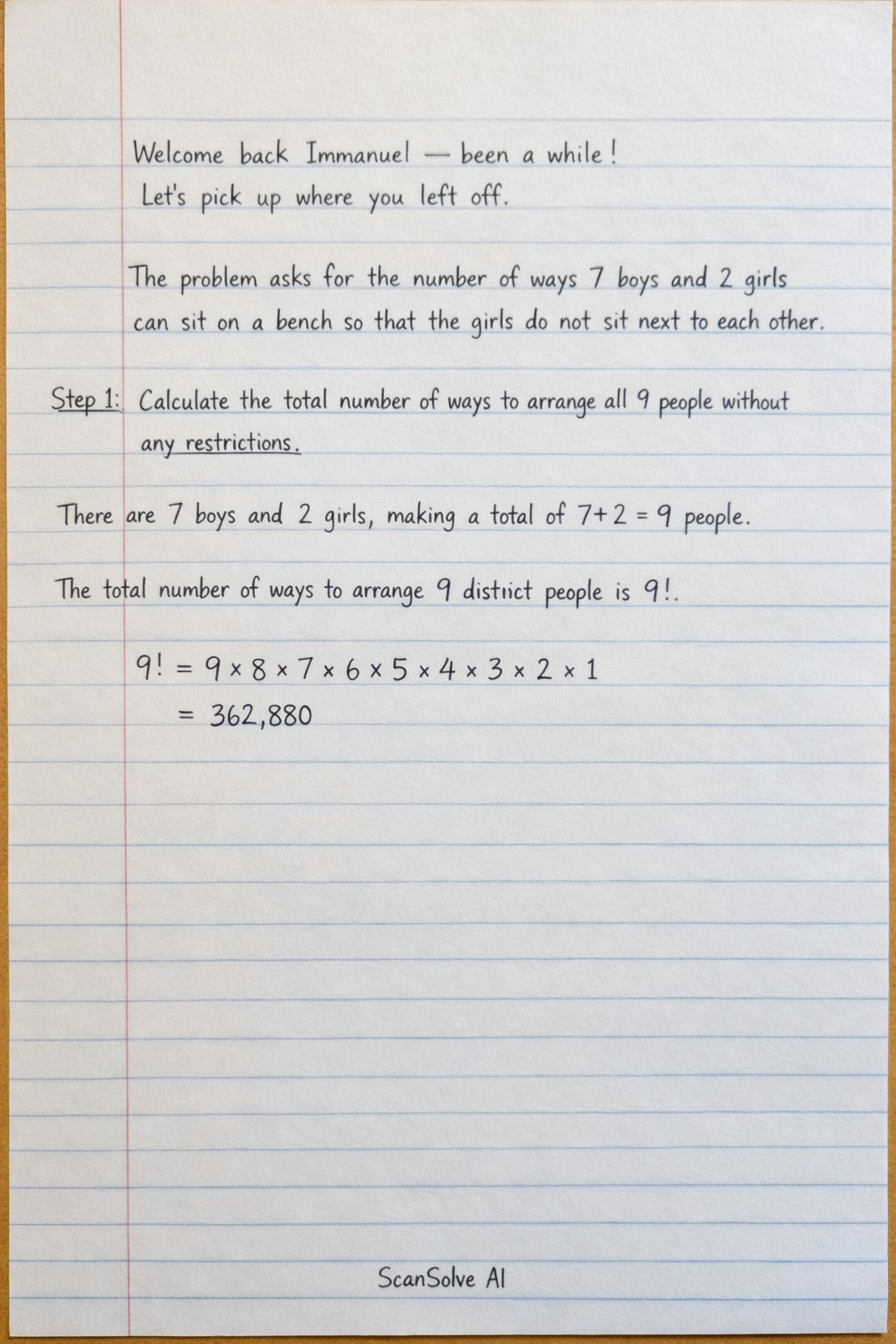
Handwritten Step-by-Step Solution
Get this as a handwritten image on WhatsApp — like a tutor wrote it for you.
Try on WhatsApp