
In that box we have 9 squares. One of the square has 1cm for all sides. That means the perimeter of one of the boxes is 4cm. For the 9 boxes, we have 4x 9= 36cm I think?
ScanSolve AI Answer
Answer
Step-by-step solution
3 stepsAjala, your calculation is correct for the sum of the perimeters of 9 separate squares.
Verify the perimeter of one square.
A square with for all sides has a perimeter of .
Calculate the sum of perimeters for 9 individual squares.
If you add up the perimeters of 9 squares, each , you get:
So, your calculation of is correct if you are summing the perimeters of 9 individual, disconnected squares.
However, when squares are placed together to form a larger shape (like "in that box"), the sides where they touch are no longer part of the outer perimeter of the combined shape.
Calculate the perimeter of the combined shape (assuming a arrangement).
If 9 squares, each by , are arranged to form a larger square (a grid), the side length of this larger square would be:
The perimeter of this larger square is:
So, if the 9 squares form a larger square, the perimeter of that larger shape is .
Try one yourself
A new problem that tests the same skill.
Still stuck on this one?
Ask a follow-up, and the answer starts from this question.
More Mathematics Questions
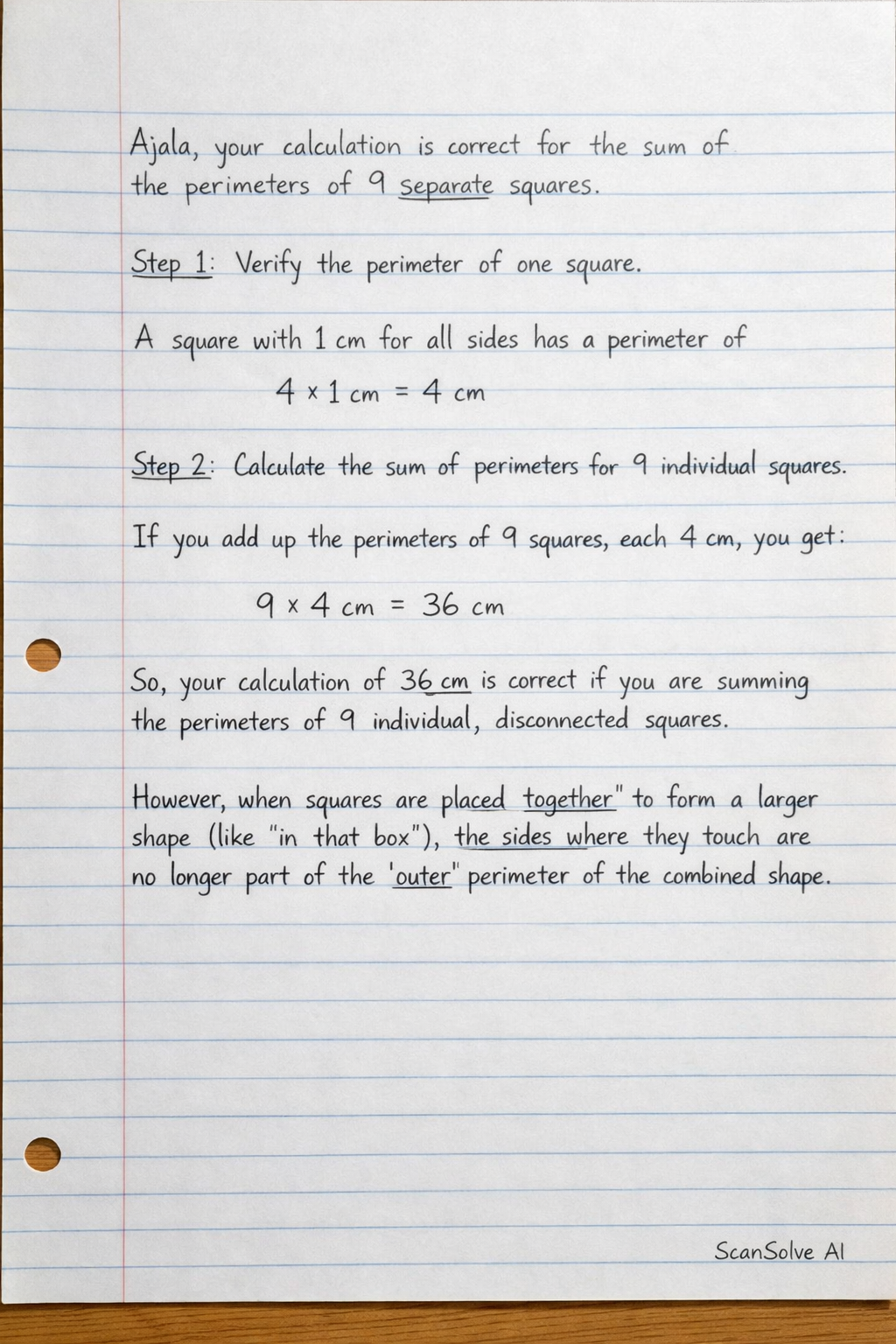
Handwritten Step-by-Step Solution
Get this as a handwritten image on WhatsApp — like a tutor wrote it for you.
Try on WhatsApp