We read your photo as:

In the diagram, M is the centre of the circle having equation (x−3)²+y²=25. E(-1; 3) and T are points on the circle. EC is a tangent to the circle at E and cuts the x-axis at D. ED= 15/4 units. MT is produced to meet the tangent at C(-7; p).

Mathematics

ScanSolve AI Answer

Step-by-step solution

25 steps

Part 4.1· 2 steps

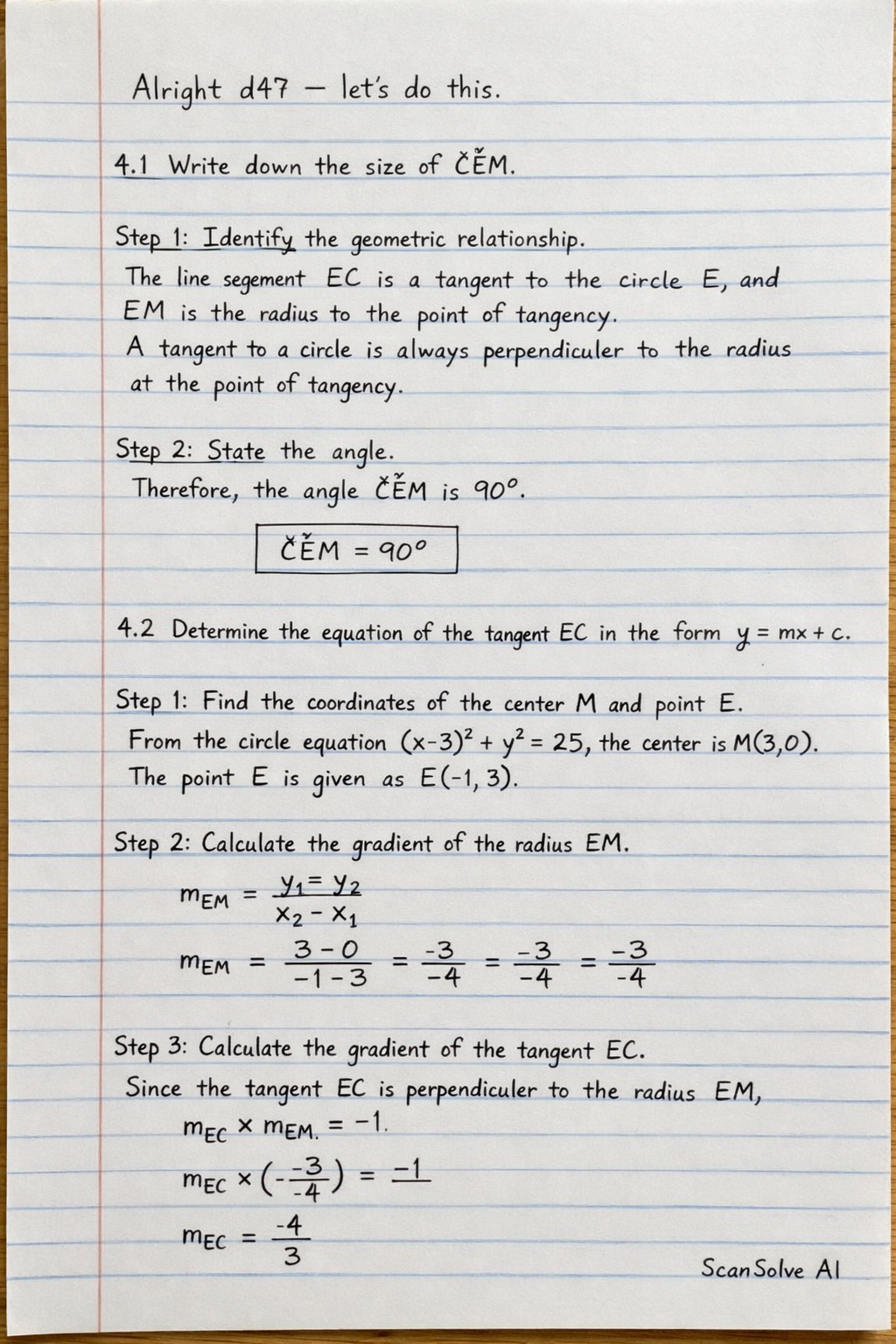
Write down the size of CÊM.

  1. Identify the geometric relationship.

    The line segment EC is a tangent to the circle at point E, and EM is the radius to the point of tangency. A tangent to a circle is always perpendicular to the radius at the point of tangency.

  2. State the angle.

    Therefore, the angle CÊM is 90∘90^\circ.

    CEˆM=90∘\boxed{\text{CÊM} = 90^\circ}

Part 4.2· 4 steps

Determine the equation of the tangent EC in the form y=mx+cy = mx + c.

  1. Find the coordinates of the center M and point E.

    From the circle equation (x−3)2+y2=25(x-3)^2 + y^2 = 25, the center is M(3,0)M(3, 0).
    The point E is given as E(−1,3)E(-1, 3).

  2. Calculate the gradient of the radius EM.

    The gradient mEM=y2−y1x2−x1m_{EM} = \frac{y_2 - y_1}{x_2 - x_1}.

    mEM=3−0−1−3=3−4=−34m_{EM} = \frac{3 - 0}{-1 - 3} = \frac{3}{-4} = -\frac{3}{4}
  3. Calculate the gradient of the tangent EC.

    Since the tangent EC is perpendicular to the radius EM, the product of their gradients is -1.

    mEC×mEM=−1m_{EC} \times m_{EM} = -1 mEC×(−34)=−1m_{EC} \times \left(-\frac{3}{4}\right) = -1 mEC=43m_{EC} = \frac{4}{3}
  4. Determine the equation of the tangent EC.

    Using the point-slope form y−y1=m(x−x1)y - y_1 = m(x - x_1) with E(−1,3)E(-1, 3) and mEC=43m_{EC} = \frac{4}{3}:

    y−3=43(x−(−1))y - 3 = \frac{4}{3}(x - (-1)) y−3=43(x+1)y - 3 = \frac{4}{3}(x + 1) y−3=43x+43y - 3 = \frac{4}{3}x + \frac{4}{3} y=43x+43+3y = \frac{4}{3}x + \frac{4}{3} + 3 y=43x+43+93y = \frac{4}{3}x + \frac{4}{3} + \frac{9}{3} y=43x+133y = \frac{4}{3}x + \frac{13}{3} y=43x+133\boxed{y = \frac{4}{3}x + \frac{13}{3}}

Part 4.3· 3 steps

Calculate the length of DM.

  1. Find the coordinates of point D.

    D is the x-intercept of the tangent EC. Set y=0y=0 in the equation of EC:

    0=43x+1330 = \frac{4}{3}x + \frac{13}{3} −133=43x-\frac{13}{3} = \frac{4}{3}x x=−134x = -\frac{13}{4}

    So, D(−134,0)D\left(-\frac{13}{4}, 0\right).

  2. Find the coordinates of point M.

    The center of the circle is $M(3, 0)$.

  3. Calculate the length of DM.

    Using the distance formula DM=(x2−x1)2+(y2−y1)2DM = \sqrt{(x_2 - x_1)^2 + (y_2 - y_1)^2}:

    DM=(3−(−134))2+(0−0)2DM = \sqrt{\left(3 - \left(-\frac{13}{4}\right)\right)^2 + (0 - 0)^2} DM=(3+134)2DM = \sqrt{\left(3 + \frac{13}{4}\right)^2} DM=(124+134)2DM = \sqrt{\left(\frac{12}{4} + \frac{13}{4}\right)^2} DM=(254)2DM = \sqrt{\left(\frac{25}{4}\right)^2} DM=254DM = \frac{25}{4} DM=254 units\boxed{DM = \frac{25}{4} \text{ units}}

Part 4.4· 2 steps

Show that p=−5p = -5.

  1. Use the coordinates of C and the equation of the tangent EC.

    Point C is given as C(−7,p)C(-7, p). The equation of the tangent EC is y=43x+133y = \frac{4}{3}x + \frac{13}{3} (from 4.2).

  2. Substitute the coordinates of C into the equation.

    p=43(−7)+133p = \frac{4}{3}(-7) + \frac{13}{3} p=−283+133p = -\frac{28}{3} + \frac{13}{3} p=−153p = -\frac{15}{3} p=−5p = -5 p=−5\boxed{p = -5}

Part 4.5· 5 steps

Calculate the coordinates of S if SEMC is a parallelogram and xS<0x_S < 0.

  1. Apply the property of parallelograms.

    In a parallelogram, the diagonals bisect each other. For parallelogram SEMC, the diagonals are SM and EC. Their midpoints must be the same.

  2. Identify the coordinates of the known points.

    E(−1,3)E(-1, 3), M(3,0)M(3, 0), C(−7,−5)C(-7, -5) (using p=−5p=-5). Let S(xS,yS)S(x_S, y_S).

  3. Calculate the midpoint of diagonal EC.

    MidEC=(−1+(−7)2,3+(−5)2)=(−82,−22)=(−4,−1)Mid_{EC} = \left(\frac{-1 + (-7)}{2}, \frac{3 + (-5)}{2}\right) = \left(\frac{-8}{2}, \frac{-2}{2}\right) = (-4, -1)
  4. Set up equations using the midpoint of diagonal SM.

    The midpoint of SM is (xS+32,yS+02)\left(\frac{x_S + 3}{2}, \frac{y_S + 0}{2}\right).
    Equate the coordinates of the midpoints:

    xS+32=−4⇒xS+3=−8⇒xS=−11\frac{x_S + 3}{2} = -4 \quad \Rightarrow \quad x_S + 3 = -8 \quad \Rightarrow \quad x_S = -11 yS2=−1⇒yS=−2\frac{y_S}{2} = -1 \quad \Rightarrow \quad y_S = -2
  5. State the coordinates of S and verify the condition.

    So, S(−11,−2)S(-11, -2). This satisfies the condition xS<0x_S < 0.

    S(−11,−2)\boxed{S(-11, -2)}

Part 4.6· 4 steps

If the radius of the circle, centred at M, is increased by 7 units, determine whether S lies inside or outside the new circle. Support your answer with the necessary calculations.

  1. Determine the new radius and center.

    The original radius is r=25=5r = \sqrt{25} = 5 units.
    The new radius is rnew=5+7=12r_{new} = 5 + 7 = 12 units.
    The center remains M(3,0)M(3, 0).

  2. Use the coordinates of S.

    From 4.5, S(−11,−2)S(-11, -2).

  3. Calculate the distance MS.

    Using the distance formula MS=(xS−xM)2+(yS−yM)2MS = \sqrt{(x_S - x_M)^2 + (y_S - y_M)^2}:

    MS=(−11−3)2+(−2−0)2MS = \sqrt{(-11 - 3)^2 + (-2 - 0)^2} MS=(−14)2+(−2)2MS = \sqrt{(-14)^2 + (-2)^2} MS=196+4MS = \sqrt{196 + 4} MS=200MS = \sqrt{200} MS=102MS = 10\sqrt{2}
  4. Compare the distance MS with the new radius.

    MS=102≈14.142MS = 10\sqrt{2} \approx 14.142 units.
    The new radius rnew=12r_{new} = 12 units.
    Since MS≈14.142>12MS \approx 14.142 > 12, point S lies outside the new circle.

    S lies outside the new circle\boxed{\text{S lies outside the new circle}} Calculations: MS=102≈14.14 units. New radius rnew=12 units. Since MS>rnew, S is outside.\text{Calculations: } MS = 10\sqrt{2} \approx 14.14 \text{ units. New radius } r_{new} = 12 \text{ units. Since } MS > r_{new}, \text{ S is outside.}

Part 4.7· 5 steps

If ET is drawn, calculate the size of EÎM.

  1. Identify properties of △EMT\triangle EMT.

    M is the center, and E and T are points on the circle. Therefore, EM and MT are radii, so EM=MT=5EM = MT = 5.
    This means △EMT\triangle EMT is an isosceles triangle.

  2. Use the collinearity of M, T, C.

    The problem states "MT is produced to meet the tangent at C". This means M, T, and C are collinear.
    Therefore, the angle ∠ETM\angle ETM (EÎM) is the same as ∠EMC\angle EMC.

  3. Calculate the lengths of the sides of △CEM\triangle CEM.

    ME=5ME = 5 (radius).
    CE=(−7−(−1))2+(−5−3)2=(−6)2+(−8)2=36+64=100=10CE = \sqrt{(-7 - (-1))^2 + (-5 - 3)^2} = \sqrt{(-6)^2 + (-8)^2} = \sqrt{36 + 64} = \sqrt{100} = 10.
    MC=(−7−3)2+(−5−0)2=(−10)2+(−5)2=100+25=125=55MC = \sqrt{(-7 - 3)^2 + (-5 - 0)^2} = \sqrt{(-10)^2 + (-5)^2} = \sqrt{100 + 25} = \sqrt{125} = 5\sqrt{5}.

  4. Use trigonometry in the right-angled △CEM\triangle CEM.

    From 4.1, we know ∠CEM=90∘\angle CEM = 90^\circ. We can use this right triangle to find ∠EMC\angle EMC.

    tan⁡(∠EMC)=OppositeAdjacent=CEME=105=2\tan(\angle EMC) = \frac{\text{Opposite}}{\text{Adjacent}} = \frac{CE}{ME} = \frac{10}{5} = 2 ∠EMC=arctan⁡(2)\angle EMC = \arctan(2) ∠EMC≈63.43∘\angle EMC \approx 63.43^\circ
  5. Conclude the size of EÎM.

    Since ∠ETM=∠EMC\angle ETM = \angle EMC,

    EIˆM≈63.43∘\text{EÎM} \approx 63.43^\circ EIˆM≈63.43∘\boxed{\text{EÎM} \approx 63.43^\circ}
Was this helpful?

Still stuck on this one?

Ask a follow-up, and the answer starts from this question.

Got a different question?Ask your own question
Handwritten step-by-step solution preview

Handwritten Step-by-Step Solution

Get this as a handwritten image on WhatsApp — like a tutor wrote it for you.

Try on WhatsApp