
We read your photo as:
In the figure below, QT is a tangent to the circle at Q. AT is a straight line and QD is a chord, given that AX = 8cm, PT = 12cm, QX = 6.8cm and XD = 1cm.
ScanSolve AI Answer
Step-by-step solution
11 stepsQuestion 11:
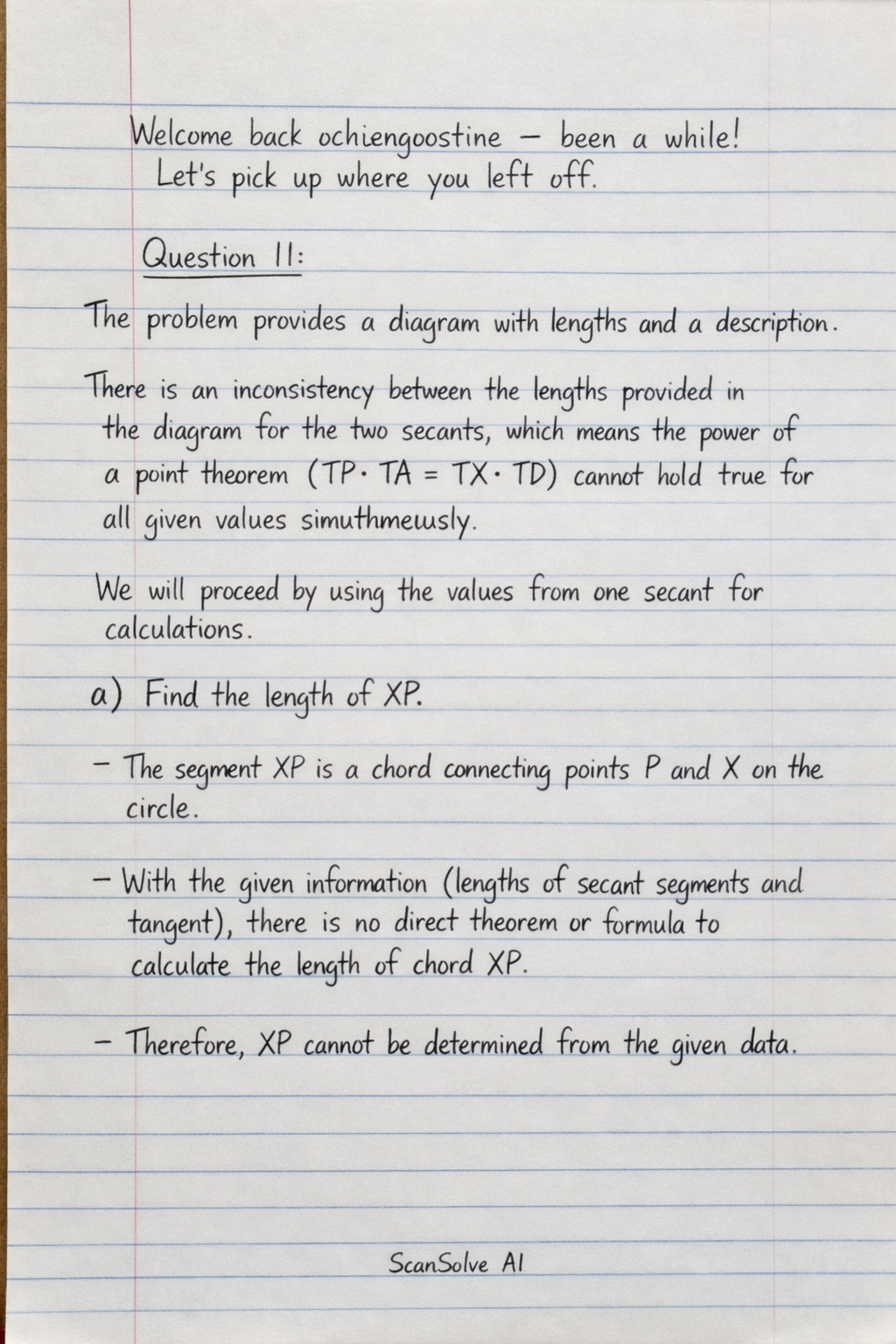
The problem provides a diagram with lengths and a description. There is an inconsistency between the lengths provided in the diagram for the two secants, which means the power of a point theorem () cannot hold true for all given values simultaneously. We will proceed by using the values from one secant for calculations.
a) Find the length of XP.
The segment XP is a chord connecting points P and X on the circle. With the given information (lengths of secant segments and tangent), there is no direct theorem or formula to calculate the length of chord XP. Therefore, XP cannot be determined from the given data.
b) Find the length of QT.
We use the tangent-secant theorem, which states that the square of the length of the tangent segment from an external point is equal to the product of the length of the secant segment from the external point to the farther intersection point and the length of the secant segment from the external point to the nearer intersection point.
From the diagram, we have:
External point: T
Tangent segment: TQ
Secant segment TPA: TP = 12 cm, PA = 8 cm.
So, the whole secant length cm.
Apply the tangent-secant theorem.
Substitute the known values.
Solve for TQ.
Since the problem has inconsistent data (using the other secant TXD: cm, cm, so cm, which would give , so cm), we have chosen to use the secant TPA.
a) XP cannot be determined with the given information.
b)
Question 12: Make the subject of the formula .
Square both sides of the equation to remove the square root.
Multiply both sides by to clear the denominator.
Divide both sides by .
Subtract $2w$ from both sides.
Take the square root of both sides.
The subject of the formula is .
Question 13: Find the value of given that is a singular matrix.
A matrix is singular if its determinant is equal to zero. For a matrix , the determinant is .
Calculate the determinant of the given matrix.
Set the determinant to zero for a singular matrix.
Solve for .
The value of is .
Still stuck on this one?
Ask a follow-up, and the answer starts from this question.
More Mathematics Questions
Handwritten Step-by-Step Solution
Get this as a handwritten image on WhatsApp — like a tutor wrote it for you.
Try on WhatsApp