
We read your photo as:
Construct a circle with radius 4 cm. Draw a diameter PT. Construct a tangent at T. Mark a point R on the tangent such that TR = 9 cm. Calculate the length of PR.
Mathematics
ScanSolve AI Answer
Answer
Step-by-step solution
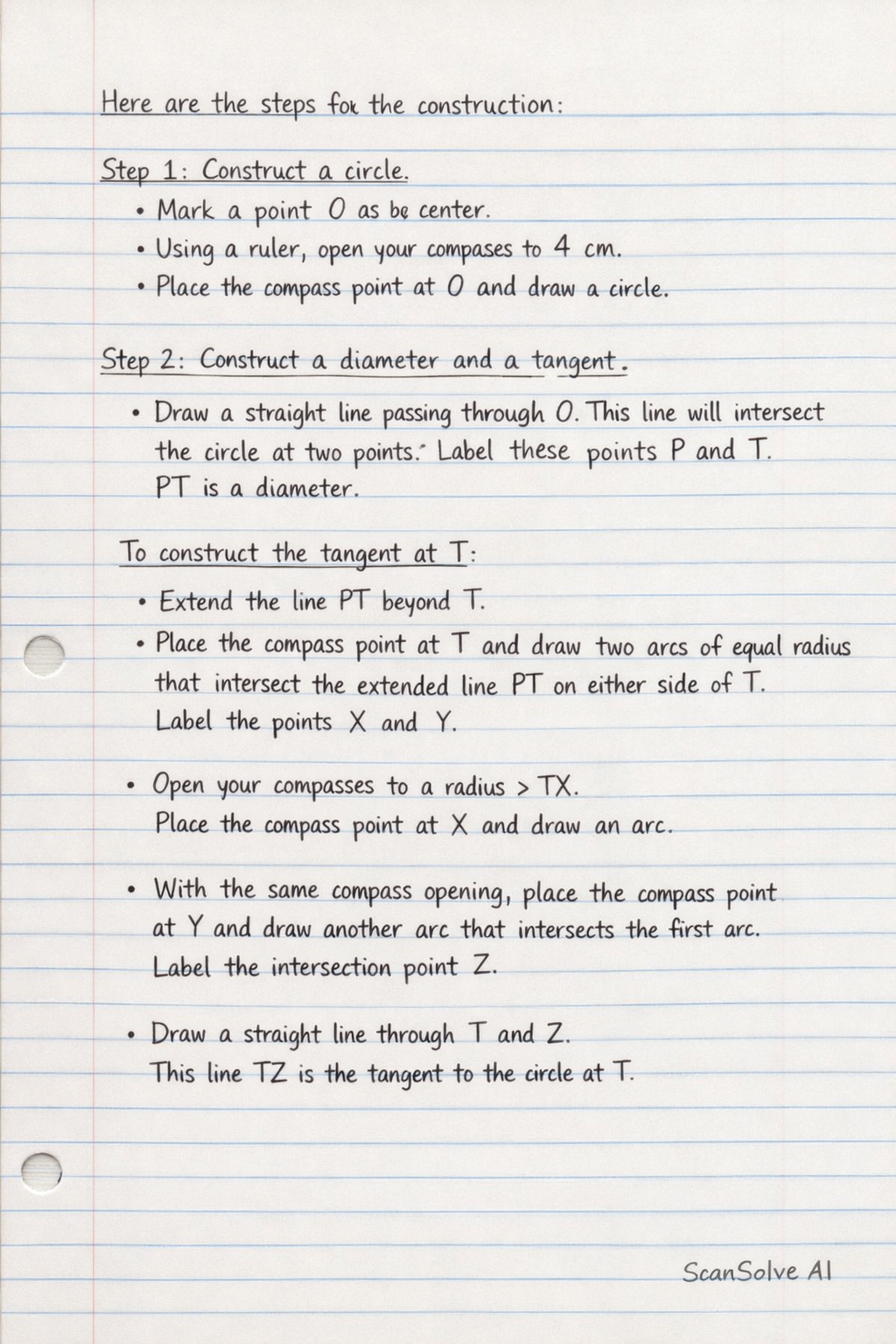
4 stepsHere are the steps for the construction:
Construct a circle.
- Mark a point O as the center.
- Using a ruler, open your compasses to .
- Place the compass point at O and draw a circle.
Construct a diameter and a tangent.
- Draw a straight line passing through O. This line will intersect the circle at two points. Label these points P and T. PT is a diameter.
- To construct the tangent at T:
- Extend the line PT beyond T.
- Place the compass point at T and draw two arcs of equal radius that intersect the extended line PT on either side of T. Let these intersection points be X and Y.
- Open your compasses to a radius greater than TX. Place the compass point at X and draw an arc.
- With the same compass opening, place the compass point at Y and draw another arc that intersects the first arc. Let this intersection point be Z.
- Draw a straight line through T and Z. This line TZ is the tangent to the circle at T.
Locate point R.
- Place the compass point at T.
- Using a ruler, open your compasses to .
- Draw an arc on the tangent line TZ. Label the intersection point R.
Measure and state PR.
- Draw a straight line connecting point P to point R.
- Measure the length of PR with a ruler.
Since this is a digital environment, I will calculate the length of PR.
The radius of the circle is .
Since PT is a diameter, .
The tangent at T is perpendicular to the diameter PT at T. Therefore, is a right-angled triangle with the right angle at T.
We have and .
Using the Pythagorean theorem:As a decimal, (to 2 decimal places).
The length of PR is
Was this helpful?
Try one yourself
A new problem that tests the same skill.
Still stuck on this one?
Ask a follow-up, and the answer starts from this question.
Got a different question?Ask your own question
More Mathematics Questions
QA circle has a radius of 3 cm. Draw a diameter AB. Construct AC = 4.5 cm such that C is on the…QIn the figure below (QT is a tangent to the circle at Q, PXRT and QXS are straight lines. PQ = 6cm…QConstruct an equilateral triangle in a circle of radius 4cm. Explain the steps.QFind the length of the tangent segment from a point 12 cm away from the center of a circle to the…QUsing ruler and a pair of compasses only, construct a triangle PQR such that PQ = 6cm and angle PQR…
Browse by topic:Geometry
Handwritten Step-by-Step Solution
Get this as a handwritten image on WhatsApp — like a tutor wrote it for you.
Try on WhatsApp