
We read your photo as:
A circle has a radius of 3 cm. Draw a diameter AB. Construct AC = 4.5 cm such that C is on the circle. Connect BC and measure its length.
ScanSolve AI Answer
Answers
2 partsStep-by-step solution
8 stepsIt looks like part a) of the question, which likely involved drawing the initial circle, is missing. I will assume you have drawn a circle with a radius of (so the diameter is ) to proceed with the following steps.
Part b· 2 steps
Draw a diameter AB
Locate the center of your circle.
Draw a straight line segment passing through the center of the circle and touching the circle at two points.
Label these points A and B. This line segment AB is the diameter.
Part c· 4 steps
Construct AC = 4.5 cm such that C is on the circle
Place the compass point at A.
Open the compass to a radius of .
Draw an arc that intersects the circle.
Label one of the intersection points as C.
Draw a straight line segment from A to C.
This segment AC will be long.
Part d
Connect BC and measure its length
Draw a straight line segment connecting point B to point C.
Measure the length of the segment BC using a ruler.
Calculation based on assumed diameter:
If the diameter and , then is a right-angled triangle with the right angle at C (angle in a semicircle).
Using the Pythagorean theorem ():You should measure approximately .
Part e
State the value of angle ACB
The angle subtended by a diameter at any point on the circumference of a circle is always a right angle. Since AB is the diameter and C is a point on the circumference, is the angle subtended by the diameter.
The value of angle ACB is .
Try one yourself
A new problem that tests the same skill.
Still stuck on this one?
Ask a follow-up, and the answer starts from this question.
More Mathematics Questions
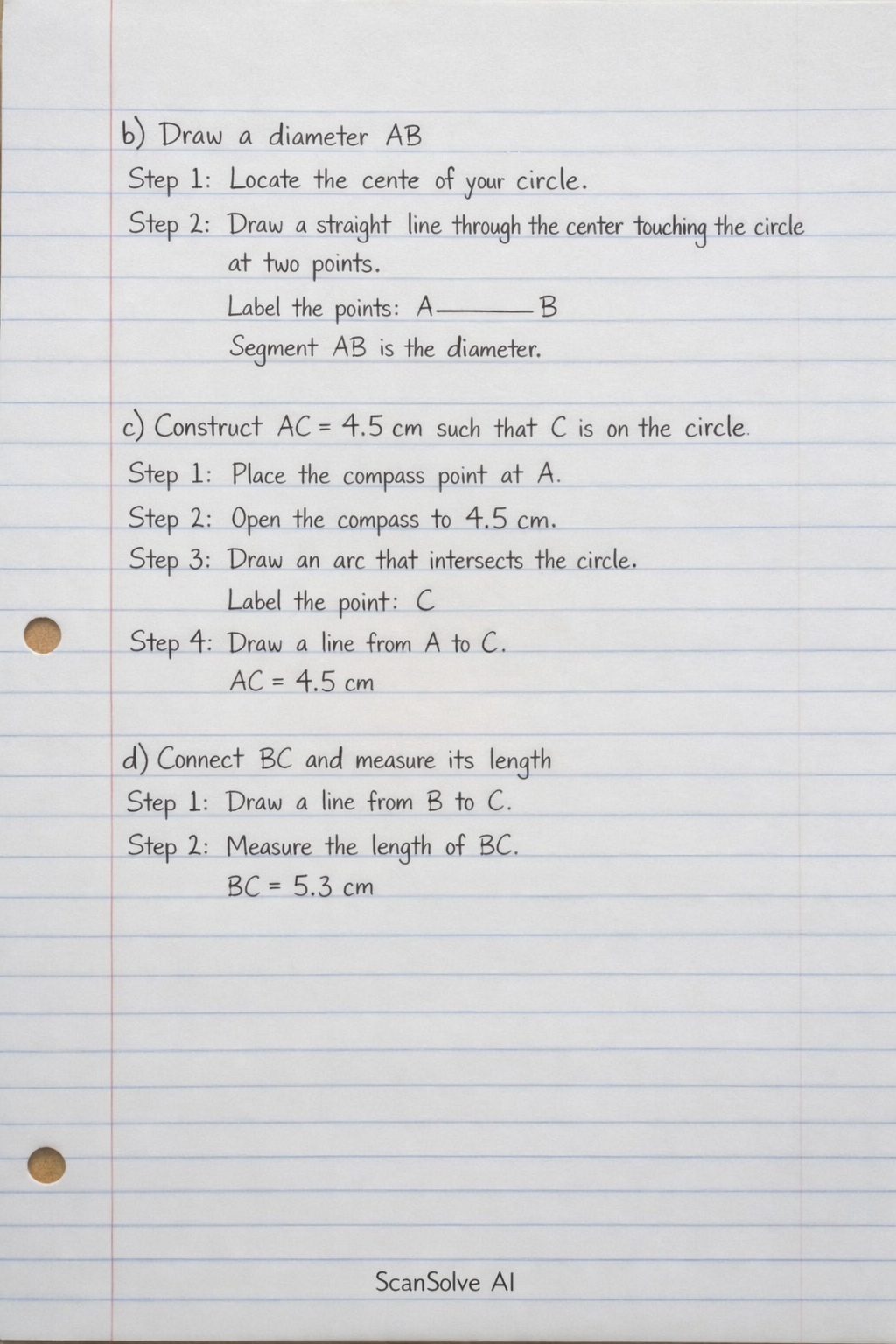
Handwritten Step-by-Step Solution
Get this as a handwritten image on WhatsApp — like a tutor wrote it for you.
Try on WhatsApp