
We read your photo as:
In triangle ABC, AC = 18, CD = 14, angle C = 90 degrees. Find x and y.
ScanSolve AI Answer
Answer
Step-by-step solution
4 stepsHere's how to solve the problem, assuming is an isosceles right-angled triangle. This assumption is made because the length of is not provided, and this is a common way for such problems to be solvable with specific numerical values for the angles.
Assumption: is an isosceles right-angled triangle, meaning , which implies .
Determine the length of .
Given and assuming is an isosceles right-angled triangle, then .
Calculate the length of .
The length of the base is the sum of and .
Calculate angle in .
is a right-angled triangle at . We use the tangent function, which is the ratio of the opposite side to the adjacent side.
To find , take the inverse tangent:
Calculate angle in .
is a right-angled triangle at . We use the tangent function.
To find , take the inverse tangent:
The values of the angles are:
Try one yourself
A new problem that tests the same skill.
Still stuck on this one?
Ask a follow-up, and the answer starts from this question.
More Mathematics Questions
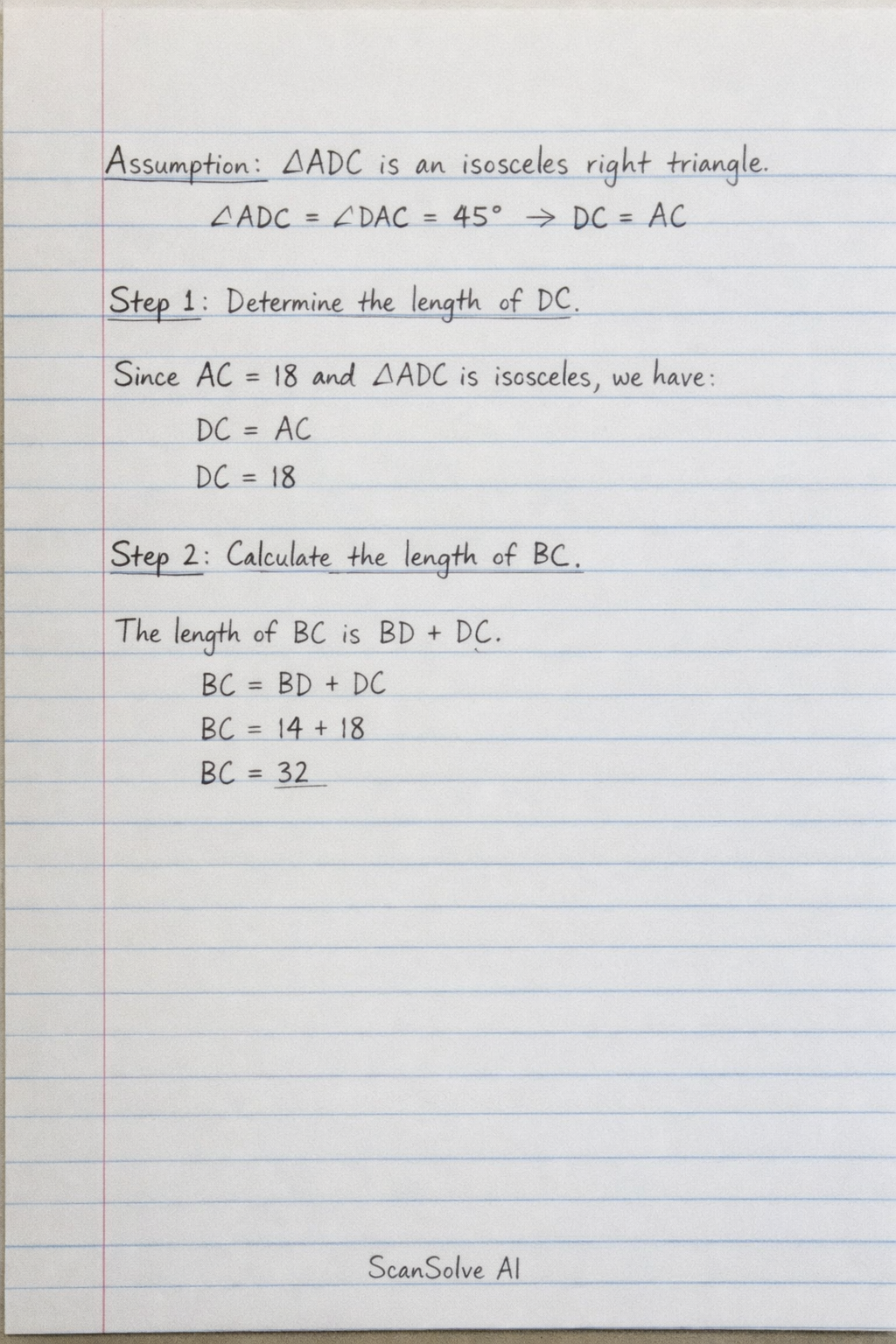
Handwritten Step-by-Step Solution
Get this as a handwritten image on WhatsApp — like a tutor wrote it for you.
Try on WhatsApp