
We read your photo as:
Solve the inequality (3x + 11)(x - 1) ext > 0
ScanSolve AI Answer
Answer
Step-by-step solution
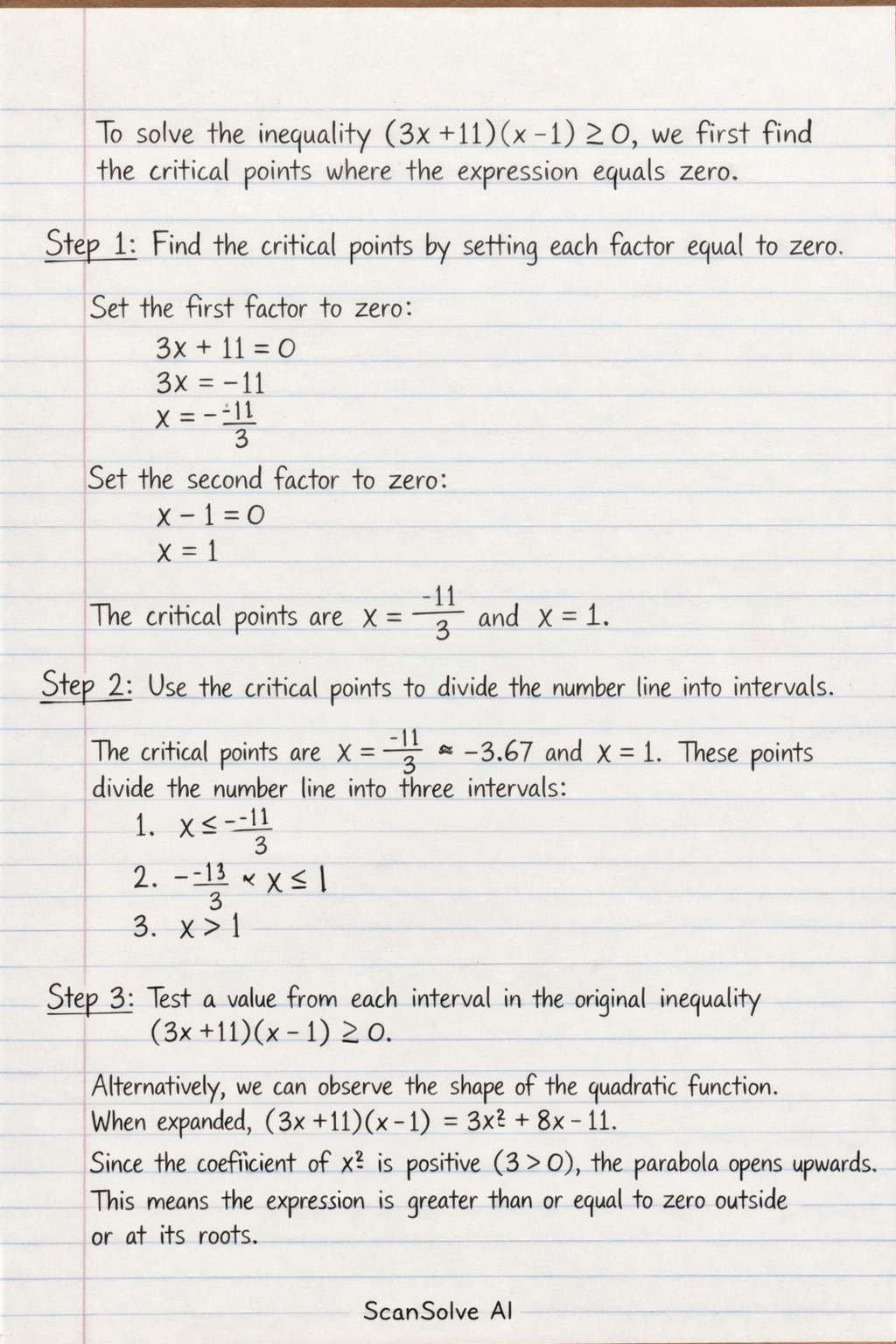
4 stepsTo solve the inequality , we first find the critical points where the expression equals zero.
Find the critical points by setting each factor equal to zero.
Set the first factor to zero:
Set the second factor to zero:
The critical points are and .
Use the critical points to divide the number line into intervals.
The critical points are and . These points divide the number line into three intervals:
Test a value from each interval in the original inequality .
Alternatively, we can observe the shape of the quadratic function. When expanded, . Since the coefficient of is positive (), the parabola opens upwards. This means the expression is greater than or equal to zero outside or at its roots.
So, the inequality is satisfied when is less than or equal to the smaller root, or greater than or equal to the larger root.
This means or .Write the solution set.
The solution set in interval notation is .
Try one yourself
A new problem that tests the same skill.
Still stuck on this one?
Ask a follow-up, and the answer starts from this question.
More Mathematics Questions
Handwritten Step-by-Step Solution
Get this as a handwritten image on WhatsApp — like a tutor wrote it for you.
Try on WhatsApp