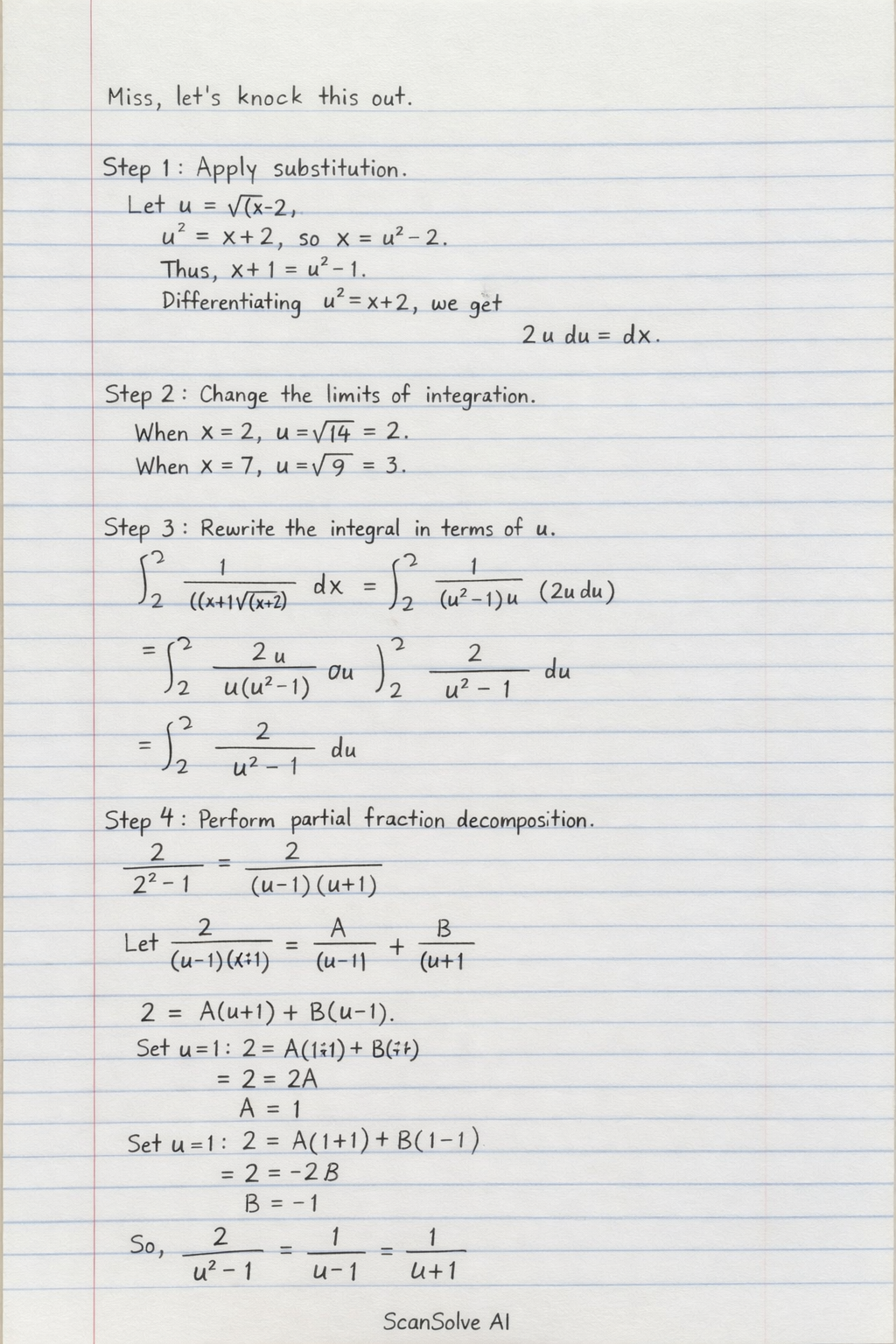
Evaluate the integral integral27 (1)/((x+1)sqrt(x+2)) dx.
|Mathematics
Evaluate the integral integral27 (1)/((x+1)sqrt(x+2)) dx.
ScanSolve AI Answer
Answer
ln23
Miss, let's knock this out.
Step 1: Apply substitution.
Let u=x+2.
Then u2=x+2, which means x=u2−2.
From this, x+1=(u2−2)+1=u2−1.
Differentiating u2=x+2 with respect to x, we get 2udu=dx.
Step 2: Change the limits of integration.
When x=2, u=2+2=4=2.
When x=7, u=7+2=9=3.
Step 3: Rewrite the integral in terms of u.
∫27(x+1)x+21dx=∫23(u2−1)u1(2udu)=∫23u(u2−1)2udu=∫23u2−12du
Step 4: Perform partial fraction decomposition for the integrand.
u2−12=(u−1)(u+1)2
Let (u−1)(u+1)2=u−1A+u+1B.
Multiplying by (u−1)(u+1) gives:
2=A(u+1)+B(u−1)
Set u=1: 2=A(1+1)+B(1−1)⟹2=2A⟹A=1.
Set u=−1: 2=A(−1+1)+B(−1−1)⟹2=−2B⟹B=−1.
So, the integrand becomes:
u2−12=u−11−u+11
Step 5: Integrate the decomposed expression.
∫23(u−11−u+11)du=[ln∣u−1∣−ln∣u+1∣]23
Using the logarithm property lna−lnb=lnba:
=[lnu+1u−1]23
Step 6: Evaluate the definite integral using the limits.
[lnu+1u−1]23=ln3+13−1−ln2+12−1=ln42−ln31=ln(21)−ln(31)
Again, using the logarithm property lna−lnb=lnba:
=ln(1/31/2)=ln(21×13)=ln(23)
The final answer is ln23.
Send me the next one 📸
Was this helpful?
Need help with your own homework?
Get instant step-by-step solutions to any question. Free to start.
This mathematics problem involves applying core mathematical principles and formulas. Below you will find a complete step-by-step solution with detailed explanations for each step, helping you understand not just the answer but the method behind it.
ScanSolve AI Answer
Miss, let's knock this out. Step 1: Apply substitution. Let u = sqrt(x+2). Then u^2 = x+2, which means x = u^2 - 2. From this, x+1 = (u^2 - 2) + 1 = u^2 - 1. Differentiating u^2 = x+2 with respect to x, we get 2u\,du = dx. Step 2: Change the limits of integration. When x=2, u = sqrt(2+2) = sqrt(4) = 2. When x=7, u = sqrt(7+2) = sqrt(9) = 3. Step 3: Rewrite the integral in terms of u. _2^7 (1)/((x+1)sqrt(x+2))\,dx = _2^3 (1)/((u^2-1)u) (2u\,du) = _2^3 (2u)/(u(u^2-1))\,du = _2^3 (2)/(u^2-1)\,du Step 4: Perform partial fraction decomposition for the integrand. (2)/(u^2-1) = (2)/((u-1)(u+1)) Let (2)/((u-1)(u+1)) = (A)/(u-1) + (B)/(u+1). Multiplying by (u-1)(u+1) gives: 2 = A(u+1) + B(u-1) Set u=1: 2 = A(1+1) + B(1-1) 2 = 2A A=1. Set u=-1: 2 = A(-1+1) + B(-1-1) 2 = -2B B=-1. So, the integrand becomes: (2)/(u^2-1) = (1)/(u-1) - (1)/(u+1) Step 5: Integrate the decomposed expression. _2^3 ((1)/(u-1) - (1)/(u+1))\,du = [|u-1| - |u+1|]_2^3 Using the logarithm property a - b = (a)/(b): = [|(u-1)/(u+1)|]_2^3 Step 6: Evaluate the definite integral using the limits. [|(u-1)/(u+1)|]_2^3 = |(3-1)/(3+1)| - |(2-1)/(2+1)| = |(2)/(4)| - |(1)/(3)| = ((1)/(2)) - ((1)/(3)) Again, using the logarithm property a - b = (a)/(b): = ((1/2)/(1/3)) = ((1)/(2) × (3)/(1)) = ((3)/(2)) The final answer is (3)/(2). Send me the next one 📸