

This mathematics problem involves applying core mathematical principles and formulas. Below you will find a complete step-by-step solution with detailed explanations for each step, helping you understand not just the answer but the method behind it.
ScanSolve AI Answer
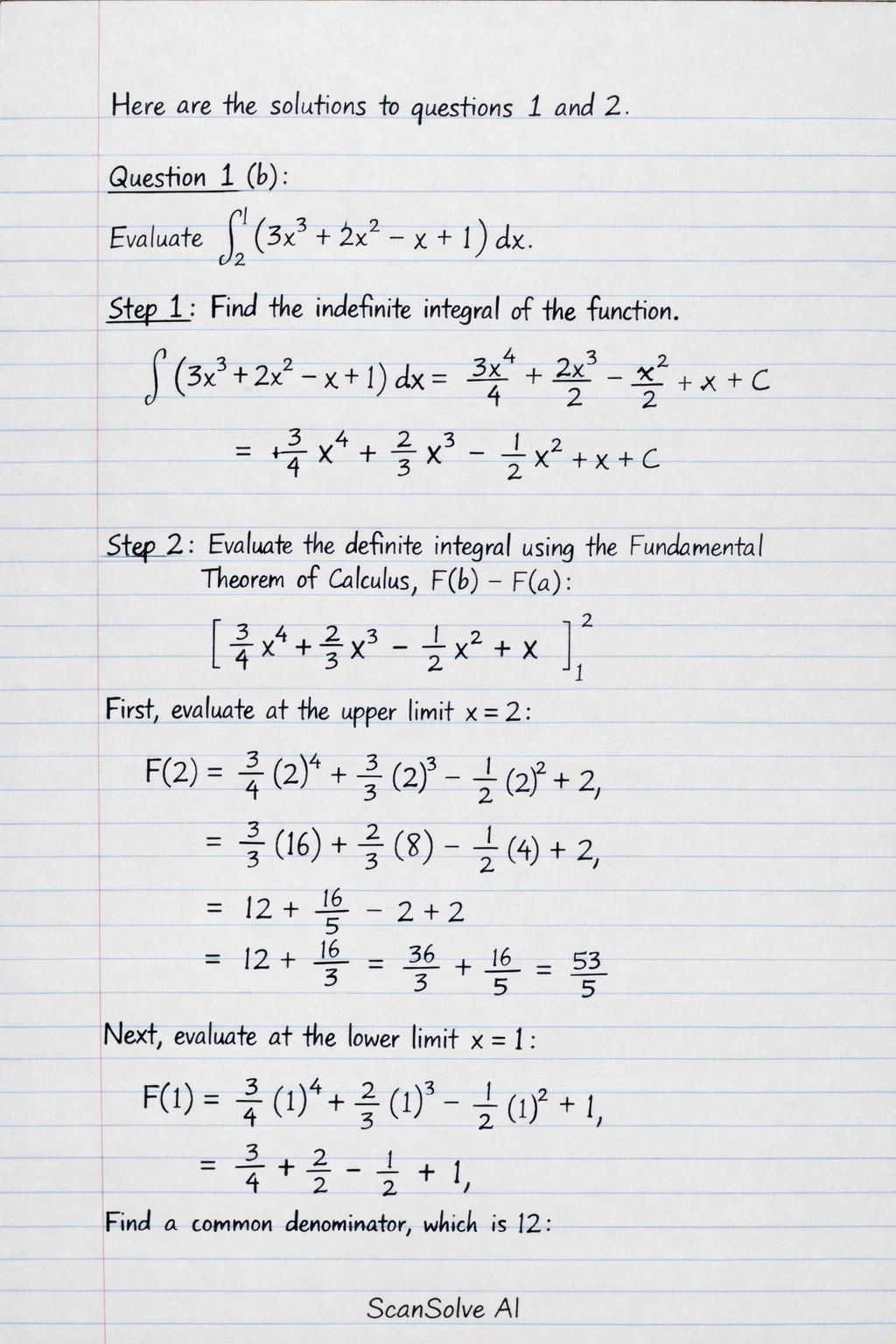
Here are the solutions to questions 1 and 2. Question 1 (b): Evaluate _1^2 (3x^3 + 2x^2 - x + 1)\,dx. Step 1: Find the indefinite integral of the function. (3x^3 + 2x^2 - x + 1)\,dx = 3x^3+13+1 + 2x^2+12+1 - x^1+11+1 + x + C = (3)/(4)x^4 + (2)/(3)x^3 - (1)/(2)x^2 + x + C Step 2: Evaluate the definite integral using the Fundamental Theorem of Calculus, F(b) - F(a). [ (3)/(4)x^4 + (2)/(3)x^3 - (1)/(2)x^2 + x ]_1^2 First, evaluate at the upper limit x=2: F(2) = (3)/(4)(2)^4 + (2)/(3)(2)^3 - (1)/(2)(2)^2 + 2 F(2) = (3)/(4)(16) + (2)/(3)(8) - (1)/(2)(4) + 2 F(2) = 12 + (16)/(3) - 2 + 2 F(2) = 12 + (16)/(3) = (36)/(3) + (16)/(3) = (52)/(3) Next, evaluate at the lower limit x=1: F(1) = (3)/(4)(1)^4 + (2)/(3)(1)^3 - (1)/(2)(1)^2 + 1 F(1) = (3)/(4) + (2)/(3) - (1)/(2) + 1 Find a common denominator, which is 12: F(1) = (9)/(12) + (8)/(12) - (6)/(12) + (12)/(12) F(1) = (9 + 8 - 6 + 12)/(12) = (23)/(12) Step 3: Subtract F(1) from F(2). _1^2 (3x^3 + 2x^2 - x + 1)\,dx = F(2) - F(1) = (52)/(3) - (23)/(12) = (52 × 4)/(3 × 4) - (23)/(12) = (208)/(12) - (23)/(12) = (208 - 23)/(12) = (185)/(12) The final answer is (185)/(12). Question 2 (5): A car with a mass of 1600 kg starts from rest and accelerates to a speed of 18 m/s in 10 seconds. The frictional force is 500 N. i. calculate the force required to accelerate the car Step 1: Identify the given values and calculate the acceleration. Given: Mass (m) = 1600 kg Initial velocity (u) = 0 m/s (starts from rest) Final velocity (v) = 18 m/s Time (t) = 10 s Frictional force (F_f) = 500 N Using the kinematic equation v = u + at: 18 m/s = 0 m/s + a × 10 s 18 = 10a a = (18)/(10) m/s^2 = 1.8 m/s^2 Step 2: Calculate the net force (F_net) required for acceleration using Newton's second law (F_net = ma). F_net = 1600 kg × 1.8 m/s^2 F_net = 2880 N Step 3: Calculate the total applied force (F_applied) needed to overcome friction and cause acceleration. The net force is the applied force minus the frictional force (F_net = F_applied - F_f). F_applied = F_net + F_f F_applied = 2880 N + 500 N F_applied = 3380 N The force required to accelerate the car is 3380 N. ii. find the distance traveled within the time. Step 1: Use a kinematic equation to find the distance (s). Using the equation s = ut + (1)/(2)at^2: s = (0 m/s)(10 s) + (1)/(2)(1.8 m/s^2)(10 s)^2 s = 0 + (1)/(2)(1.8)(100) s = 0.9 × 100 s = 90 m The distance traveled is 90 m. Last free one today — make it count tomorrow, or type /upgrade for unlimited.