Integrate the following expressions: a) x2 b) 4x5 c) 2√x d) 7 e) x3+x2+x+1
|Mathematics
Integrate the following expressions: a) x2 b) 4x5 c) 2√x d) 7 e) x3+x2+x+1
ScanSolve AI Answer
Answer
3x3+C
You're on a roll —
Here are the integrations for each expression:
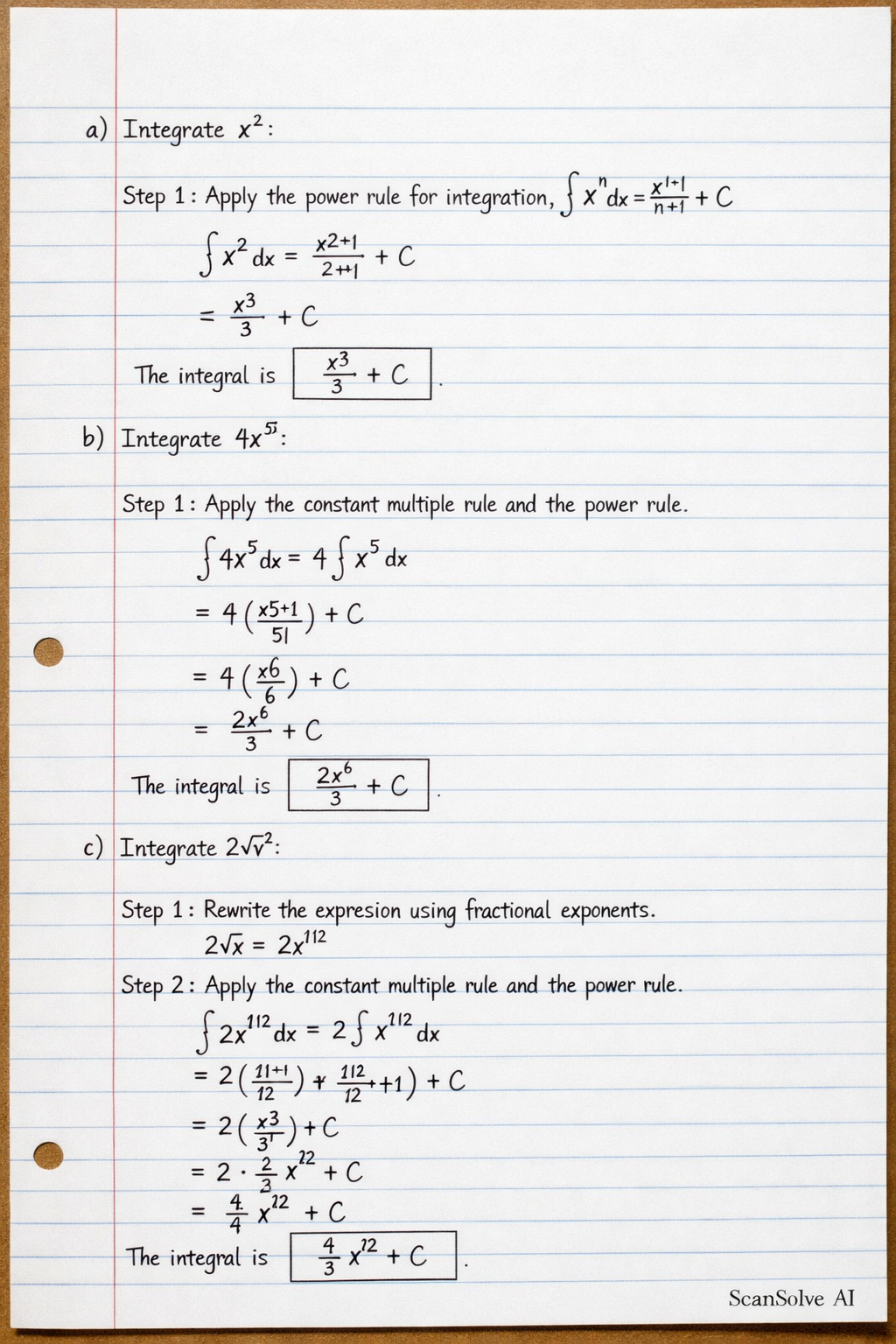
a) Integrate x2.
Step 1: Apply the power rule for integration, ∫xndx=n+1xn+1+C.
∫x2dx=2+1x2+1+C=3x3+C
The integral is 3x3+C.
b) Integrate 4x5.
Step 1: Apply the constant multiple rule and the power rule.
∫4x5dx=4∫x5dx=4(5+1x5+1)+C=4(6x6)+C=32x6+C
The integral is 32x6+C.
c) Integrate 2x.
Step 1: Rewrite the expression using fractional exponents.
2x=2x1/2
Step 2: Apply the constant multiple rule and the power rule.
∫2x1/2dx=2∫x1/2dx=2(1/2+1x1/2+1)+C=2(3/2x3/2)+C=2⋅32x3/2+C=34x3/2+C
The integral is 34x3/2+C.
d) Integrate 7.
Step 1: Apply the rule for integrating a constant, ∫kdx=kx+C.
∫7dx=7x+C
The integral is 7x+C.
e) Integrate x3+x2+x+1.
Step 1: Integrate each term separately using the power rule.
∫(x3+x2+x+1)dx=∫x3dx+∫x2dx+∫xdx+∫1dx=3+1x3+1+2+1x2+1+1+1x1+1+x+C=4x4+3x3+2x2+x+C
The integral is 4x4+3x3+2x2+x+C.
f) Integrate x3/5.
Step 1: Apply the power rule for integration.
∫x3/5dx=3/5+1x3/5+1+C=8/5x8/5+C=85x8/5+C
The integral is 85x8/5+C.
i) Integrate 2x6.
Step 1: Rewrite the expression and apply the constant multiple rule and the power rule.
∫2x6dx=21∫x6dx=21(6+1x6+1)+C=21(7x7)+C=14x7+C
The integral is 14x7+C.
j) Integrate x−x.
Step 1: Rewrite the expression using fractional exponents.
x−x=x−x1/2
Step 2: Integrate each term separately using the power rule.
∫(x−x1/2)dx=∫xdx−∫x1/2dx=1+1x1+1−1/2+1x1/2+1+C=2x2−3/2x3/2+C=2x2−32x3/2+C
The integral is 2x2−32x3/2+C.
k) Integrate 2x4(x+3)2.
Step 1: Expand the numerator and simplify the expression.
(x+3)2=x2+6x+92x4(x+3)2=2x4x2+6x+9=2x4x2+2x46x+2x49=21x−2+3x−3+29x−4
Step 2: Integrate each term separately using the power rule.
∫(21x−2+3x−3+29x−4)dx=21∫x−2dx+3∫x−3dx+29∫x−4dx=21(−2+1x−2+1)+3(−3+1x−3+1)+29(−4+1x−4+1)+C=21(−1x−1)+3(−2x−2)+29(−3x−3)+C=−21x−1−23x−2−23x−3+C
Step 3: Rewrite the terms with positive exponents.
=−2x1−2x23−2x33+C
The integral is −2x1−2x23−2x33+C.
Got more? Send 'em!
Was this helpful?
Need help with your own homework?
Get instant step-by-step solutions to any question. Free to start.
This mathematics problem involves applying core mathematical principles and formulas. Below you will find a complete step-by-step solution with detailed explanations for each step, helping you understand not just the answer but the method behind it.
ScanSolve AI Answer
You're on a roll — Here are the integrations for each expression: a) Integrate x^2. Step 1: Apply the power rule for integration, x^n \,dx = x^n+1n+1 + C. x^2 \,dx = x^2+12+1 + C = (x^3)/(3) + C The integral is (x^3)/(3) + C. b) Integrate 4x^5. Step 1: Apply the constant multiple rule and the power rule. 4x^5 \,dx = 4 x^5 \,dx = 4 (x^5+15+1) + C = 4 ((x^6)/(6)) + C = (2x^6)/(3) + C The integral is (2x^6)/(3) + C. c) Integrate 2sqrt(x). Step 1: Rewrite the expression using fractional exponents. 2sqrt(x) = 2x^1/2 Step 2: Apply the constant multiple rule and the power rule. 2x^1/2 \,dx = 2 x^1/2 \,dx = 2 (x^1/2+11/2+1) + C = 2 (x^3/23/2) + C = 2 · (2)/(3) x^3/2 + C = (4)/(3) x^3/2 + C The integral is (4)/(3) x^3/2 + C. d) Integrate 7. Step 1: Apply the rule for integrating a constant, k \,dx = kx + C. 7 \,dx = 7x + C The integral is 7x + C. e) Integrate x^3+x^2+x+1. Step 1: Integrate each term separately using the power rule. (x^3+x^2+x+1) \,dx = x^3 \,dx + x^2 \,dx + x \,dx + 1 \,dx = x^3+13+1 + x^2+12+1 + x^1+11+1 + x + C = (x^4)/(4) + (x^3)/(3) + (x^2)/(2) + x + C The integral is (x^4)/(4) + (x^3)/(3) + (x^2)/(2) + x + C. f) Integrate x^3/5. Step 1: Apply the power rule for integration. x^3/5 \,dx = x^3/5+13/5+1 + C = x^8/58/5 + C = (5)/(8) x^8/5 + C The integral is (5)/(8) x^8/5 + C. i) Integrate (x^6)/(2). Step 1: Rewrite the expression and apply the constant multiple rule and the power rule. (x^6)/(2) \,dx = (1)/(2) x^6 \,dx = (1)/(2) (x^6+16+1) + C = (1)/(2) ((x^7)/(7)) + C = (x^7)/(14) + C The integral is (x^7)/(14) + C. j) Integrate x-sqrt(x). Step 1: Rewrite the expression using fractional exponents. x-sqrt(x) = x-x^1/2 Step 2: Integrate each term separately using the power rule. (x-x^1/2) \,dx = x \,dx - x^1/2 \,dx = x^1+11+1 - x^1/2+11/2+1 + C = (x^2)/(2) - x^3/23/2 + C = (x^2)/(2) - (2)/(3) x^3/2 + C The integral is (x^2)/(2) - (2)/(3) x^3/2 + C. k) Integrate ((x+3)^2)/(2x^4). Step 1: Expand the numerator and simplify the expression. (x+3)^2 = x^2 + 6x + 9 ((x+3)^2)/(2x^4) = (x^2 + 6x + 9)/(2x^4) = (x^2)/(2x^4) + (6x)/(2x^4) + (9)/(2x^4) = (1)/(2)x^-2 + 3x^-3 + (9)/(2)x^-4 Step 2: Integrate each term separately using the power rule. ((1)/(2)x^-2 + 3x^-3 + (9)/(2)x^-4) \,dx = (1)/(2) x^-2 \,dx + 3 x^-3 \,dx + (9)/(2) x^-4 \,dx = (1)/(2) (x^-2+1-2+1) + 3 (x^-3+1-3+1) + (9)/(2) (x^-4+1-4+1) + C = (1)/(2) (x^-1-1) + 3 (x^-2-2) + (9)/(2) (x^-3-3) + C = -(1)/(2)x^-1 - (3)/(2)x^-2 - (3)/(2)x^-3 + C Step 3: Rewrite the terms with positive exponents. = -(1)/(2x) - (3)/(2x^2) - (3)/(2x^3) + C The integral is -(1)/(2x) - (3)/(2x^2) - (3)/(2x^3) + C. Got more? Send 'em!