

This chemistry question involves key chemical concepts and calculations. The detailed solution below walks through each step, from identifying the reaction type to computing the final answer.
ScanSolve AI Answer
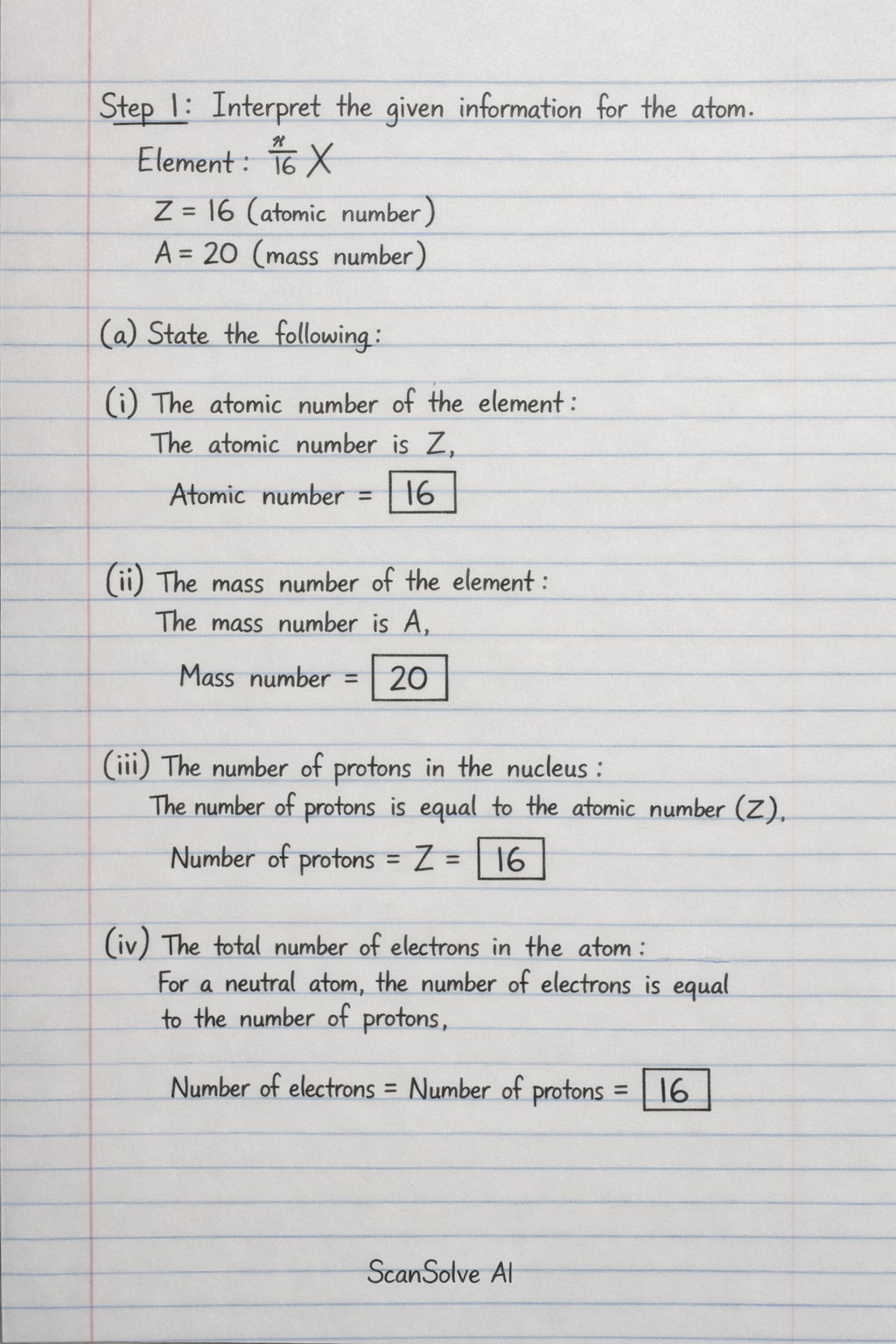
Step 1: Interpret the given information for the atom. The atom is represented by _Z^A X. From the student's work: i) The atomic number of the element (Z) is given as 16. ii) The mass number of the element (A) is calculated as 34 - 14 = 20. Based on these values, we can answer the subsequent questions. a) State the following: i) The atomic number of the element: The atomic number is Z. Atomic number = 16 ii) The mass number of the element: The mass number is A. Mass number = 20 iii) The number of protons in the nucleus of one atom of the element: The number of protons is equal to the atomic number (Z). Number of protons = Z = 16 iv) The total number of electrons in one atom of the element: For a neutral atom, the number of electrons is equal to the number of protons. Number of electrons = Number of protons = 16 b) Calculate the number of neutrons in the nucleus of one atom of the element. The number of neutrons is calculated as Mass number (A) - Atomic number (Z). Number of neutrons = A - Z = 20 - 16 = 4 c) Draw and write the electronic configuration of the atom. The atom has 16 electrons. The electronic configuration (shell model) is 2, 8, 6. The electronic configuration (orbital model) is 1s^2 2s^2 2p^6 3s^2 3p^4. To draw the electronic configuration (Bohr model): Draw a central nucleus containing 16 protons and 4 neutrons. Draw the first electron shell with 2 electrons. Draw the second electron shell with 8 electrons. Draw the third electron shell with 6 electrons. d) In which group and period will the element be located? The atomic number is 16, which corresponds to Sulfur (S). The electronic configuration is 2, 8, 6. The number of electron shells occupied determines the period. Since there are 3 shells, the element is in Period 3*. The number of valence electrons (electrons in the outermost shell) determines the group. Since there are 6 valence electrons, the element is in Group 16* (or Group VIA). Group = 16, Period = 3 Step 2: Complete the table. Row 1: Given: Mass number = 32, Number of neutrons = 8. Atomic number = Mass number - Number of neutrons = 32 - 8 = 24. Number of protons = Atomic number = 24. Number of electrons = Number of protons (for a neutral atom) = 24. | Number of protons | Number of electrons | Mass number | Number of neutrons | Atomic number | | :---------------- | :------------------ | :---------- | :----------------