
We read your photo as:
Explain the atomic structure and calculate the mass number of a hydrogen atom with 1 proton and 0 neutrons.
ScanSolve AI Answer
Step-by-step solution
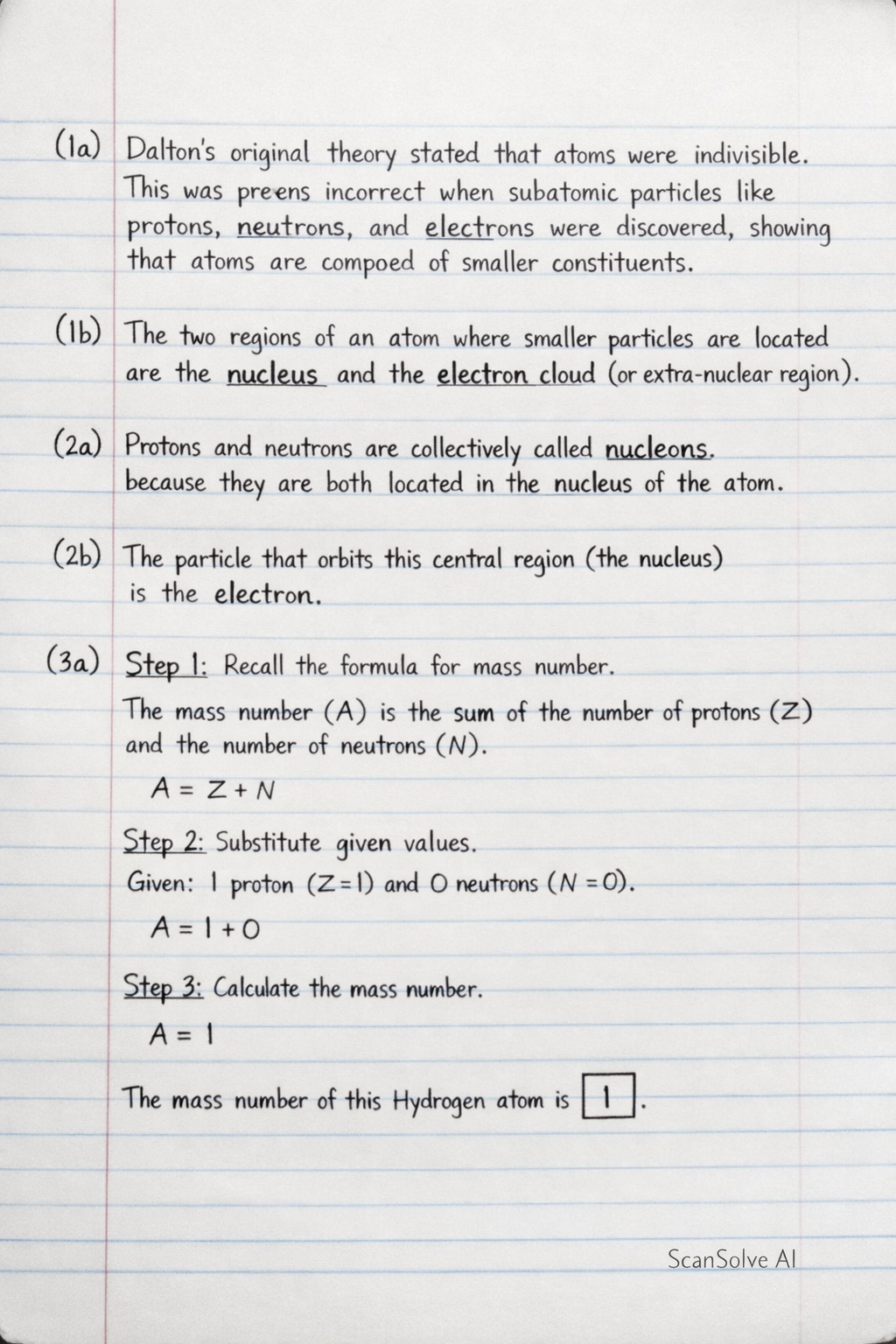
3 steps1(a) Dalton's original theory stated that atoms were indivisible. This was proven incorrect when subatomic particles like protons, neutrons, and electrons were discovered, showing that atoms are composed of smaller constituents.
1(b) The two regions of an atom where smaller particles are located are the nucleus and the electron cloud (or extra-nuclear region).
2(a) Protons and neutrons are collectively called nucleons because they are both located in the nucleus of the atom.
2(b) The particle that orbits this central region (the nucleus) is the electron.
3(a)
Recall the formula for mass number.
The mass number () is the sum of the number of protons () and the number of neutrons ().
Substitute the given values.
Given: 1 proton () and 0 neutrons ().
Calculate the mass number.
The mass number of this Hydrogen atom is .
3(b) The mass of an atom is concentrated in the nucleus because protons and neutrons, which have significantly larger masses compared to electrons, are located there. Electrons, which orbit the nucleus, have negligible mass.
Still stuck on this one?
Ask a follow-up, and the answer starts from this question.
More Chemistry Questions
Handwritten Step-by-Step Solution
Get this as a handwritten image on WhatsApp — like a tutor wrote it for you.
Try on WhatsApp