
We read your photo as:
Explain the structure of an atom, including its subatomic particles, their locations, and the concept of mass number. Illustrate with an example if possible.
ScanSolve AI Answer
Step-by-step solution
3 steps1 (a)
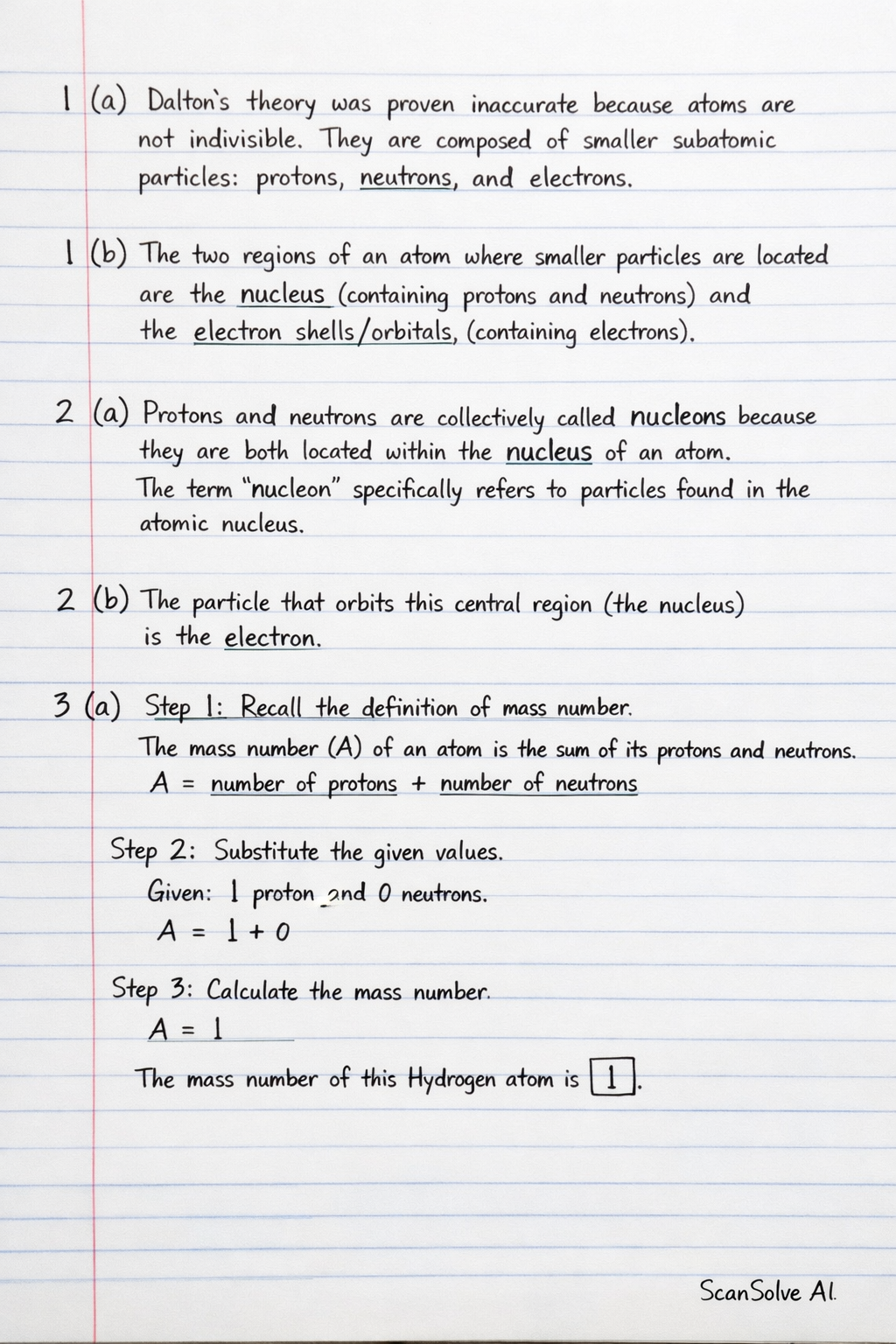
Dalton's theory was proven inaccurate because atoms are not indivisible. They are composed of smaller subatomic particles: protons, neutrons, and electrons.
1 (b)
The two regions of an atom where smaller particles are located are the nucleus (containing protons and neutrons) and the electron shells/orbitals (containing electrons).
2 (a)
Protons and neutrons are collectively called nucleons because they are both located within the nucleus of an atom. The term "nucleon" specifically refers to particles found in the atomic nucleus.
2 (b)
The particle that orbits this central region (the nucleus) is the electron.
3 (a)
Recall the definition of mass number.
The mass number (A) of an atom is the sum of its protons and neutrons.
Substitute the given values.
Given: 1 proton and 0 neutrons.
Calculate the mass number.
The mass number of this Hydrogen atom is .
3 (b)
The mass of an atom is concentrated in the nucleus because protons and neutrons, which are located in the nucleus, have significantly greater mass compared to electrons. Electrons, which occupy the surrounding region, have a negligible mass.
Still stuck on this one?
Ask a follow-up, and the answer starts from this question.
More Chemistry Questions
Handwritten Step-by-Step Solution
Get this as a handwritten image on WhatsApp — like a tutor wrote it for you.
Try on WhatsApp