
We read your photo as:
Provide definitions for atoms, elements, periodic table, and sub-atomic particles, and describe the charges and arrangements of sub-atomic particles in an atom.
ScanSolve AI Answer
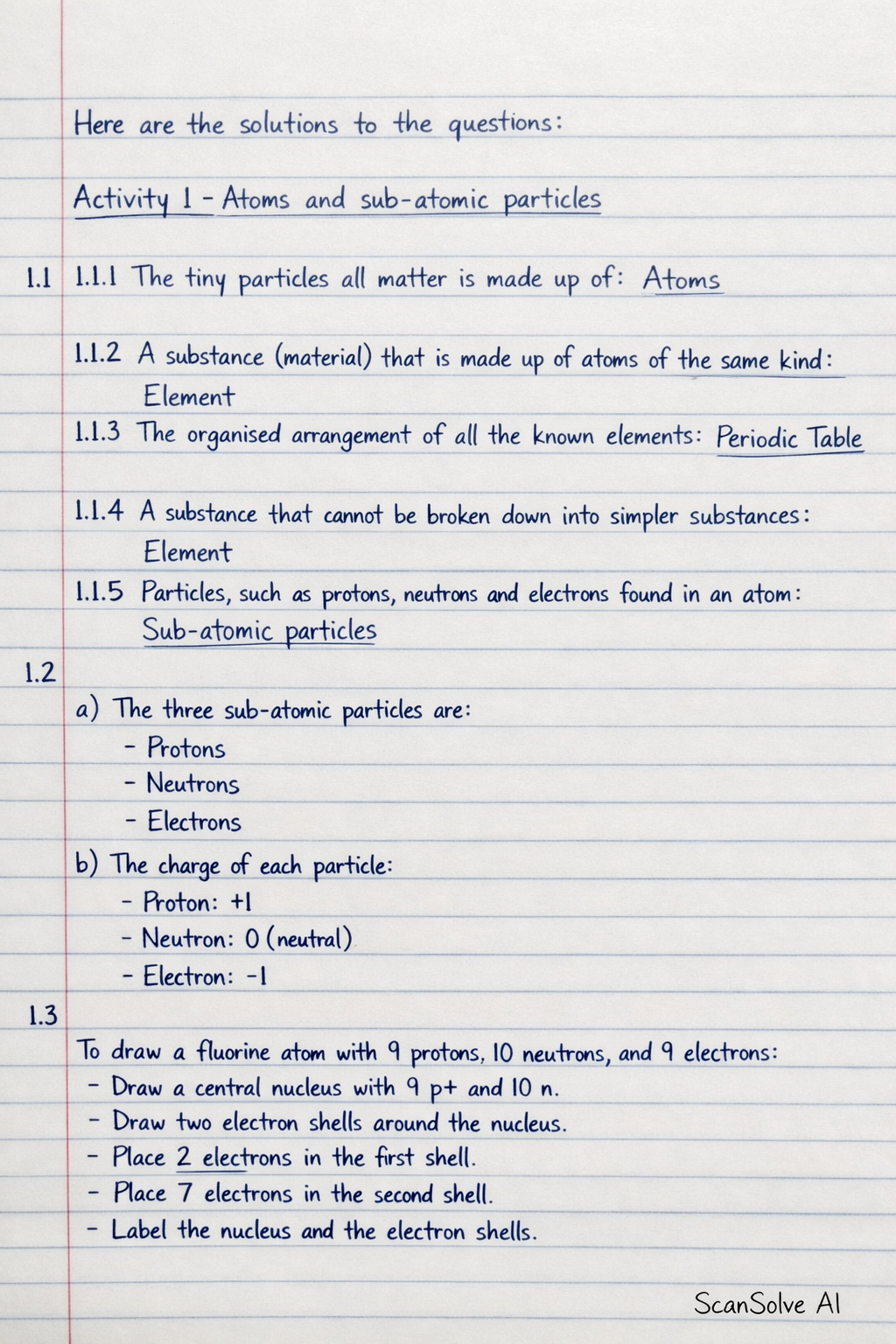
Here are the solutions to the questions:
Activity 1 - Atoms and sub-atomic particles
1.1
1.1.1 The tiny particles all matter is made up of:
- Atoms
1.1.2 A substance (material) that is made up of atoms of the same kind:
- Element
1.1.3 The organised arrangement of all the known elements:
- Periodic Table
1.1.4 A substance that cannot be broken down into simpler substances:
- Element
1.1.5 Particles, such as protons, neutrons and electrons found in an atom:
- Sub-atomic particles
1.2
a) The three sub-atomic particles are:
- Protons
- Neutrons
- Electrons
b) The charge of each particle:
- Proton: +1
- Neutron: 0 (neutral)
- Electron: -1
1.3
To draw a fluorine atom with 9 protons, 10 neutrons, and 9 electrons:
- Draw a central nucleus containing 9 protons (labeled 'p+') and 10 neutrons (labeled 'n').
- Draw two electron shells around the nucleus.
- Place 2 electrons in the first shell.
- Place 7 electrons in the second shell.
- Label the nucleus and the electron shells.
Activity 2 - Pure substances (Elements and Compounds); Mixtures
2.1
Here are the models for the molecules:
- 2.1.1 H₂: Two small circles (representing Hydrogen atoms) joined together.
- 2.1.2 O₂: Two large empty circles (representing Oxygen atoms) joined together.
- 2.1.3 N₂: Two striped circles (representing Nitrogen atoms) joined together.
- 2.1.4 H₂O: One large empty circle (Oxygen) bonded to two small circles (Hydrogen). The molecule has a bent shape.
- 2.1.5 CO₂: One solid black circle (Carbon) bonded to two large empty circles (Oxygen). The molecule has a linear shape.
Still stuck on this one?
Ask a follow-up, and the answer starts from this question.
More Chemistry Questions
Handwritten Step-by-Step Solution
Get this as a handwritten image on WhatsApp — like a tutor wrote it for you.
Try on WhatsApp